
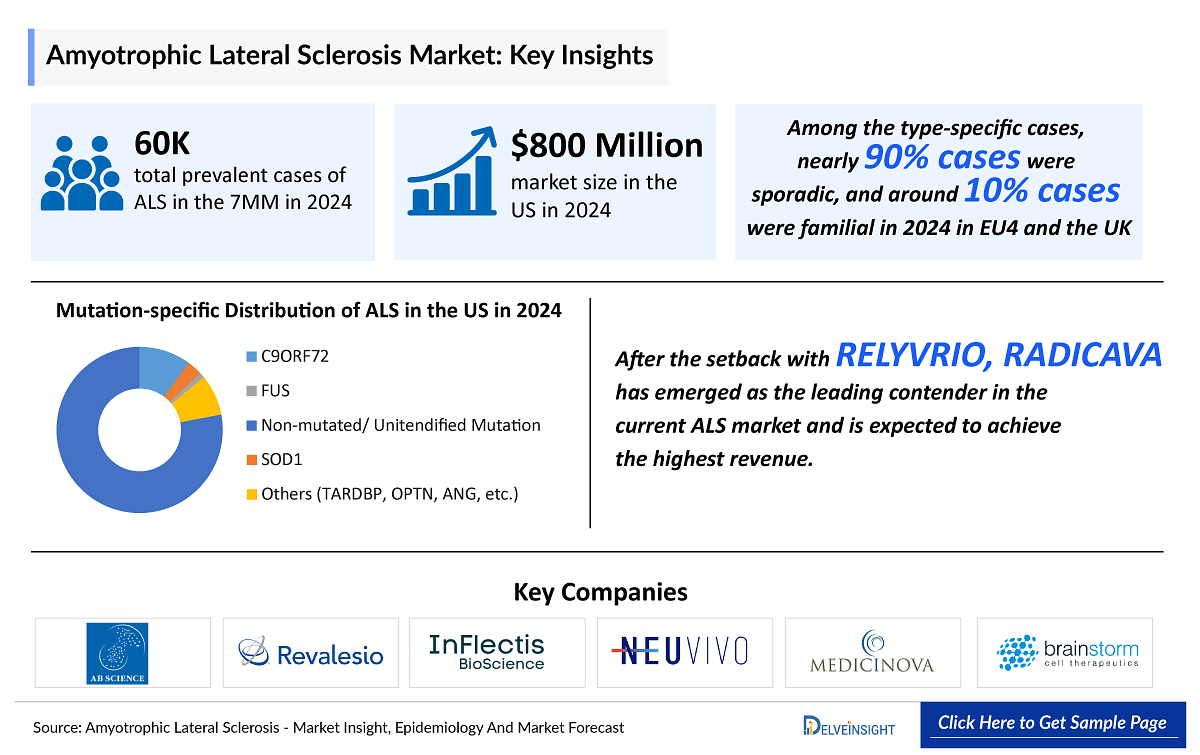
- Projected ALS prevalence increase: From nearly 60,000 cases in 2024 to 75,000 by 2034 across seven major markets.
- US market value: Approximately USD 800 million in 2024.
- Pipeline diversity: Multiple novel therapies targeting ALS through different mechanisms, including AI-driven drug discovery.
Experts agree that the ALS market is experiencing significant growth driven by a diverse and maturing therapeutic pipeline, despite past clinical setbacks, reflecting a renewed focus on innovation and unmet medical needs.
Decoding the ALS Market: Pipeline Promises Fuel a Billion-Dollar Battle
LAS VEGAS, NV – December 10, 2025 – A new market analysis from DelveInsight projects a period of significant growth for the amyotrophic lateral sclerosis (ALS) market, forecasting a surge driven by an expanding therapeutic pipeline. This optimistic signal arrives at a pivotal moment for a field still grappling with the aftershocks of high-profile clinical failures, most notably the withdrawal of Amylyx Pharmaceuticals’ RELYVRIO in April 2024. The failure of its confirmatory trial sent a sobering message about the immense difficulty of treating this relentless neurodegenerative disease.
Yet, where one door closed, several others appear to be opening. The DelveInsight report, projecting an increase from nearly 60,000 prevalent cases in 2024 to 75,000 by 2034 across seven major markets, suggests that the underlying drivers of growth—rising prevalence and, crucially, profound unmet medical need—are stronger than ever. The key signal is not just the projection of growth itself, but the source of that growth: a diverse and maturing pipeline of novel therapies attacking ALS from multiple angles. This flurry of activity indicates that the industry, far from being deterred by past failures, is doubling down on innovation, creating a dynamic and fiercely competitive landscape.
A Renaissance in the Lab
The current momentum is built on a foundation of scientific diversity. Unlike past eras that relied on a narrow set of therapeutic approaches, the emerging pipeline is characterized by a multi-pronged assault on the disease's complex pathology. This isn't about finding a single silver bullet; it's about building an arsenal.
One of the most watched candidates is AB Science’s Masitinib, an oral tyrosine kinase inhibitor designed to modulate neuroinflammation by targeting mast cells and macrophages. After a long and complex development history, the therapy is now advancing into a confirmatory Phase III study across Europe and the US, a critical step that could finally validate its approach.
Elsewhere, companies are finding new potential in combining existing drugs. NeuroSense Therapeutics’ PrimeC, a novel formulation of two FDA-approved drugs, demonstrated a significant effect on disease progression in its Phase IIb trial. The company’s plan to initiate a pivotal Phase III study in 2025 signals strong confidence in its synergistic mechanism, which targets neuroinflammation, iron accumulation, and RNA dysregulation.
This new wave also includes highly specific, genetically targeted treatments. The 2023 accelerated approval of Biogen’s QALSODY (Tofersen) for patients with SOD1 mutations was a landmark moment. While it addresses only a small subset of the ALS population, it provided a powerful proof-of-concept for precision medicine in neurodegeneration. This success is fueling further research into therapies for other genetic mutations, such as Transposon Therapeutics' TPN-101 for C9ORF72 mutations.
Innovation is also coming from entirely new frontiers. DR.NOAH's NDC-011, a novel drug combination developed using an AI-based discovery platform, recently received Orphan Drug Designation and IND approval for Phase I trials. This represents a powerful signal of how artificial intelligence is beginning to accelerate the identification of novel therapeutic targets, compressing development timelines in a field where time is the most precious commodity.
The Shifting Financial Battleground
The scientific advancements are mirrored by equally significant shifts in the market's financial structure. The US market alone, valued at approximately USD 800 million in 2024, is the epicenter of this transformation. The withdrawal of RELYVRIO created a competitive vacuum, reinforcing the market-leading position of Mitsubishi Tanabe Pharma’s RADICAVA. The company’s strategic introduction of an oral formulation, RADICAVA ORS, was a masterclass in life-cycle management, dramatically improving patient compliance and solidifying its revenue stream.
This high-stakes environment, marked by both billion-dollar potential and catastrophic risk, is paradoxically attractive to investors. Regulatory incentives like Orphan Drug Designation, granted to many pipeline candidates, provide market exclusivity and financial credits that de-risk the enormous R&D investment required. The recent EUR 6 million financing for CERES Brain Therapeutics to advance its creatine prodrug, CBT101, into Phase I trials is a tangible indicator of sustained investor appetite.
These financial signals suggest a market that is maturing. It is moving away from a reliance on one or two blockbuster drugs and toward a more fragmented, competitive ecosystem where multiple therapies with distinct mechanisms and patient populations can coexist. The anticipated launches of therapies like Masitinib, PrimeC, and InFlectis BioScience's IFB-088 are expected to challenge RADICAVA's dominance and capture significant market share, assuming they can deliver on the promise shown in clinical trials. The battle is no longer just about slowing progression but about demonstrating superior efficacy, safety, and a meaningful impact on patients' lives.
From Market Value to Human Value
While market reports quantify growth in dollars and prevalence in numbers, the true measure of momentum lies in the potential for tangible human impact. The rising prevalence of ALS is not an abstract market driver; it represents thousands of individuals and families being diagnosed each year, desperately seeking hope in the face of a devastating prognosis. For them, the expanding pipeline is the most powerful signal of all.
Patient advocacy groups have long emphasized that the greatest unmet need is for therapies that do more than modestly slow decline—they need treatments that can halt or even reverse the disease. The recent positive topline results from AL-S Pharma’s Phase II study of AP-101, which showed stabilization of clinical disease-staging and neurofilament biomarkers, offer a glimpse of that possibility.
However, progress brings its own set of challenges. The advent of highly effective, innovative therapies is almost always accompanied by prohibitive pricing. The high cost of QALSODY set a precedent, and future approvals will inevitably force difficult conversations about access and affordability. The projected growth of the ALS market is inextricably linked to the high price tags these novel therapies will command. This creates a fundamental tension: the very innovation that brings hope to patients could be financially out of reach for many, posing a major hurdle for patients, insurers, and healthcare systems alike.
The road ahead for ALS treatment remains fraught with uncertainty. Clinical trials can and do fail. Regulatory pathways are complex. But the current landscape is undeniably different from that of a decade ago. The sheer volume and diversity of the therapeutic pipeline, coupled with sustained financial investment and breakthroughs in genetic and AI-driven science, are clear and powerful signals of growth. The ultimate test of this momentum, however, will not be measured in market share, but in the number of lives transformed by a new era of medicine.