
- 1.5 GWp of new solar capacity secured by DayOne under the agreement.
- RM28 billion investment planned by DayOne in Malaysia by the end of 2026.
- 2.2 GWh of battery storage included in the renewable energy contract.
Experts would likely conclude that DayOne's landmark agreement with TNB represents a pivotal success for Malaysia's green energy transition, demonstrating how strategic public-private partnerships can drive large-scale renewable energy adoption in the digital infrastructure sector.
DayOne’s Gigawatt Gambit: Securing Malaysia’s Green Digital Future
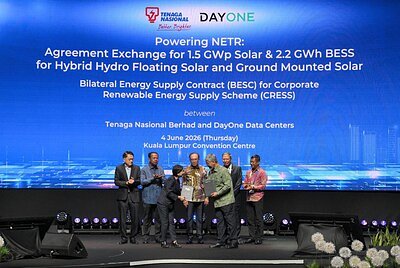
KUALA LUMPUR, Malaysia – June 04, 2026 – In a ceremony attended by the highest levels of the Malaysian government, Singapore-based DayOne Data Centers finalized a landmark agreement with national utility Tenaga Nasional Berhad (TNB) that fundamentally reshapes the landscape for digital infrastructure in Southeast Asia. By securing over a gigawatt of renewable energy, DayOne has moved from ambitious prototype to profitable reality, providing a masterclass in how strategic partnerships can translate national policy into commercial dominance.
The deal, signed in the presence of Prime Minister YAB Dato' Seri Anwar bin Ibrahim, commits DayOne to offtake power from approximately 1.5 gigawatt-peak (GWp) of new solar capacity, backed by an impressive 2.2 gigawatt-hours (GWh) of battery storage. This isn't just another corporate green initiative; it is one of the largest renewable energy contracts for a data center operator in the region and a critical milestone that underpins DayOne's planned RM28 billion investment in Malaysia by the end of 2026.
From Policy Blueprint to Power Purchase
This gigawatt-scale agreement represents the most significant success to date for Malaysia's Corporate Renewable Energy Supply Scheme (CRESS), a policy framework designed to be the engine of the country's green transition. Launched in late 2024, CRESS enables corporations to purchase renewable energy directly from developers, a crucial step away from the grid's standard fossil-fuel-heavy mix. However, the scheme's journey has not been without challenges.
Industry analysts note that CRESS initially saw an “underwhelming market response.” Potential investors and corporate buyers were cautious, discouraged by factors including high System Access Charges—fees for using the national grid—that could make green power significantly more expensive. Early iterations of the policy also created uncertainty around the financial viability of surplus energy generation. For the framework to succeed, it needed a flagship project to prove its potential.
DayOne's partnership with TNB is that proof point. As one of the first companies to navigate the CRESS framework from initial intent to full contractual execution, DayOne has effectively stress-tested and validated the policy. By working through the complexities, the data center firm has created a replicable blueprint for other large-scale energy users. This transition from a promising but unproven government scheme to a facilitator of tangible, multi-billion-dollar investments is a pivotal step in Malaysia’s commercialization journey, demonstrating that its regulatory environment can support world-class green projects.
The New Currency of the Cloud: Verifiable Green Energy
For DayOne, this deal is less about corporate social responsibility and more about core business strategy. The explosive growth of artificial intelligence and cloud computing has created an insatiable demand for data processing, and with it, an enormous appetite for electricity. Modern, AI-ready data centers are power-intensive operations, and their global hyperscaler clients—the tech giants of the world—are increasingly bound by their own stringent environmental, social, and governance (ESG) mandates. Access to massive, reliable, and, crucially, verifiable green energy is no longer a preference; it is a prerequisite for doing business.
By securing this long-term power supply, DayOne de-risks its massive expansion in Malaysia, which is set to become its largest global operational footprint with campuses in Nusajaya Tech Park and Kempas Tech Park. The agreement, which includes the transfer of Renewable Energy Certificates (RECs), allows DayOne to offer its clients a certifiably green home for their data, a powerful competitive advantage in a crowded market.
"As demand for AI and cloud infrastructure accelerates, securing long-term access to renewable energy is critical," said Jamie Khoo, Chief Executive Officer of DayOne, in the official announcement. His emphasis on contributing to "the stability of the national grid" while growing with "greater energy resilience" highlights the symbiotic nature of the deal. DayOne gets the green power it needs to attract and serve top-tier clients, while its massive, predictable demand helps underwrite the development of new renewable assets for Malaysia.
A Nation’s Ambition, A Corporate Catalyst
The partnership is a powerful example of a public-private collaboration successfully driving a national agenda. This deal is a cornerstone of Malaysia's National Energy Transition Roadmap (NETR), which ambitiously targets 70% renewable energy in its installed capacity by 2050. DayOne’s commitment single-handedly makes a significant contribution toward this goal, catalyzing the development of both ground-mounted and innovative hybrid hydro floating solar projects.
The presence of the Prime Minister and other senior cabinet members at the signing ceremony was not merely symbolic. It was a clear signal that Malaysia is staking its future as a premier regional digital hub on the promise of sustainable energy. As neighboring countries also vie for lucrative data center investments, Malaysia is differentiating itself by directly addressing the biggest operational and reputational challenge the industry faces: its carbon footprint.
Datuk Ir. Ts. Shamsul bin Ahmad, President/CEO of TNB, reinforced this, stating, "Through CRESS, we are facilitating greater access to sustainable and reliable energy solutions." The collaboration positions TNB not just as a utility provider, but as a key enabler of the national digital economy. By partnering with a major customer like DayOne, TNB secures a long-term revenue stream that justifies the large-scale capital investment required for new solar farms and battery storage facilities.
As digital infrastructure demands continue to soar, the DayOne-TNB partnership offers a compelling model for responsible scaling. It demonstrates that the immense energy needs of the digital age can be met in a way that aligns with, and even accelerates, a nation's climate goals, setting a new standard for turning industrial power consumption into a powerful force for sustainable development.