
- 5 years: Development time for the 'Crayola Creative Styles Tool'
- 13.2 million students: Reached by Crayola Creativity Week in 2025
- 3 core dimensions: The tool assesses creative styles through thinking, engagement, and perception
Experts in creativity studies, such as Dr. Gerard Puccio, endorse the tool as a valuable, research-backed resource for understanding and nurturing creativity as a lifelong skill.
Crayola Redefines Creativity with New Tool for Adults
EASTON, Pa. – January 15, 2026 – Crayola, a brand synonymous with childhood imagination for more than a century, today launched a significant initiative aimed not at children, but at the adults who guide them. The new 'Crayola Creative Styles Tool' is a free, online resource designed to help parents and teachers identify and understand their own innate approaches to creativity, marking a strategic expansion for the company into the realm of adult personal development and educational psychology.
Developed over five years, the tool signals a deliberate pivot for the iconic brand. It moves Crayola beyond its role as a supplier of art materials and into a new position as a proponent of creativity as a fundamental, lifelong skill. By focusing on adults, the company is targeting the gatekeepers of children's creative education, operating on the principle that to nurture creativity in the young, one must first understand and have confidence in their own.
This launch is the most tangible product yet of Crayola's broader 'Campaign for Creativity,' an advocacy program designed to challenge narrow definitions of creativity and promote it as an essential skill for problem-solving, collaboration, and personal well-being in the modern world.
The Science of Style, Not Score
At the heart of the new initiative is a commitment to demystifying creativity and dispelling the myth that it is a rare talent reserved for a gifted few. To achieve this, Crayola partnered with Dr. Gerard Puccio, a distinguished professor and Chair of the Center for Applied Imagination at Buffalo State University. Dr. Puccio, a leading scholar in creativity studies, provided a comprehensive review of contemporary research to ensure the tool was built on a solid academic foundation.
The 'Creative Styles Tool' is explicitly framed as a self-assessment, not a test. It doesn't measure how much creativity a person has, but rather how their creativity manifests. This distinction sets it apart from many existing psychometric assessments, such as the Torrance Tests of Creative Thinking, which often focus on scoring specific abilities. Crayola's approach is designed to be more inclusive and confidence-boosting, confirming that everyone is creative in their own way.
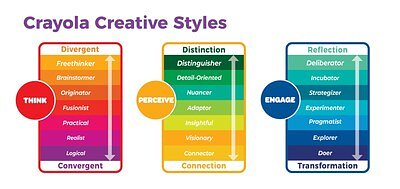
Within five minutes of answering a series of questions, users receive a personalized report based on three core dimensions of the creative process:
- How You Think: This dimension explores the spectrum between divergent thinking (expansive, brainstorming) and convergent thinking (focused, curating ideas). It helps users understand if they are more naturally inclined to generate a wide array of possibilities or to refine and select the best path forward.
- How You Engage: This examines how people participate in creative experiences, from a reflective style (drawing on memory, anticipating outcomes) to a transformative style (hands-on experimentation and active participation).
- How You Perceive: This dimension reveals how individuals see and make sense of the world, ranging from distinct perception (seeing things as independent and separate) to connected perception (seeing things as interwoven and part of a larger system).
"These insights help you understand your creative style and appreciate the different ways creativity shows up in others," said Cheri Sterman, Senior Director of Education at Crayola. "We believe creativity is innate to the human experience and needs to be nurtured at every stage of life. When parents and teachers understand their creative styles, it boosts their confidence in being able to support children's creativity."
From Brand Evolution to Classroom Application
The tool represents a calculated move in Crayola's brand evolution. While competitors in the adult assessment space often target corporate training or charge for detailed reports, Crayola is leveraging its trusted brand name and making its tool free and easily accessible. This strategy aims to build a community of practice among its core audience of parents and educators, reinforcing the brand's authority on the subject of creativity for all ages.
The development process included extensive feedback from the intended users. Prior to its public release, several hundred educators participated in focus groups, testing early versions of the tool. Reports from these sessions indicate that participants found the resulting profiles to be highly accurate and insightful, providing them with a new vocabulary to discuss creativity. Some noted its potential as a valuable resource for fostering diversity and inclusion by helping them appreciate the different problem-solving approaches within a classroom or a team of colleagues.
"Our ultimate ambition is to empower adults to embrace creativity as an essential life skill," Sterman stated in the announcement. "Each customized report confirms that every participant is creative, and that the world needs both divergent thinkers who brainstorm, as well as convergent thinkers who curate ideas."
A Catalyst for a Creative Ecosystem
The timing of the launch is no coincidence. It arrives just as the brand prepares to celebrate the fifth anniversary of Crayola Creativity Week (Jan. 26-Feb. 1), a massive free virtual learning program. This event, which reached over 13.2 million students in more than 120 countries last year, provides educators and parents with interactive content from world-renowned creative talents to integrate creativity across core school subjects.
By integrating the 'Creative Styles Tool' into the registration for Creativity Week, Crayola is creating a powerful feedback loop. Educators can discover their own style and then immediately access a wealth of resources designed to put creative principles into action in the classroom. This ecosystem approach—combining self-assessment with practical application—is designed to have a lasting impact, moving beyond a one-time quiz to foster sustained behavioral change.
This initiative underscores a growing consensus in education and business: that creativity is not a 'soft skill' but a critical competency for navigating a complex and rapidly changing world. As Crayola steps into this new territory, it is betting that the key to unlocking the next generation's potential lies in first helping adults rediscover their own.
Topics & Related
Related Company Pulse