
- $26M Investment: The development cost of Papagayo Park, a 23-acre luxury hub in Costa Rica's Peninsula Papagayo.
- 1,400-acre Retreat: The total size of the coastal luxury community where the park is located.
- 51% Water Reduction: Achieved at the Arnold Palmer Signature Golf Course through sustainable practices.
Experts view Papagayo Park as a pioneering model for luxury resort development, blending high-end amenities with sustainable practices, community integration, and a focus on human connection, setting a new standard for the global hospitality industry.
Costa Rica's $26M Papagayo Park: The New Blueprint for Luxury Living
PENINSULA PAPAGAYO, Costa Rica – December 03, 2025 – In the world of luxury travel, the definition of opulence is undergoing a radical transformation. It's no longer just about infinity pools and thread counts. Today, true luxury is measured in experiences, community, and a seamless integration with nature. Peninsula Papagayo, Costa Rica's premier 1,400-acre coastal retreat, is placing a $26 million bet on this new paradigm with the official opening of Papagayo Park, a sprawling 23-acre hub designed to be the social and recreational soul of the community.
Developed by Mohari Hospitality and Gencom, the park is more than an impressive collection of amenities; it represents a strategic evolution in how integrated resort communities are conceived. Opening this month, it serves as a central gathering point for guests and residents of the peninsula’s elite properties, including the Four Seasons, Andaz, and the new Nekajui, a Ritz-Carlton Reserve. By creating a dedicated nexus for wellness, sport, and social life, the developers are crafting an environment where the lines between vacation and community living blur, setting a new benchmark for the global hospitality industry.
The Evolution of the Luxury Enclave
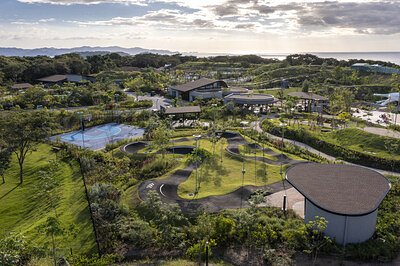
Papagayo Park is an ambitious project designed to cater to every generation. The facility, planned in collaboration with the globally renowned landscape architecture firm EDSA, moves far beyond the traditional resort offerings. It features a state-of-the-art Racquet Center with four hard-surface tennis courts, six pickleball courts, and two padel courts—a nod to one of the world's fastest-growing sports. For younger guests and the young at heart, a custom-built pump track offers a dynamic circuit for bikes and skateboards, while a kids' adventure area provides a nature-inspired playground and splash zone.
This investment reflects a deeper understanding of the modern luxury consumer. The focus is on active, shared experiences. Rather than isolated activities, the park is designed as a cohesive, walkable environment. A central lawn hosts games and events, an art studio encourages creativity, and a dedicated wellness shala offers a space for reflection and fitness. Evenings are anchored by social hubs like Patio Social, a relaxed restaurant and bar, and Cono Loco, a playful gelateria, all steps from a serene lap pool.
"Papagayo Park is the embodiment of how we see the future of community life at Peninsula Papagayo," said Francesca Poddie, Chief Operating Officer of Peninsula Papagayo. "Designed not only for multigenerational travel but for everyday life on the peninsula, it is an investment in the moments that bring people together... Its blend of play, wellness, creativity, and casual dining fosters shared moments that naturally strengthen community ties, making Papagayo Park a vibrant social anchor for residents and hotel guests alike."
This vision materializes a strategy that began when Mohari Hospitality and Gencom acquired the peninsula's assets in 2016, followed by a major investment of over $100 million in 2017 to transform the destination. The goal was to pivot towards what they termed "meaningful eco-luxury," and Papagayo Park is the latest, and perhaps most significant, manifestation of that long-term plan.
A Blueprint for Regenerative Development?
Operating in one of the most biodiverse countries on Earth comes with immense responsibility. In an era where 'greenwashing' is a valid concern for any large-scale development, Peninsula Papagayo is making a concerted effort to position itself as a leader in sustainable and even regenerative practices. The design of Papagayo Park and other recent projects, like the Nekajui Reserve, was guided by principles of minimal land disturbance and the use of native landscaping to blend structures into the environment.
This commitment appears to be more than just marketing rhetoric. The peninsula's master plan mandates that less than 30% of its land will ever be developed, preserving a vital corridor of tropical dry forest. The organization's operational innovations have garnered international recognition. Just this month, Peninsula Papagayo won two prestigious titles at the World Sustainable Travel & Hospitality Awards: "World's Leading Sustainable Hotel or Resort Development" and "World's Leading Sustainable Community Empowerment Program."
These accolades are backed by tangible initiatives. The resort community operates with an ISO 50001-certified energy management system, has reportedly reduced water consumption at its Arnold Palmer Signature Golf Course by 51%, and utilizes AI-driven technology to minimize food waste. This fusion of high-tech efficiency and ecological mindfulness is a core tenet of the "Future Forward" economy, demonstrating a viable model where luxury and environmental stewardship are not mutually exclusive but are, in fact, symbiotic.
Fostering Connection in the Digital Age
Perhaps the most forward-thinking aspect of Papagayo Park is its implicit focus on human connection. In an increasingly digital and fragmented world, the park is an intentionally analog space. The design encourages spontaneous social interaction and shared experiences across different age groups. It's a place where families can play bocce ball, friends can meet for a padel match at sunset, and children can learn new skills on the pump track.
This stands in stark contrast to the traditional resort model, which often prioritizes private, isolated relaxation. By creating a central, vibrant heart for the entire 1,400-acre peninsula, the developers are catering to a profound human need for belonging and community—a desire that has only intensified in the post-pandemic era. This focus on building a genuine community, rather than just a collection of luxury villas and hotel rooms, is a powerful differentiator in a competitive market.
The Local Stake: Economic and Social Integration
Beyond the guest experience, the project's impact on the local Guanacaste region is a critical part of its story. The expansion is creating tangible economic benefits, with Papagayo Park alone adding dozens of new jobs. Crucially, the development emphasizes promoting local talent into leadership positions. Homegrown leaders like Karen Mairena, the park's new General Manager, are a testament to a commitment to internal career growth.
Furthermore, Peninsula Papagayo has a long-standing relationship with the local community through "Creciendo Juntos" (Growing Together), a non-profit it founded to support health and education programs in nearby towns. This initiative, which includes opportunities for guests to engage in immersive volunteerism, was recognized with the recent community empowerment award. By investing in local infrastructure and human capital, the development aims to create a more resilient and integrated regional economy, ensuring that the prosperity generated by high-end tourism extends beyond the resort's gates.
As Papagayo Park welcomes its first visitors, it stands as a compelling case study for the future of resort development. It suggests a new economy of luxury where the ultimate amenities are not just material comforts, but a profound sense of place, authentic connection, and a tangible commitment to the health of both the planet and the local community.