
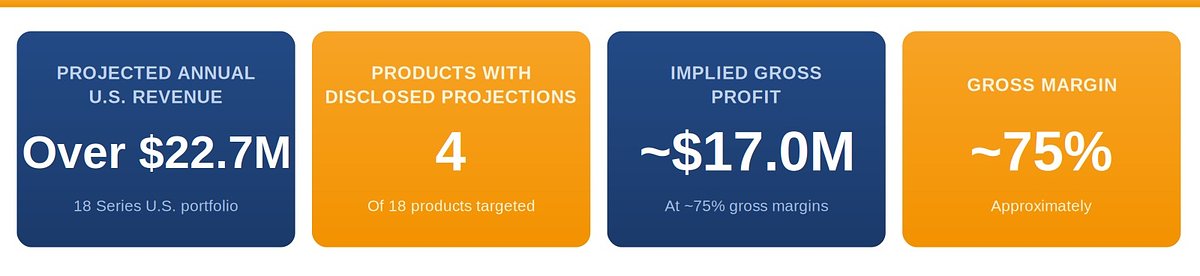
- $22.7M projected annual revenue from just 4 products in the new 18 Series platform.
- 75% gross margin forecasted for the 18 Series, up from the company's overall 12.1% gross margin.
- $19.14M GAAP net loss reported in 2025 despite 20% revenue growth.
Experts would likely conclude that Cosmos Health's aggressive U.S. nutraceutical expansion represents a high-risk, high-reward strategy to pivot toward profitability, with success hinging on sustained consumer demand and execution in a highly competitive market.
Cosmos Health’s American Gambit: A High-Stakes Bid for Profitability
CHICAGO, IL – June 15, 2026 – Cosmos Health, a global healthcare group with roots in Europe, has made a bold entrance into the competitive U.S. market, announcing ambitious financial targets for its new line of nutraceuticals. The company projects that just four products from its new “18 Series” platform will generate over $22.7 million in annualized revenue, a figure that represents a significant portion of its entire 2025 revenue of $65.3 million.
This move, centered on a direct-to-consumer model, is more than just a geographic expansion; it's a high-stakes play for profitability. The company is forecasting an eye-catching 75% gross margin on these products, a dramatic leap from its overall 12.1% gross margin reported last fiscal year. While Cosmos Health has celebrated record revenue growth, it has also contended with widening net losses and a notice from Nasdaq regarding its minimum stock price. The success or failure of this American venture could therefore become a defining chapter in the company’s story, testing whether a pivot to high-margin wellness products can build a new foundation for sustainable growth and restore investor trust.
The Wager on Wellness
At the heart of the strategy is the “18 Series,” a planned portfolio of 18 science-based supplements. The first wave includes products targeting some of the wellness industry’s most lucrative sectors: Noor18™ for healthy aging, Liv18™ for liver support, Fort18™ for men’s wellness, and Cur18™ for inflammation. According to the company's projections, these initial offerings alone could yield approximately $17.0 million in gross profit annually.
These are not trivial numbers for Cosmos Health. The projections signal a strategic imperative to cultivate a new, powerful revenue stream. The company’s recent financial history paints a picture of a business in rapid transition. While revenue climbed 20% in 2025, operating expenses also surged, leading to a GAAP net loss of $19.14 million. This financial pressure is compounded by the need to regain compliance with Nasdaq’s minimum bid price requirement by December 2026. In this context, the U.S. nutraceutical launch is less a casual market test and more a crucial offensive. As CEO Greg Siokas stated, “We already expect the 18 Series to become a key engine of our growth,” adding that the company has a “sharpened focus on profitability as we move the business to a different level.”
The stark contrast between the projected 75% margin for the 18 Series and the company’s historical performance highlights the strategic shift. Cosmos Health's existing business includes lower-margin segments like pharmaceutical distribution. The U.S. nutraceutical line represents a deliberate pivot into a high-value category, where a direct-to-consumer model can eliminate intermediary costs and maximize profit per sale. The question is whether these projections, based on what the company calls “encouraging early demand,” can be sustained as the products move beyond their launch phase.
Scrutinizing the Science in a Saturated Market
Cosmos Health bills its 18 Series as a “science-driven nutraceutical platform, built on proprietary ingredients, published clinical research, and exact clinical dosing.” This messaging is critical in the U.S. nutraceutical market, a sprawling, $160 billion industry where over 85,000 products compete for consumer attention and trust. Discerning customers increasingly demand transparency and evidence of efficacy.
For at least one of its products, Cur18™, the company provides specific details. It describes the product as a patented curcumin formulation with clinically studied, enhanced bioavailability—up to 39 times higher than standard curcumin in published research—and a self-affirmed GRAS (Generally Recognized as Safe) status. This level of detail aligns with best practices in an industry where claims are often vague. However, similar public-facing clinical specifics for Noor18™, Liv18™, and Fort18™ are not yet as readily available, leaving the “science-driven” promise as a broader platform-level claim.
It is also crucial for consumers to understand the regulatory landscape. The company notes that its products are made in U.S.-based GMP-certified, FDA-registered facilities. While this ensures manufacturing quality control, it does not mean the FDA has approved the products or their health claims. Under the Dietary Supplement Health and Education Act (DSHEA) of 1994, manufacturers are responsible for ensuring their products are safe and their marketing is truthful, but they do not require pre-market approval from the FDA. This system places the burden of proof on the company and the burden of scrutiny on the consumer.
Penetrating this market is a formidable challenge. The U.S. wellness sector is dominated by established giants like Nature's Bounty, Garden of Life, and NOW Foods, all with deep pockets for R&D and massive distribution networks. Cosmos Health’s initial direct-to-consumer strategy is a nimble way to enter the market, but its long-term plan to “expand into additional retail channels” will be essential for capturing significant market share, as brick-and-mortar stores still account for the majority of supplement sales.
A Pivot to a Broader American Future
The 18 Series launch is the most visible element of a broader strategic re-orientation for Cosmos Health. For years, the company has been a diversified, vertically integrated entity with a strong European footprint, spanning manufacturing through its Cana Laboratories in Greece, pharmaceutical distribution in the UK, and a portfolio of regional brands. This U.S. initiative marks a decisive pivot toward the world’s largest and most dynamic healthcare market.
This is likely just the beginning. Greg Siokas hinted at a larger ambition, stating, “we are pleased to be working on new projects in the United States that extend beyond the nutraceutical space.” This points toward a future where Cosmos Health could leverage its other assets on American soil. The company already owns the Texas-based telehealth platform ZipDoctor, Inc., and is actively engaged in R&D partnerships using artificial intelligence for drug repurposing. An integrated strategy connecting telehealth consultations with personalized, science-backed nutritional supplements and other healthcare solutions could represent a powerful long-term vision.
This multi-pronged approach—combining high-margin nutraceuticals with telehealth, AI-driven R&D, and potential future pharmaceutical ventures—suggests a company attempting to build an innovative, vertically integrated global healthcare platform. The 18 Series is the first pillar of that platform to be planted firmly in the U.S. While the financial projections are ambitious and the market challenges are significant, the launch signals a clear and determined strategy to transform Cosmos Health’s business model and secure a profitable future.