
- $1.6 trillion: The total student debt crisis in the U.S.
- $100,000: The prize amount awarded to each grand prize winner of the Dr Pepper Tuition Giveaway
- $20 million: Total tuition awarded by Dr Pepper over three decades
Experts would likely conclude that corporate initiatives like the Dr Pepper Tuition Giveaway play a crucial role in addressing the student debt crisis by directly funding the education of future professionals who will shape sustainable and equitable urban environments.
Corporate Halftime Heroes: Funding the Minds of Our Future Cities
FRISCO, TX – December 08, 2025
In this column, we regularly explore the steel, silicon, and fiber optics that form the backbone of our connected future. We analyze the rollout of 5G networks, the expansion of intelligent transportation systems, and the complex data platforms required to build smarter, more responsive cities. But as we map out the physical and digital infrastructure of tomorrow, a critical question emerges: who will design, build, and lead these new urban ecosystems? The most advanced network is inert without the human ingenuity to leverage it. The most sustainable city plan is just a document without the environmental lawyers, urban planners, and community health advocates to implement it.
While governments and public-private partnerships focus on the hard assets, a different kind of infrastructure investment is taking place—one focused on human capital. It’s an investment that doesn't always make headlines in the tech and engineering sectors, but it is just as foundational. This year, one of the most visible examples of this played out not in a boardroom or a data center, but on the turf of America's most-watched college football games, offering a powerful lesson in how corporate America can help build the next generation of innovators.
A Spectacle of Scholarship at Center Field
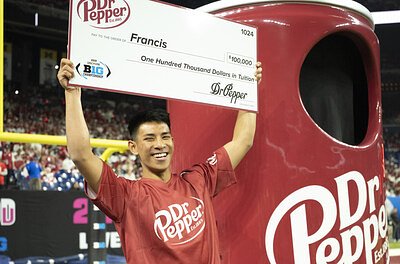
During the halftime shows of the SEC, Big Ten, and ACC Conference Championship games this past Saturday, the usual pageantry of marching bands and highlight reels was interrupted by a contest of a different sort. Six college students, finalists in the 18th annual Dr Pepper Tuition Giveaway, stood at center field, each with 30 seconds to throw as many footballs as possible into an oversized Dr Pepper can. The prize: $100,000 in tuition funds.
For 18 years, this unique blend of sports entertainment and philanthropy has become a fixture of the college football season. The high-pressure, high-reward format transforms the abstract concept of a scholarship into a compelling human drama watched by millions. While runners-up received significant tuition aid, three grand prize winners walked away with an award that can fundamentally alter their educational and professional trajectories. This year's winners were David Vilches in the ACC Championship, Francis Pham in the Big Ten, and Jesse Kompany in the SEC.
The event is a masterclass in experiential marketing, seamlessly integrating the Dr Pepper brand into a key cultural moment for its target demographic. Yet, to dismiss it as mere marketing would be to overlook its substantial impact. As a nation grapples with a student debt crisis exceeding $1.6 trillion, a $100,000 scholarship is more than just a prize; it's a lifeline.
Erasing Debt, Building Futures
The significance of Dr Pepper's giveaway is best understood against the backdrop of America's higher education landscape. The average debt for a bachelor's degree recipient hovers in the tens of thousands, while those pursuing graduate or professional degrees—like law or dentistry—can face six-figure debt loads. This financial burden not only impacts individual lives but also shapes career choices, often steering talented graduates away from public service or community-focused roles toward more lucrative, debt-servicing positions.
This is where an award of this magnitude becomes a game-changer. For the 2025 winners, the funds are a direct enabler of their ambitions to serve their communities. Francis Pham, a student at the University of Texas at San Antonio who won during the Big Ten halftime, is pursuing a career in dentistry. "The Dr Pepper Tuition Giveaway will help support me in my dream of becoming a dentist as I complete my undergraduate degree and attend dental school," Pham said. "I'm driven by the opportunity to serve my Texas community, and this support brings me one step closer to giving back through compassionate dental care."
Similarly, David Vilches, an undergraduate at the University of California, Los Angeles, sees the scholarship as a key to unlocking a future in public advocacy. "The funds from the Dr Pepper Tuition Giveaway will help me pursue my goal of becoming a real estate and environmental lawyer," Vilches stated. "This tuition money will help me become the first member of my family with a law degree, where I'll apply the degree to give back to my community through housing, land, and environmental advocacy." His chosen field lies at the very heart of creating the sustainable and equitable urban environments that smart city visionaries champion.
These are not just feel-good stories; they represent a tangible investment in the professional expertise our cities desperately need. An environmental lawyer to navigate green building codes, a community dentist to improve public health outcomes, a real estate attorney to advocate for equitable housing—these are the people who will translate the technological promise of connected infrastructure into real-world quality of life.
The Long Game: Corporate Citizenship as Human Infrastructure
Dr Pepper's program is a powerful case study in long-term corporate social responsibility (CSR). With over $20 million in tuition awarded over three decades, the initiative demonstrates a sustained commitment that builds brand authenticity and genuine goodwill. This longevity distinguishes it from fleeting, campaign-driven marketing stunts.
Derek Dabrowski, Senior Vice President of Brand Marketing at Keurig Dr Pepper, noted the brand's deep-rooted connection to the college experience. "No one knows college football like Dr Pepper, and that extends beyond the game day rituals and rivalries to supporting students both on and off the field," he said. "These exceptional students have illustrated leadership and a commitment to being a positive force in their communities, while working to achieve their dreams."
Compared to other corporate philanthropic efforts, such as the Coca-Cola Scholars Program which awards smaller amounts to a larger cohort, Dr Pepper's high-stakes, high-reward model generates a unique level of public engagement and media focus. This 'gamified philanthropy' proves that doing good and smart business are not mutually exclusive. The success stories of past winners, like Nikki Boon (2010), who is now a successful music manager, and Andrew Jimenez (2023), who is pursuing a career in marketing consulting after his education at UNC-Chapel Hill, serve as powerful testimonials to the program's lasting impact.
Ultimately, the foundation of our connected future rests not only on the networks we build but on the people we empower. While the spectacle of a halftime football toss may seem far removed from the sober work of urban planning and infrastructure development, its outcome is directly relevant. By removing the crippling burden of student debt, corporate initiatives like the Dr Pepper Tuition Giveaway are making a direct investment in the architects, advocates, and innovators of tomorrow. They are funding the human infrastructure that will bring our future cities to life.