
- 2,500+ patient cases in Europe with high accuracy in arrhythmia identification
- 88.9% success rate in atrial fibrillation ablation with standard patterns vs. 48.0% with complex patterns
- 10-minute non-invasive, radiation-free mapping of all four heart chambers
Experts view Corify Care's ACORYS® System as a transformative advancement in cardiac electrophysiology, offering safer, faster, and more precise arrhythmia mapping that could redefine standard treatment protocols.
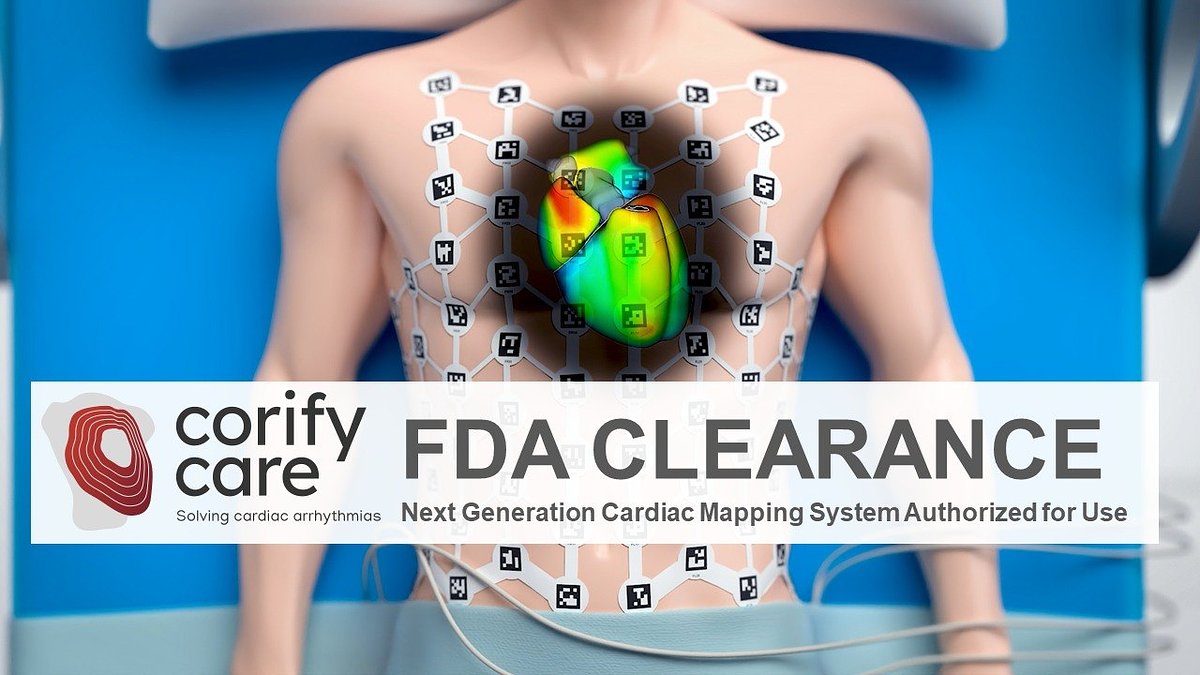
Corify Care's 4D Heart Mapping Tech Earns FDA Clearance
By George Flores
MADRID, Spain – April 17, 2026 – The U.S. Food and Drug Administration has granted clearance to a groundbreaking cardiac technology poised to fundamentally alter the diagnosis and treatment of heart rhythm disorders. Corify Care, a Madrid-based medical technology company, announced today it has received 510(k) clearance for its ACORYS® System, the first imageless and non-invasive platform that provides a complete, four-chamber electrical map of the heart in real-time.
This milestone introduces what the company has termed true “4D cardiac mapping” to the field of electrophysiology (EP). By generating a comprehensive, dynamic view of the heart's electrical activity on a beat-by-beat basis, the ACORYS® system promises to make complex ablation procedures—a common treatment for arrhythmias—faster, safer, and more predictable. The clearance paves the way for the technology's entry into the competitive U.S. market, signaling a potential paradigm shift away from decades-old invasive mapping techniques.
A New Dimension in Cardiac Visualization
For years, electrophysiologists have relied on contact-based mapping, a process that involves threading catheters into the heart to record electrical signals point by point. While effective, this method is time-consuming, provides an incomplete picture of the arrhythmia, and often requires pre-procedural imaging like CT or MRI scans, adding complexity and cost.
ACORYS® challenges this established workflow by creating its detailed maps entirely from the outside. The system uses a vest with 128 sensors placed on the patient's torso to capture electrical data, which is then processed by advanced algorithms to construct a high-resolution 3D anatomical model of all four heart chambers. This model is then overlaid with real-time electrical activity, creating a dynamic, global view of the arrhythmia's behavior. The entire visualization can be generated in under ten minutes without any radiation or invasive imaging.
"FDA clearance of ACORYS is a defining moment—not just for Corify, but for the future of electrophysiology," said Andreu Climent, PhD, CEO of Corify Care, in a company statement. "For decades, EP has been limited by incomplete and time-intensive contact based mapping. ACORYS changes the paradigm—by delivering immediate pre-procedural and inter-procedural, global insight that allows physicians to understand complexity, define targets, and act with confidence from the very first beat."
The system's ability to map the entire heart with a single beat allows physicians to see how an arrhythmia originates and travels, including through the heart wall or across different chambers—pathways often missed by conventional tools. This comprehensive understanding is critical for planning effective ablation strategies.
Clinical Impact and Enhanced Patient Safety
The technology is not just a theoretical advancement; it arrives in the U.S. backed by significant clinical experience in Europe, where it has held a CE mark. The ACORYS® system has been used in over 2,500 patient cases across leading European EP centers, demonstrating high accuracy in identifying arrhythmia mechanisms and guiding successful treatments.
One of the most significant advantages for patients is the system's ability to improve safety. For instance, in patients with ventricular tachycardia (VT), a potentially life-threatening arrhythmia, clinicians can use ACORYS® to identify the problematic heart tissue (substrate) while the patient is in a normal sinus rhythm. This often eliminates the dangerous and uncomfortable need to induce the unstable arrhythmia in the lab to map it, a standard practice that carries inherent risks.
"ACORYS gives us something we've never had before—a complete understanding of the arrhythmia before we even start ablating," noted Felipe Atienza, MD, CMO and Co-Founder of Corify Care. "This has the potential to dramatically change how we approach complex cases, particularly in VT and Atrial Tachyarrhythmias."
Clinical data has already pointed toward improved outcomes. Studies have shown that when ACORYS® was used to guide ablation for atrial fibrillation (AF), a success rate of 88.9% was achieved in patients whose arrhythmia originated from a standard location, compared to just 48.0% in patients with more complex patterns requiring different ablation sites. This ability to precisely characterize an arrhythmia beforehand allows for more targeted, and therefore more effective, treatment. To further bolster its clinical dossier, Corify Care is scheduled to present new data at the upcoming Heart Rhythm Society (HRS) 2026 conference in Chicago later this month.
Entering a Competitive MedTech Arena
With FDA clearance secured, Corify Care now faces the challenge of penetrating the lucrative but fiercely competitive U.S. cardiac device market, a space long dominated by industry giants like Abbott, Medtronic, and Boston Scientific. These companies have their own sophisticated, albeit typically invasive, mapping systems.
Corify Care's strategy is a measured one. The company plans a phased commercial rollout, initially partnering with a select group of leading U.S. electrophysiology centers to drive adoption and gather further real-world evidence. This approach aims to build a strong foundation of clinical champions before a wider expansion.
Critically, the ACORYS® system was designed not to replace existing infrastructure but to complement it. It integrates into standard EP workflows, providing a powerful upfront diagnostic and planning tool that enhances the utility of catheter ablation systems already in place. The company is also actively developing integrations with leading catheter navigation platforms to create a seamless hybrid workflow, making it easier for hospitals to adopt the technology without a complete overhaul of their labs.
Looking ahead, Corify Care is already working on ACORYS 2.0, a next-generation version expected to incorporate digital twins and other advanced applications. This forward-looking innovation, combined with the potential for reduced procedure times and improved patient outcomes, positions the ACORYS® system not just as a new product, but as a potential new standard in the quest to more effectively manage complex cardiac arrhythmias.