
- $142.7 billion: Predicted mobile holiday shopping spend in 2025 (Adobe forecast).
- $32 billion: Projected market size for conversational commerce by 2035.
- $8 million: Seed funding raised by Continua, led by GV and Bessemer Venture Partners.
Experts view Continua’s AI as a strategic innovation in social commerce, leveraging conversational AI to streamline group shopping while navigating significant competition and privacy concerns.
Continua’s AI Enters Group Chats to Reshape Social Commerce
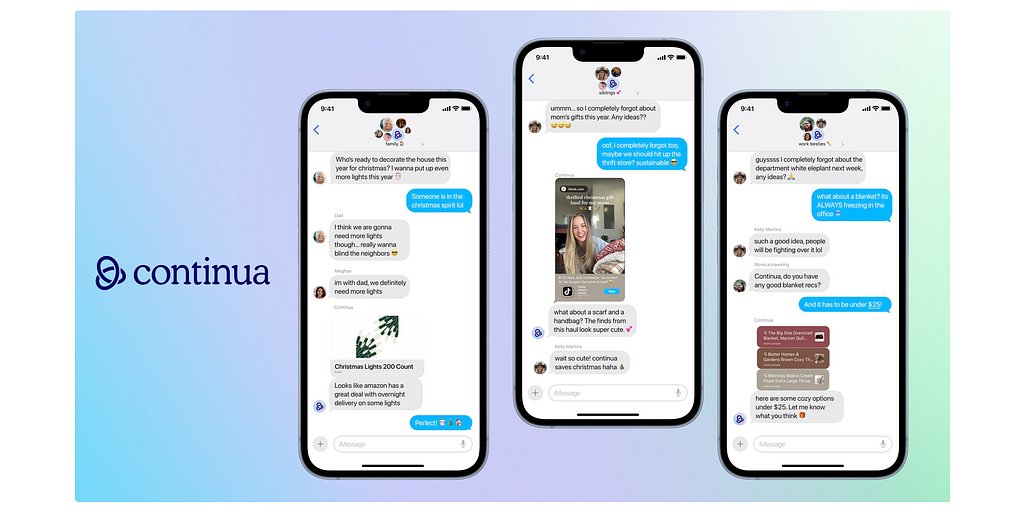
NEW YORK, NY – November 25, 2025 – While shoppers gear up for a holiday season dominated by mobile devices, a new player is betting that the next frontier of e-commerce isn’t a new app or website, but the group chats already buzzing on our phones. Continua, a startup pioneering what it calls “Social AI,” has launched a service that brings a collaborative shopping assistant directly into iMessage, Discord, and other messaging platforms. The move positions the company at the intersection of two powerful trends—conversational AI and social commerce—posing a direct challenge to the integrated shopping experiences being built by tech giants.
Just in time for the holiday rush, Continua’s AI can now field requests inside a group chat to find gift ideas, search for specific products, and compare prices across major retailers including Amazon, Google Shopping, Instagram, and TikTok. The goal is to eliminate the friction of collaborative planning, which so often involves toggling between browsers and messaging apps, copying and pasting endless links.
The Mall Inside Your Group Chat
The core innovation of Continua is its seamless integration. There is no application to download; users simply add the AI to a group conversation by inviting its phone number. Once present, the AI lies dormant until called upon, designed to understand the nuanced etiquette of a multi-person conversation. A group planning a white elephant exchange can now ask the AI for “funny gift ideas under $30,” and it will return a list of products from various storefronts directly within the chat, ready for discussion.
“We know that holiday season can be overwhelming, and that so much of the planning to make it magical happens in group chats,” said Shane Hulse, Continua's Head of Product, in a recent announcement. The company's strategy leans heavily on market data, such as a recent Adobe forecast predicting that 56.1% of this year's holiday shopping—a staggering $142.7 billion—will occur on mobile devices. Continua aims to capture a slice of that spending by meeting consumers where they already are.
This approach represents a significant evolution from single-user assistants like Siri or Alexa. Continua’s technology was built to navigate the complex, overlapping threads of a group discussion, differentiating between casual chatter and an actionable request. For founder and CEO David Petrou, the ultimate goal is to use AI to augment, not replace, human interaction. “Our goal with Continua has always been to use artificial intelligence to deepen human-to-human connection,” he stated. “With these new shopping tools, we are providing family and friends with the ability to surprise and delight each other…while reducing the stress it takes to pull off all those memorable moments.”
A Strategic Play Backed by Tech Heavyweights
Continua is not a casual experiment. The company is the brainchild of David Petrou, a former Distinguished Software Engineer at Google with foundational work on Google Lens and Google Glass under his belt. His expertise in on-device machine intelligence signals the deep technological pedigree behind the company. This vision has attracted serious capital, with Continua recently closing an $8 million seed round led by GV (formerly Google Ventures) and Bessemer Venture Partners, with participation from influential angel investors like Google’s own AI leader, Jeff Dean.
This backing validates Continua’s high-stakes bet on the future of “conversational commerce,” a market projected to grow from over $11 billion in 2025 to more than $32 billion within the next decade. By creating a platform-agnostic AI layer, Continua is attempting to build a universal utility that sits on top of the world’s most popular communication platforms. It’s a bold strategy that leverages the network effects of existing messaging apps rather than trying to build a new social network from scratch. The freemium model, offering a basic free tier and a premium subscription for unlimited use, provides a clear path to monetization if the concept gains traction.
Navigating a Crowded Social Shopping Landscape
While Continua’s approach is novel, it enters a fiercely competitive arena. Its primary rivals are not other startups, but the very platforms whose products it helps sell. Meta is aggressively integrating commerce into Instagram and WhatsApp, creating walled-garden ecosystems where users can discover, browse, and purchase without ever leaving the app. TikTok Shop has exploded into a social commerce juggernaut, proving its ability to turn viral trends into instant sales. Even Amazon, a key retailer in Continua’s integration, is developing its own in-app AI shopping assistant, Rufus.
Continua's key differentiator is its role as a neutral aggregator. Instead of locking users into one ecosystem, it offers choice, allowing a group to compare a product on Amazon against a similar find on TikTok. This cross-platform functionality is its unique value proposition. However, it also presents its greatest challenge: competing for user habits against the deeply integrated, visually rich, and algorithmically perfected shopping funnels of social media titans. Success will depend on whether the convenience of a universal chat-based assistant is compelling enough to rival the native, frictionless experience offered within these massive platforms.
Balancing Convenience with the Privacy Imperative
The most significant hurdle for Continua, and for the concept of Social AI writ large, is the question of trust. The idea of an AI “reading” private group conversations, even to be helpful, inevitably raises privacy concerns. Acknowledging this, Continua has built its service with specific safeguards outlined in its privacy policy. The company states that all data is encrypted both in transit and at rest, with personal data secured by per-user encryption keys.
Crucially, the AI's knowledge is siloed; information from one group chat cannot be accessed by or shared with another, and the AI’s memory is reset if the chat's membership changes. The company is explicit in its policy: “Continua does not and will not sell, share or disclose your personal data to non-affiliated third parties.” While data is used to personalize the AI model for a specific user's account, it is not used to train generalized AI models. These measures represent a robust technical effort to build a “privacy-first” assistant. Yet, the fundamental trade-off remains. The service’s utility is directly proportional to the data it can access, forcing consumers to make a conscious decision about whether the convenience of a streamlined shopping experience is worth inviting an AI into their inner circle.
Ultimately, Continua is a fascinating test case for the future of business and AI. Armed with top-tier talent, significant funding, and a clever market strategy, it is tackling a real-world friction point for millions of consumers. Its journey will provide critical insights into whether businesses can build meaningful services on top of existing platforms and, more importantly, whether the promise of AI-driven convenience is enough to earn a permanent place in our most private digital spaces.