
- $70/month savings: Customers can save over $70 per month by bundling video with Xfinity's internet and mobile plans.
- 20-30% price inflation: Hidden charges like broadcast TV and regional sports fees often inflate advertised prices by 20-30%.
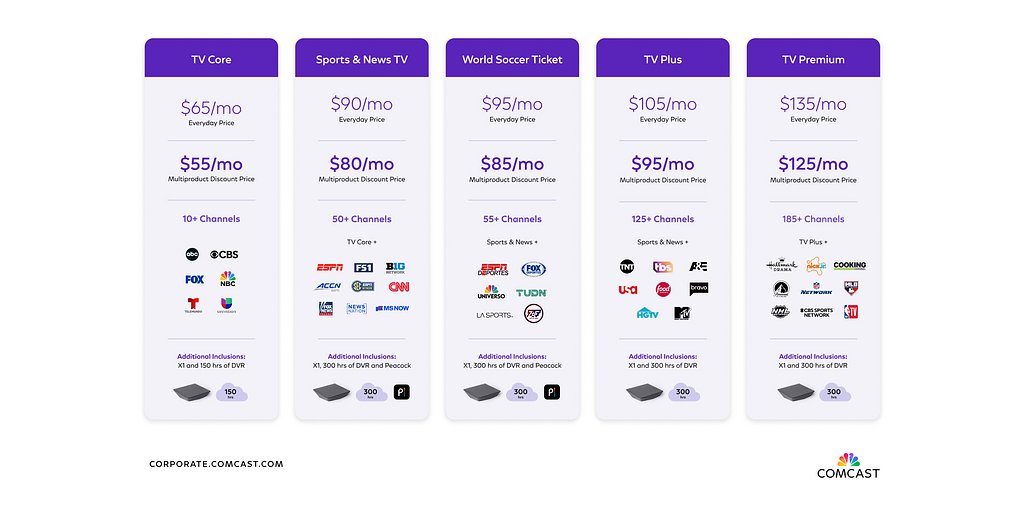
- $95/month for 'TV Plus': The new 'TV Plus' plan with over 125 channels costs $95/month when bundled with internet, higher than standalone streaming services.
Experts view Comcast's transparent pricing as a strategic move to rebuild trust and retain broadband customers, though its long-term success in competing with streaming services remains uncertain.
Comcast's Big Bet: Can Transparent Pricing Save Traditional TV?
PHILADELPHIA, PA – December 10, 2025 – In a market defined by subscriber exodus and consumer frustration, Comcast has fired a strategic volley aimed squarely at the heart of the pay-TV industry's most persistent problem: opaque pricing. The company's Xfinity brand has launched a new suite of national video plans built on a foundation of 'all-in pricing,' a move that promises to fold long-despised hidden charges like broadcast TV and regional sports fees into a single, upfront monthly cost. This pivot represents one of the most significant attempts by a legacy provider to stanch the bleeding from cord-cutting and compete with the straightforward billing models of its digital-native rivals.
For years, the cable bill has been a symbol of consumer angst, a monthly puzzle of surcharges and fees that often inflate the advertised price by 20-30%. By bundling its primary set-top box and eliminating its most notorious company-imposed fees, Xfinity is making a calculated gamble. It is betting that transparency can rebuild trust and reframe the value proposition of traditional television in an era dominated by on-demand streaming. As Steve Croney, incoming CEO of Comcast's Connectivity & Platforms division, stated, the goal is to create a “simplified and reimagined” experience that is “easy and hassle-free.” The question for investors and consumers alike is whether this strategic shift is a genuine transformation or a well-marketed repackaging designed to slow the inevitable.
A Strategic Defense for a Shifting Landscape
Make no mistake, this initiative is less about reviving the golden age of linear television and more about a pragmatic defense of Comcast's most valuable asset: its broadband business. For years, the industry has watched video subscriber numbers plummet. In this new reality, video is no longer the primary profit engine but a crucial component in a larger retention strategy. The new Xfinity plans are designed to be most attractive when bundled with the company's internet and mobile services, a strategy aimed at creating a 'sticky' ecosystem that is difficult for customers to leave.
The company claims customers can save over $70 per month by bundling video with its national internet and mobile plans. This highlights the core strategy: use a more appealing video product to lock in high-margin broadband households and drive adoption of Xfinity Mobile. By making the entire bundle more valuable than the sum of its parts, Comcast increases the overall revenue per household while reducing churn across all its services. In this model, video becomes the glue that helps hold the profitable connectivity empire together. This is a classic move for a resilient market leader: leveraging a legacy product to fortify its modern growth engine.
Deconstructing the 'All-In' Promise
While the promise of 'all-in pricing' is compelling, its real-world application warrants a closer look. Xfinity’s move to absorb broadcast TV and regional sports fees—charges that can add $20-$30 to a monthly bill from competitors like Charter Spectrum or Verizon Fios—is a significant step toward transparency. Including the primary X1 4K TV box and voice remote without a separate rental fee further simplifies the cost structure, bringing it closer to the straightforward model pioneered by streaming services.
However, 'all-in' does not mean 'all-inclusive.' Government-mandated taxes and franchise fees will almost certainly remain as separate line items, as they are outside Comcast's control. Furthermore, customers requiring additional set-top boxes for other rooms will likely face extra monthly charges. The pricing, while transparent, still positions traditional TV as a premium product. The new 'TV Plus' plan, with over 125 channels, costs $95 per month when bundled with internet, a price point significantly higher than standalone live TV streaming services like YouTube TV, which offers over 100 channels for around $73 per month with no hidden fees or equipment costs.
The true value, therefore, is not in a direct cost comparison with streamers but in the integrated experience and bundled savings. For a household already committed to Xfinity's robust internet service, adding a transparently priced video package becomes a more logical and less frustrating proposition than it was before.
Building a Broader Entertainment Ecosystem
This pricing overhaul is not happening in a vacuum. It is the latest piece in Comcast's broader strategy to position itself as the central aggregator for the modern digital home. This vision began to take shape earlier this year with the launch of national internet plans that also featured simplified pricing and a price guarantee. It was further solidified with the introduction of StreamSaver, a bundle packaging Netflix, Apple TV+, and Peacock at a steep discount for its broadband customers.
Viewed together, these moves reveal a company adapting to a world where it no longer holds a monopoly on video content. Instead of fighting the streaming tide, Comcast is building a bigger boat. The X1 platform serves as the hub for this integrated ecosystem, seamlessly blending live linear channels with on-demand content and apps from major streaming players. Features like 'Multiview' for sports fans and 'StreamStore' for managing subscriptions are designed to add value that a simple streaming dongle cannot offer.
This strategy acknowledges that the modern consumer wants choice and simplicity. By offering a transparently priced traditional TV package alongside a discounted streaming bundle, Xfinity caters to a wider spectrum of customers—from the dedicated sports fan who needs linear channels to the streaming-centric household that still wants a centralized, easy-to-use interface. The company is transitioning from a simple utility provider to a comprehensive platform for connectivity and entertainment, a move critical for long-term resilience and value creation in a fiercely competitive market.