
- $200 million investment: Hithium’s new battery assembly plant in Texas.
- 10 gigawatt-hours annually: The plant’s production capacity.
- 30% faster deployment: Guozi Robotics' 'factory in a box' model reduced project timelines.
Experts would likely conclude that the success of the Hithium plant demonstrates how global collaboration and advanced automation are essential for accelerating domestic manufacturing goals, particularly in high-stakes sectors like battery production.
China's Robots, America's Batteries: A New Industrial Blueprint
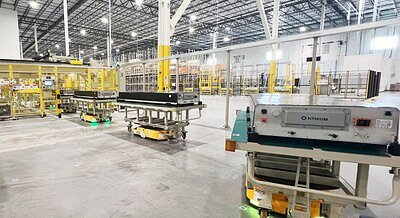
MESQUITE, TX – December 10, 2025 – In the sprawling industrial parks of Mesquite, Texas, a new 480,000-square-foot facility is humming with a quiet, relentless efficiency. This is Hithium’s new battery assembly plant, a nearly $200 million investment poised to churn out 10 gigawatt-hours of energy storage systems annually. But the story here isn't just about another factory opening in America's booming battery belt. It's about how it came online so quickly, a process powered by a fleet of intelligent robots and an innovative deployment strategy from across the Pacific.
The facility represents a critical node in the U.S. strategy to build a domestic clean energy supply chain. Yet, its operational backbone—a sophisticated, plant-wide intelligent logistics system—was engineered and delivered by Zhejiang Guozi Robotics, a Chinese automation firm. This partnership highlights a crucial reality of modern industrial transformation: the race for domestic manufacturing is often won using global innovation.
The Automated Heart of a Gigafactory
Step inside the Hithium plant, and the scale of automation is immediately apparent. Over one hundred of Guozi's intelligent logistics robots glide across the factory floor, a choreographed dance of steel and silicon. These aren't simple conveyors; they are the circulatory system of a true Industry 4.0 facility.
The workhorses of the fleet include advanced reach truck AGVs (Automated Guided Vehicles). Leveraging a multi-navigation system that fuses data from both vision cameras and LiDAR, these robots can lift loads of 1.2 tons to heights of 7 meters, placing them into high-bay racking with a precision of ±10 millimeters. They autonomously interface with material carts and production machinery, feeding components to the assembly lines and moving finished modules with minimal human intervention.
Handling the truly massive components is a fleet of heavy-duty transport robots, each capable of maneuvering an astonishing 60 tons. These titans are essential for moving large-scale battery packs and prefabricated systems within the plant. The seamless integration of this diverse robotic fleet—from nimble underride lifting robots to the colossal transporters—is what enables the facility to achieve its ambitious production targets. This level of automation is no longer a luxury; it is a necessity to compete in the fast-paced, high-stakes world of battery manufacturing, a sector supercharged by the financial incentives of the Inflation Reduction Act (IRA).
The 'Factory in a Box' Model: A New Paradigm for Deployment
Perhaps more disruptive than the robots themselves is the method by which they were deployed. Guozi Robotics utilized an "integrated delivery" model, effectively creating a "factory in a box" that radically compressed the project timeline. This approach directly confronts one of the biggest bottlenecks in large-scale industrial projects: the lengthy, complex, and often unpredictable process of on-site commissioning.
Instead of shipping individual components to Texas for a painstaking assembly and debugging process, Guozi conducted the entire system integration in China. They built a simulation of the Hithium plant's layout and workflow, then assembled and tested the entire logistics system—robots, racking, control software, and equipment linkages—as a single, cohesive unit. This included debugging the intricate handoffs between their robots and the production line equipment provided by other partners.
Once fully vetted, the entire pre-commissioned system was packaged and shipped to Texas. Upon arrival, it was essentially a plug-and-play operation. According to the company, this innovative model slashed the overall project implementation cycle by an estimated 30% compared to similar overseas projects. In an industry where speed to market is paramount, shaving months off a factory's launch schedule provides an immense competitive advantage. This strategy offers a powerful blueprint for how complex, multi-vendor industrial systems can be deployed with greater speed and predictability across global supply chains.
The Unseen Hurdles: Safety, Certification, and Market Trust
Deploying advanced automation in the United States involves more than just technical prowess; it requires navigating a stringent regulatory and safety landscape. A critical, though often overlooked, element of this project's success is that Guozi's entire robot series obtained UL certification. This is far more than a simple compliance checkbox; it is a fundamental enabler of market access and a testament to the system's safety.
UL Solutions, a global leader in safety science, has developed specific standards like UL 3100 to evaluate automated mobile platforms for a host of potential hazards, including electrical shock, fire, and collision risks. The certification process involves rigorous testing of a robot's object detection and avoidance systems, battery safety, and overall functional safety architecture. For a facility where autonomous robots weighing several tons operate in proximity to human workers, this third-party validation is non-negotiable.
While the Occupational Safety and Health Administration (OSHA) relies on a "general duty clause" for robotic safety, it points to national consensus standards like those from UL as the benchmark for ensuring a safe workplace. By securing this certification, Guozi not only mitigated liability for its client but also demonstrated a deep understanding of the U.S. market's operational requirements. It's a crucial step that builds the trust necessary for foreign technology providers to become integral partners in America's industrial resurgence.
The Hithium plant in Texas stands as a powerful case study in 21st-century industrial strategy. It showcases a symbiotic relationship where national policy goals, like building a domestic battery supply chain, are accelerated by highly specialized technology from global leaders. The project's success is not just a story about robots; it's a story about systems thinking, innovative deployment models, and the intricate dance of global collaboration required to build the factories of the future. As the U.S. continues to re-shore critical manufacturing, the ability to rapidly and safely integrate sophisticated automation will be a key determinant of which companies—and which countries—lead the next industrial revolution.