
- 35 nations represented at the 5th Asian Youth Para Games where AI robots debuted as hosts
- 9 languages supported by Mornine, the humanoid robot
- 30 countries where Mornine has been deployed for retail and exhibition services
Experts view this deployment as a significant milestone in human-robot interaction, demonstrating the maturity of embodied AI for accessibility and social engagement in global events.
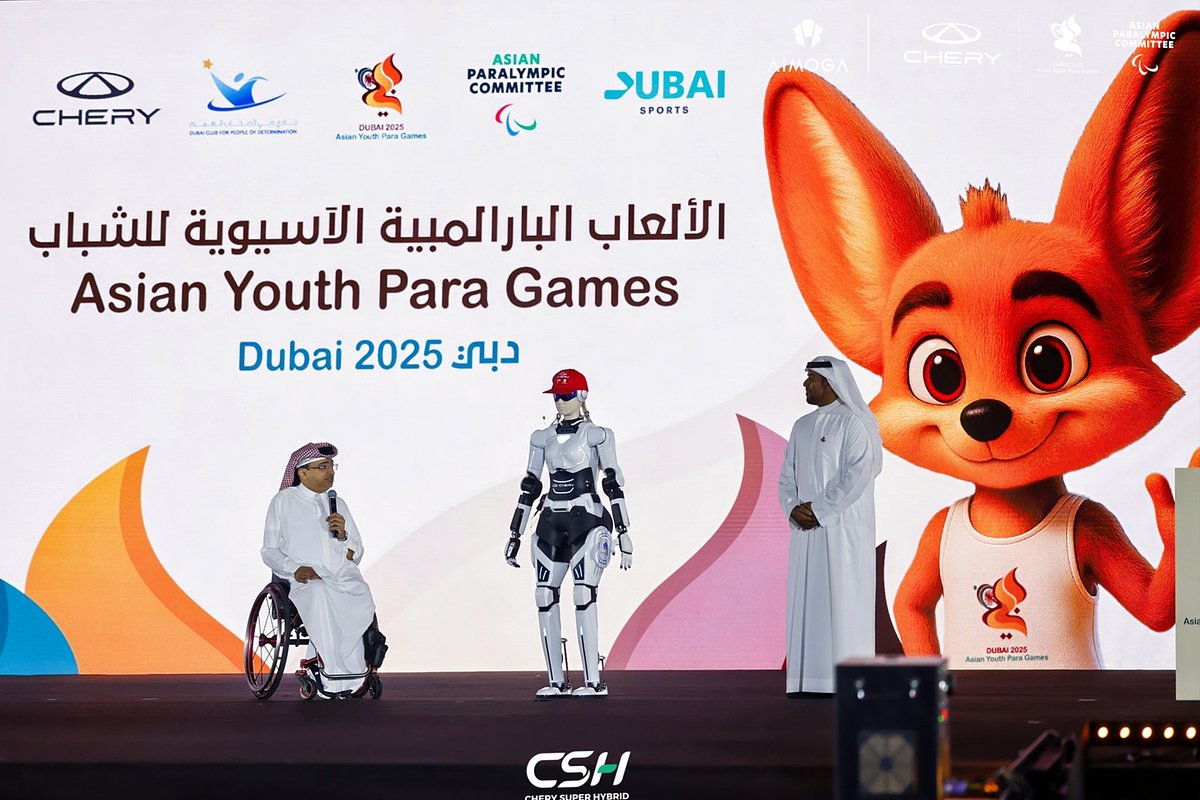
China's Robotic Ambassadors: AI Redefines Para-Sports Accessibility
DUBAI, UAE – December 11, 2025 – As athletes from 35 nations entered the stadium for the opening ceremony of the 5th Asian Youth Para Games, they were joined by an unusual companion. Argos, a sleek quadruped robot, trotted alongside the procession, a silent, metallic member of the welcoming party. Nearby, its humanoid counterpart, Mornine, engaged guests, switching seamlessly between nine languages. This was not a scene from science fiction, but a calculated debut by China’s AiMOGA Robotics, deploying its machines as hosts, guides, and companions on a major international stage.
The event in Dubai marks a significant moment in the application of embodied intelligence. While robots have assisted at major sporting events before, this deployment represents a new level of sophisticated, public-facing interaction, transforming these advanced machines from logistical tools into active participants in the human experience of the Games.
A New Benchmark for Human-Robot Interaction
The roles assigned to Mornine and Argos were far from trivial. Mornine, the humanoid robot, served as a multilingual host and ceremonial assistant, demonstrating an ability to navigate complex social settings and cultural nuances. Argos, the dog-like quadruped, performed choreographed dance routines and provided route guidance, interacting closely with athletes and attendees. This performance, sponsored by automotive giant Chery, was designed to showcase not just technological capability, but a vision of "Trusted AI Assistants."
While the company's announcement highlighted this as the "first participation of Chinese robots in a major international para sports event," the history is more layered. The Tokyo 2020 Paralympics saw Toyota deploy a fleet of support robots, and the Beijing 2022 Winter Paralympics featured Chinese-made exoskeleton robots assisting torchbearers. However, the deployment in Dubai is distinct. It moves beyond purely functional or assistive roles to place advanced, autonomous humanoid and quadruped robots at the center of communication and hospitality. It’s a powerful statement about the maturity of embodied AI, where robots can understand social context, interact naturally, and enhance the atmosphere of a global event.
Throughout the Games, the robots’ duties will continue, serving as award ceremony assistants, exhibition guides, and service volunteers. Their purpose, according to organizers, is to help young athletes overcome communication barriers and provide both practical and emotional support, embodying the event's slogan, "Born to Rise."
The Strategic Alliance of Cars and Code
The high-profile presence of these robots is underwritten by Chery Automobile, which designated Mornine and Argos as its official "Technology Performers." This partnership is a telling example of how cross-industry collaborations are shaping the future of AI applications. For an automotive manufacturer, the strategic benefits are multi-faceted.
First, it powerfully aligns the Chery brand with cutting-edge innovation and corporate social responsibility. By backing a technology that enhances accessibility at a para-sports event, the company projects an image of being both forward-thinking and socially conscious. Second, the global stage of the Asian Youth Para Games in Dubai provides an invaluable marketing platform, boosting brand visibility in key Asian and Middle Eastern markets.
More profoundly, this collaboration hints at the long-term convergence of robotics and mobility. Automotive leaders are no longer just building cars; they are architecting mobility ecosystems. Exploring human-robot interaction in complex public spaces provides crucial data and insights for developing future autonomous vehicles, in-cabin assistants, and smart city services. The partnership with AiMOGA is less a simple sponsorship and more a strategic investment in understanding how humans and intelligent machines will coexist and collaborate in the cities and vehicles of tomorrow.
From Games Assistant to Life-Changing Aid
While the spectacle in Dubai captures global attention, AiMOGA Robotics is signaling that this is merely the public face of a much deeper ambition. The company has already deployed its Mornine humanoid robot in over 30 countries for retail and exhibition services, while the Argos quadruped is finding applications in patrol and light transport. The real story, however, lies in the company's future roadmap.
AiMOGA has announced plans to develop a new line of products specifically targeting the accessibility market, including robotic guide-dogs, advanced rehabilitation systems, and intelligent exoskeletons. This strategic pivot from general-purpose service robots to specialized assistive technology is significant. It suggests the company sees a substantial and meaningful market in creating solutions that directly empower people with disabilities, a field where robotics promises to deliver transformative impact.
This move aligns with a broader industry trend. Robotic exoskeletons are already helping individuals with spinal cord injuries to walk again. Social companion robots are mitigating loneliness among the elderly, and AI-powered navigation aids are offering new levels of independence for the visually impaired. By dedicating R&D to these areas, AiMOGA is positioning itself not just as a creator of novel machines, but as a key player in the future of healthcare and personal assistance.
Navigating a Crowded Field
AiMOGA's bold moves do not occur in a vacuum. The global robotics landscape is fiercely competitive. In the United States, Boston Dynamics’ Spot and Atlas robots have long set the standard for dynamic mobility, while Agility Robotics’ Digit is making inroads in warehouse logistics. Domestically, AiMOGA faces stiff competition from rivals like Unitree Robotics, whose own quadruped and humanoid robots have demonstrated impressive athletic capabilities at dedicated robotics competitions.
In this crowded market, AiMOGA appears to be carving out a distinct niche. While competitors focus heavily on industrial automation, logistics, or pure research, AiMOGA is doubling down on human-centric applications: public interaction, service hospitality, and, most importantly, assistive technology. Its emphasis on Mornine’s multilingual and cultural adaptability is a key differentiator for global service deployments.
This strategy leverages China’s strengths in advanced manufacturing and a national push for leadership in AI, potentially allowing the firm to scale production and offer sophisticated solutions at a competitive price point. The debut at the Para Games is therefore not just a demonstration of technology but a calculated strategic play to establish a brand identity centered on usability, accessibility, and human-robot collaboration on a global scale. The event serves as a powerful proof-of-concept, showing potential customers and partners that its robots are ready for complex, real-world human environments.
The synthesis of intelligent software and capable hardware on display in Dubai offers a compelling glimpse into a future where technology is not just powerful, but also empathetic. As these robotic ambassadors continue their work at the Games, they represent a tangible step toward a world where AI-driven systems are integrated into the fabric of society to foster greater resilience, connection, and inclusion for everyone.