
- Battery Exports: China's 2025 battery exports reached $82.279 billion, a 22.8% increase in value from 2024, with lithium-ion exports up 25.55% to $76.746 billion.
- Event Scale: CIBF2026 will host 3,100 exhibitors across 280,000 square meters in Shenzhen.
- Regulatory Impact: New carbon footprint reporting and battery recycling laws took effect in 2026, mandating lifecycle emissions tracking and producer responsibility.
Experts view China's battery sector as transitioning from mass production to high-value innovation, driven by technological advancements and stringent green regulations, solidifying its global leadership in the energy storage race.
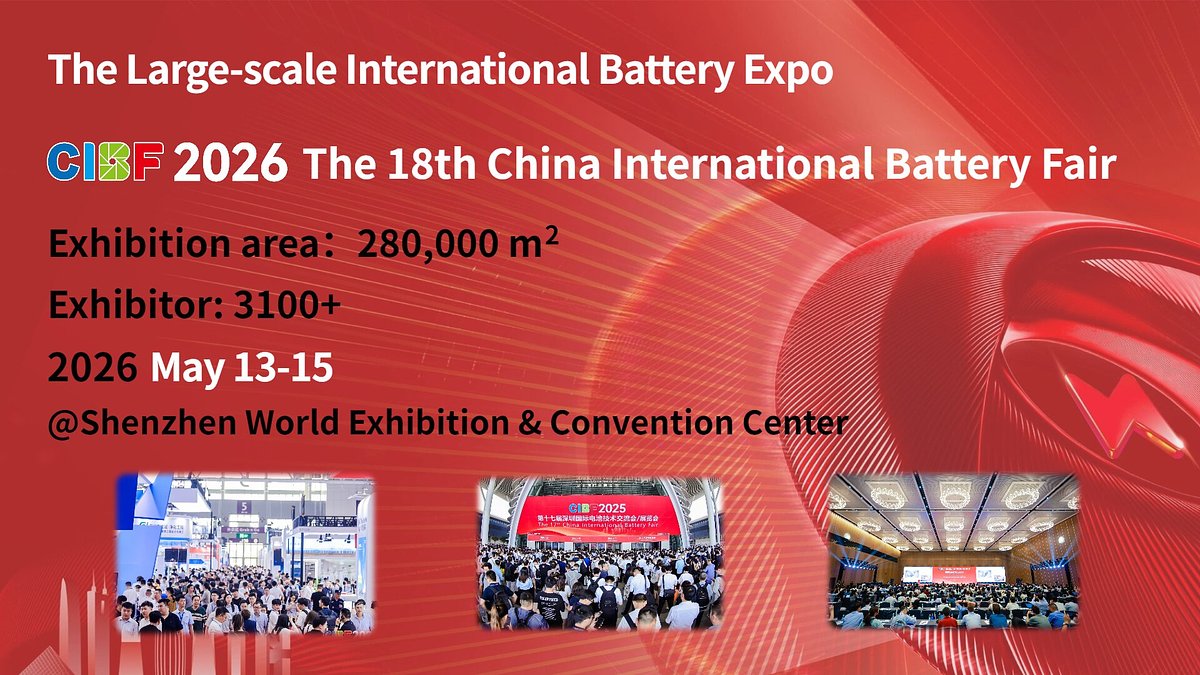
China's Battery Sector Flexes Muscle at CIBF2026 Amid New Green Rules
TIANJIN, China – April 06, 2026 – As China’s battery industry continues its formidable expansion, the upcoming 18th China International Battery Fair (CIBF2026) is poised to be more than just a trade show. It is a declaration of the nation's strategic pivot from sheer production volume to high-value, technologically advanced leadership in the global green energy race. Set against a backdrop of soaring export values and sweeping new environmental regulations, the event, scheduled for May 13-15 in Shenzhen, will offer a crucial glimpse into the future of energy storage.
The industry closed out 2025 on a high note, with full-year battery exports reaching a staggering $82.279 billion, a 22.8% jump in value from the previous year, even as shipment volumes remained relatively flat. This surge was overwhelmingly driven by higher-value lithium-ion products, whose exports climbed 25.55% to $76.746 billion. This data underscores a critical shift: China is no longer just the world's factory for batteries, but its premier innovator, a trend that CIBF2026 is set to amplify.
A Global Nexus for Battery Innovation
The sheer scale of CIBF2026 is a testament to its central role in the industry. The Shenzhen World Exhibition & Convention Center will host over 3,100 exhibitors across a sprawling 280,000 square meters of floor space. This makes it one of the largest and most comprehensive battery exhibitions globally, rivaling and in many cases surpassing other major events in North America, Europe, and Japan. The exhibitor list spans the entire supply chain, from raw material giants like Albemarle Corporation to manufacturers of power batteries, energy storage systems, 3C cells, and advanced recycling solutions.
This year’s fair is positioned as a critical crossroads where international opportunity meets domestic ambition. While events like The Battery Show in North America focus on the EV market and Energy Storage Europe centers on grid solutions, CIBF2026 integrates all facets under one roof. It provides an unparalleled platform for global players to connect with Chinese partners, access a dynamic market, and witness the rapid translation of laboratory concepts into mass-produced realities. The presence of a significant international contingent, alongside China's domestic champions like CATL and BYD, solidifies the event's status as a key gathering point for the entire international battery community.
The Push for Next-Generation Technologies
While lithium-ion batteries remain the commercial backbone, the spotlight at CIBF2026 will be on what comes next. The event is set to feature major advancements in solid-state and sodium-ion batteries, reflecting a national push to break new ground and diversify beyond current chemistries. This focus aligns directly with directives from China's Ministry of Industry and Information Technology (MIIT), which has prioritized accelerating breakthroughs in all-solid-state batteries in 2026.
Chinese automakers and suppliers are already racing to commercialize this next-generation technology. Companies like Dongfeng, SAIC, and Sunwoda are moving from prototypes to planning scaled production, targeting ambitious energy densities between 350-600 Wh/kg, which could enable electric vehicles with driving ranges exceeding 1,000 kilometers. The fair will serve as a crucial barometer for how close these technologies are to market readiness. Alongside solid-state tech, sodium-ion batteries will be highlighted as a promising alternative that could ease reliance on lithium and cobalt, offering a more cost-effective solution for stationary energy storage and smaller EVs.
The Green Mandate: A New Era of Sustainability and Regulation
Perhaps the most significant context for CIBF2026 is the raft of new environmental regulations taking effect this year, fundamentally reshaping the industry's obligations. As of 2026, China has implemented a mandatory carbon footprint reporting system for all new energy vehicle (NEV) power batteries. This policy requires manufacturers to calculate and submit detailed emissions data covering the entire battery lifecycle—from raw material extraction and manufacturing to distribution and end-of-life recycling.
This move toward transparency is complemented by sweeping new battery recycling laws that came into force on April 1, 2026. The "Interim Measures for the Management of Recycling and Comprehensive Utilization of Retired Power Batteries" mandate that automakers and battery producers assume direct responsibility for collecting and recycling used batteries. A core element of this policy is a national traceability platform, which assigns a unique digital identity to every battery to track it from cradle to grave.
These regulatory shifts will be a central topic of discussion at the fair, particularly during the "3rd International Battery Passport Conference." This conference highlights the convergence of Chinese policy with global trends, such as the EU's battery passport initiative, suggesting a future where sustainability metrics and transparent supply chains are non-negotiable for market access. The focus on recycling technologies and energy-efficient manufacturing equipment on the exhibition floor underscores the industry's adaptation to this new, greener paradigm.
Navigating Shifting Trade Winds
The industry's growth is not without its complexities, particularly in the international arena. While the European Union has become the primary export market for Chinese batteries, accounting for roughly 40% of demand in 2025 with a 40% growth in value to $31 billion, trade with the United States has cooled. Exports to the U.S. saw a significant 22% decline in value in 2025, a trend reflecting evolving trade dynamics and policy frictions.
Further complicating the export landscape is China's own policy adjustments. The government has begun to phase out export tax rebates for battery products, reducing them from 9% to 6% as of April 1, 2026, with a full phase-out planned for 2027. This move is widely seen as a strategy to curb price distortions in overseas markets and encourage domestic industrial consolidation and technological upgrades over pure export volume. As over 2,000 experts, researchers, and business leaders gather for the high-level forums at CIBF2026, these policy shifts and their impact on global competitiveness will undoubtedly be a key subject of analysis and debate. The event will not only showcase technological prowess but also offer critical insights into how the world's leading battery sector is navigating an increasingly complex and regulated global market.