
- 29% reduction in per-kilometer freight costs with autonomous platooning
- 195% increase in operating profit projected
- 1,000-unit production scale planned for 2026
Experts view this collaboration as a significant step toward China's dominance in autonomous freight, with the potential to revolutionize logistics through cost savings and environmental benefits, though regulatory hurdles remain.
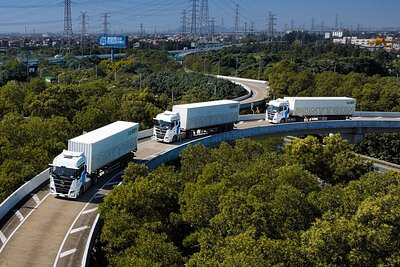
China's Autonomous Truck Era Begins: SANY & Pony.ai Target Mass Production
BEIJING – December 08, 2025
The long-promised future of autonomous freight is accelerating from controlled test zones onto the commercial highway. In a pivotal announcement, heavy equipment giant SANY Group and autonomous driving leader Pony.ai declared their fourth-generation autonomous heavy-duty truck is nearing mass-production readiness. The first wave of these intelligent, electric trucks is slated for commercial deployment in 2026, signaling a monumental shift from limited pilots to scalable, unmanned logistics in the world's largest manufacturing economy.
This collaboration, which began in 2022, is moving beyond prototypes. The plan involves an initial production run at a thousand-unit scale, a clear statement of intent to commercialize the technology. This move aims to cement China's leadership in autonomous freight and catalyze a digital, intelligent, and low-carbon transformation across the logistics industry.
The New Economics of Unmanned Freight
At the core of this disruption is a radical new economic model. The partners are championing a "1+4" autonomous platooning solution, where a single manned lead truck guides a convoy of four fully unmanned follower trucks. Based on extensive pilot programs, this configuration is projected to slash per-kilometer freight costs by an astounding 29% while increasing operating profit by 195%.
These figures, while ambitious, are rooted in fundamental operational shifts. In long-haul trucking, human driver costs typically account for 25-30% of total expenses. By removing the driver from four out of five trucks in a platoon, the model directly attacks the largest variable cost in logistics. The lead driver's role evolves into that of a fleet manager, overseeing the convoy's safe and efficient operation, while the technology handles the long, repetitive stretches of highway driving.
Further bolstering the business case is a dramatic reduction in the vehicle's manufacturing cost. By leveraging 100% automotive-grade components, many shared with Pony.ai's latest Robotaxi platform, the bill-of-materials (BOM) cost for this fourth-generation truck has been reduced by approximately 70% compared to its predecessor. This is a critical step in making autonomous trucks not just technologically feasible but commercially viable at scale, moving them from a niche experiment to a sound capital investment for logistics operators.
Zhou Wanchun, Vice President of SANY Group and General Manager of SANY Heavy Truck Marketing, highlighted the strategic importance of this milestone. "Mass production of the fourth-generation autonomous truck marks another milestone in SANY's Digitalization and decarbonization strategy," he stated. "Through deep collaboration with Pony.ai, we are accelerating the scaled adoption of intelligent logistics equipment and delivering unprecedented gains in operational efficiency."
Engineering for a Driverless Future
Achieving this level of automation and economic efficiency requires a vehicle engineered from the ground up for reliability and safety without a human at the wheel. The SANY-Pony.ai truck is built on SANY's fully redundant, drive-by-wire chassis. This design provides layers of backup for six core systems: steering, braking, communication, power supply, computing, and sensing. If any primary component fails, a secondary system instantly takes over, ensuring the vehicle remains in control.
This comprehensive safety architecture, designed for a service life of 20,000 hours and capable of supporting up to 1 million kilometers of freight operation, is crucial for building trust with regulators and the public. The trucks have undergone a battery of rigorous tests, including electromagnetic compatibility (EMC) and performance trials in extreme heat and cold, establishing a new benchmark for safety in the autonomous freight industry.
Beyond safety, the platform is a key part of the industry's green transformation. Each truck is equipped with a battery pack exceeding 400 kWh, enabling all-electric operation. The partners estimate that each vehicle will reduce annual carbon emissions by approximately 60 tons compared to a traditional diesel counterpart. While this represents a significant step forward, the planned thousand-unit production scale will necessitate a corresponding buildout of megawatt-level charging infrastructure along key logistics corridors to support continuous operation.
China's Strategic Push for Autonomous Dominance
This announcement is more than a corporate milestone; it's a significant move in the global race for technological supremacy. China has made the development of autonomous vehicles and smart logistics a national priority, and this partnership exemplifies the country's "golden triangle" strategy: combining a vehicle manufacturer (SANY), a technology provider (Pony.ai), and a logistics operator (Sinotrans) into a tightly integrated ecosystem. This "Vehicle + Technology + Scenario" model ensures that vehicle production, technological maturity, and real-world operational needs are aligned from the start.
The competitive landscape in China is heating up, with players like Inceptio Technology and DeepWay also advancing their platforms. However, Pony.ai's early start in 2018 has given it a significant lead in real-world experience, having already accumulated over 1 billion ton-kilometers of freight transport. Its partnerships provide a formidable foundation for scaling up.
Globally, this puts significant pressure on competitors in the U.S. and Europe, such as Aurora and Waymo Via. Projections from S&P Global Mobility estimate that by 2030, China will dominate the autonomous freight market with 250,000 Level 4 logistics vehicles in operation, compared to 230,000 in the United States. The country's ability to coordinate industrial policy, infrastructure investment, and regulatory frameworks provides a powerful tailwind for companies like SANY and Pony.ai.
Navigating the Regulatory Road Ahead
Despite the technological readiness and strong government backing, the path to fully unmanned, coast-to-coast freight is not without obstacles. China has been proactive in creating a supportive regulatory environment, with over 50 cities running pilot programs and key economic hubs like Beijing, Shanghai, and Shenzhen establishing extensive test zones. Beijing's new rules for Level 3+ autonomous systems, effective in 2025, provide clearer standards for deployment.
However, a crucial gap remains between regional pilot licenses and a unified national framework for fully driverless commercial freight. Most current operations, even with highly capable vehicles, still require a safety driver to be present, reflecting a cautious, phased approach to adoption. Pony.ai has secured valuable permits for cross-provincial expressway testing of its unmanned platoons, but the specific rules that will govern the paid, large-scale commercial operations planned for 2026 are still evolving.
The success of the "1+4" platooning model will depend on regulators becoming comfortable with multiple heavy-duty trucks operating without a human inside on public highways. As the technology proves its safety and reliability over millions of kilometers, the industry anticipates these regulations will mature, unlocking the full economic and environmental potential of this transformative technology. The mass-production readiness of this fourth-generation truck is designed to be the catalyst that drives that very shift, moving the entire logistics sector from demonstration to large-scale deployment.