
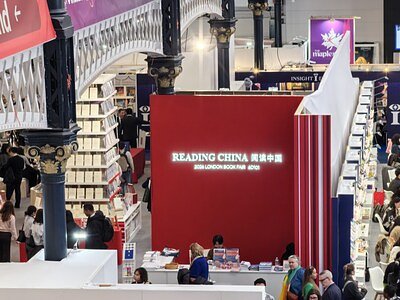
- China's delegation at the 2026 London Book Fair featured an expansive 'Reading China' pavilion, blending ancient heritage with modern creativity. - The country has surpassed the United States in the output of highly cited academic papers since launching the 'China Science and Technology Journals Excellence Action Plan' (CJEAP) in 2019. - Penguin Random House plans to reissue English editions of spy novelist Mai Jia’s classics, Decoded and In the Dark, signaling global interest in Chinese fiction.
Experts view China's participation in the London Book Fair as a strategic effort to shape its global narrative through cultural diplomacy, commercial expansion, and intellectual influence, leveraging publishing as a tool of soft power.
China Writes Its Global Narrative at London Book Fair
LONDON, UK – March 20, 2026 – As the buzz of the 2026 London Book Fair at Olympia London faded last week, one exhibitor’s presence resonated more powerfully than ever. China's delegation, marshaled by the state-owned China National Publications Import & Export (Group) Co., Ltd (CNPIEC), executed a meticulously planned showcase that was part cultural exchange, part academic summit, and part strategic business offensive. Far more than a simple display of books, China's participation signaled a sophisticated, multi-pronged effort to shape its narrative on the world stage, leveraging the publishing industry as a primary tool of soft power, commercial expansion, and intellectual influence.
Books as Bridges: A New Era of Cultural Diplomacy
At the heart of the effort was the expansive 'Reading China' pavilion, a polished and immersive space designed to do more than just sell rights. It was a masterclass in cultural diplomacy. Visitors were guided through curated sections that seamlessly blended ancient heritage with modern creativity. Award-winning contemporary novels like The Last Quarter of the Moon sat alongside classic texts such as the Yongle Encyclopedia. The display was not just static; it was interactive. A VR experience allowed attendees to step inside ancient Chinese paintings, while demonstrations of Suzhou embroidery and the quiet ritual of tea tasting offered a tangible connection to Chinese culture.
This curated experience is a core component of China's broader "going out" strategy for its cultural industries. The goal is to build bridges of understanding, but also to subtly frame the international perception of the nation. This was evident in the high-profile launch of China Under the Global Development Initiative: An Economic Perspective. Unveiled in English with a Spanish edition already signed, the book is a direct attempt to articulate China's vision for global development to an international audience. The Global Development Initiative (GDI), proposed in 2021, is a cornerstone of China's foreign policy, aiming to align global development with its principles. By publishing such texts, Beijing is not just participating in the global conversation; it is actively seeking to set the agenda.
Discussions featuring prominent Western academics like Kerry Brown of King's College London lent intellectual weight to these events, moving them beyond state propaganda and into the realm of legitimate international dialogue. It’s a strategy that presents China’s worldview not as an imposition, but as a contribution to a shared global future.
The Business of Influence: From Ancient IP to Global Markets
Beneath the veneer of cultural exchange lies a formidable commercial ambition. The Chinese delegation's activities underscored a clear strategy to transform its rich cultural heritage into bankable global intellectual property (IP). The 'China IP Exhibition' highlighted this push, showcasing creative products derived from historical sites like Dunhuang and the enigmatic Sanxingdui ruins. The goal is to move beyond simply exporting books to building global brands and licensing ecosystems around uniquely Chinese cultural elements.
This strategy is already bearing fruit in other sectors. The global success of companies like toy maker Pop Mart and the box office performance of animated films based on Chinese mythology demonstrate a potent formula for monetizing cultural IP. The publishing industry is now systematically applying this model. The buzz around author Li Shanshan’s The Millennial Vessel, a children’s book inspired by Sanxingdui artifacts, and its discussion alongside a Carnegie Medal winner, shows a concerted effort to position Chinese children’s literature on the world stage.
Perhaps the most telling commercial signal was Penguin Random House’s plan to reissue English editions of spy novelist Mai Jia’s classics, Decoded and In the Dark. Mai Jia is one of a handful of Chinese authors who have successfully crossed over, proving there is a Western market for Chinese fiction. The rights exchange session dedicated to his work drew publishers from across Europe, all keen to understand and tap into the growing global appeal of contemporary Chinese stories. As one international publishing consultant noted, "China has leapfrogged many Western counterparts in digital publishing and e-commerce. Their agility in marketing and distribution is something the global industry is watching very closely."
Forging a New Silk Road of Knowledge
Beyond fiction and cultural heritage, China is aggressively carving out a space for itself at the pinnacle of global academic and scientific discourse. The country's presence at the fair highlighted a strategic push to elevate its scholarly publishing from a regional player to a global leader. A key milestone was the launch of the English edition of The Belt and Road Handbook in partnership with the established academic publisher Taylor & Francis, a move that places a key text on China’s signature foreign policy initiative directly into the hands of the international academic community.
This is just one facet of a much larger ambition, exemplified by the 'China Science and Technology Journals Excellence Action Plan' (CJEAP). Launched in 2019, this state-funded initiative has poured resources into domestic journals, with staggering results. Research shows that since the plan's inception, the number of top-tier Chinese scientific journals has exploded. China has now surpassed the United States in the output of highly cited academic papers, and the quality of its research, as measured by citation impact, is now above the world average. The goal of the CJEAP is clear: to build a world-class domestic publishing infrastructure that can attract and retain top research, reducing reliance on Western journals and positioning China as a global hub for scientific knowledge.
The academic forum 'Beyond Borders', hosted on the fair's official International Stage, brought together Chinese experts with representatives from giants like Springer Nature and Oxford Brookes University. They weren't just discussing past achievements; they were debating the future of publishing itself—from AI integration to digital transformation. This demonstrates a confidence and a desire not merely to follow trends, but to actively shape the future of the global knowledge ecosystem.
Topics & Related
Digital Transformation
Geopolitics & Trade
Industry Conference
Financial Services
Technology
Related Company Pulse