
- MedGPT scored 15.3% higher than the runner-up in the CSEDB assessment.
- MedGPT's safety score was nearly 20% higher than the next-best model.
- The average performance across all tested LLMs was 57.2%.
Experts conclude that China's Clinical Safety-Effectiveness Dual-Track Benchmark (CSEDB) sets a new global standard for evaluating medical AI, with MedGPT demonstrating superior clinical safety and effectiveness compared to leading Western models.
China Sets New Standard for Medical AI, Outperforms Global Giants
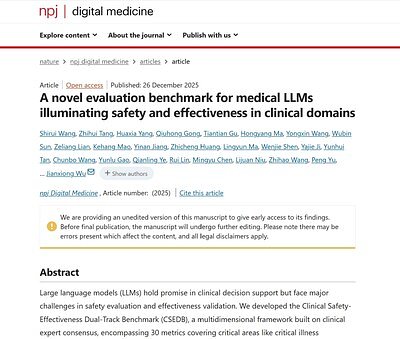
BEIJING, CN – January 08, 2026 – A Chinese research consortium has established a new global benchmark for evaluating medical artificial intelligence, with their own AI system outperforming leading models from Google, OpenAI, and Anthropic in a comprehensive clinical assessment. The findings, published in the high-impact Nature Portfolio journal npj Digital Medicine, introduce a framework designed to measure an AI's real-world clinical safety and effectiveness, a critical step toward deploying AI in high-stakes patient care.
The study presents the Clinical Safety-Effectiveness Dual-Track Benchmark (CSEDB), the first standardized evaluation system of its kind developed in China and published in a top-tier international journal. In a head-to-head comparison of the world's most advanced large language models (LLMs), MedGPT—an AI developed by the Chinese medical technology company Future Doctor—achieved the highest scores across all metrics, signaling a potential shift in the landscape of medical AI innovation.
Bridging the Chasm Between Code and Clinic
For years, the primary method for testing a medical AI's knowledge has been to pit it against standardized medical licensing exams. While models have shown impressive results in these tests, experts have consistently warned that exam performance is a poor proxy for the complexities of real-world patient care. Clinical practice is not a multiple-choice test; it involves dynamic conditions, unique patient histories, and a constant balancing of risks and benefits.
"Patient safety is the fundamental priority in healthcare," the study's authors state, highlighting a significant disconnect between current AI testing and the demands of actual clinical work. This gap has been a major barrier to the responsible deployment of AI in diagnosis and treatment, leaving the industry without a reliable way to validate if an AI is truly ready for the bedside.
The CSEDB framework was created to fill this void. Developed through a collaboration between Future Doctor's research team and 32 leading clinicians from 23 of China's most prestigious hospitals, including Peking Union Medical College Hospital and the Chinese PLA General Hospital, it introduces a novel dual-track evaluation. Instead of just measuring correctness, it assesses AI performance across 30 distinct indicators split between two crucial domains:
* Safety (17 indicators): This track scrutinizes the AI's ability to recognize critical illnesses, avoid fatal diagnostic errors, identify dangerous drug interactions, and adhere to absolute contraindications.
* Effectiveness (13 indicators): This track measures performance in areas like following clinical guidelines, prioritizing care for patients with multiple diseases, and optimizing treatment pathways.
Each indicator is weighted on a five-point scale based on clinical risk, with a score of 5 representing life-threatening scenarios. The evaluation uses 2,069 open-ended clinical scenarios across 26 medical specialties, forcing the AI to navigate the ambiguity and complexity that define a physician's daily decisions.
MedGPT Ascends: A New Leader in Clinical AI
When major global AI models were subjected to the rigorous CSEDB assessment, the results were revealing. The cohort, which included powerhouse models like OpenAI's o3, Google's Gemini 2.5, and Anthropic's Claude 3.7, generally demonstrated weaker performance on safety metrics compared to effectiveness.
However, MedGPT, a specialized medical AI from Future Doctor, delivered a remarkable performance. It not only secured the top position overall but did so by a significant margin, scoring 15.3% higher than the runner-up. More critically, its score in the safety dimension was nearly 20% higher than the next-best model.
Perhaps the most significant finding was that MedGPT was the only model tested whose safety score was higher than its effectiveness score. While its capabilities continue to approach the professional level of human physicians, this result suggests the system has been imbued with a crucial sense of clinical caution. This trait, often learned by doctors through years of training and experience, is essential for any tool intended to assist in life-or-death decisions and has been a notoriously difficult quality to instill in AI systems. The average performance across all tested LLMs was a moderate 57.2%, indicating that most general-purpose models are not yet prepared for unsupervised clinical application.
Thinking Like a Physician: The Architecture of Safety
MedGPT's standout performance is not an accident of massive data training but the result of a deliberate design philosophy. Future Doctor states its goal was to create an AI that "thinks like a physician," rather than one that merely "sounds like a physician." This was achieved by moving away from a pure reliance on the emergent intelligence of LLMs and instead building an architecture modeled on human cognitive reasoning processes.
From its inception, the system's core architecture was embedded with safety and effectiveness principles derived from clinical expert consensus. This foundational approach contrasts sharply with that of general-purpose LLMs, which learn about medicine as one of many topics from a vast corpus of internet data, without the same built-in guardrails for clinical risk.
This "safety-by-design" approach is complemented by a powerful real-world feedback mechanism. MedGPT's capabilities were first validated in 2023 trials, where it achieved a 96% diagnostic concordance rate with attending physicians in tertiary hospitals. Today, its evolution is driven by a continuous "feedback-driven iteration" flywheel. Over 10,000 physicians currently use the Future Doctor platform for patient interactions, generating around 20,000 real clinical feedback entries each week. This constant stream of expert-verified data allows MedGPT's accuracy to improve by an estimated 1.2% to 1.5% every month, ensuring it becomes progressively more aligned with the nuanced realities of patient care.
A New Global Standard from the East
The publication of the CSEDB and MedGPT's dominant performance represents more than just a technological breakthrough; it marks a significant moment in the global AI landscape. By establishing the first comprehensive, clinically-grounded benchmark in a leading international journal, the Chinese research team has positioned itself at the forefront of shaping the standards for the next generation of medical AI.
This development challenges the long-held assumption that foundational AI innovation flows primarily from Silicon Valley. In the high-stakes, specialized field of medicine, a domain-specific, safety-first approach appears to be yielding superior results. The deep collaboration with China's top medical institutions underscores a national-level commitment to integrating AI into healthcare safely and effectively. As regulators and healthcare systems worldwide grapple with how to approve and integrate AI decision-support tools, the CSEDB provides a robust, transparent, and replicable model for validation. This move not only provides a clear direction for the iterative improvement of all medical LLMs but also lays the essential groundwork for their deployment in serious clinical settings, where the margin for error is zero.