
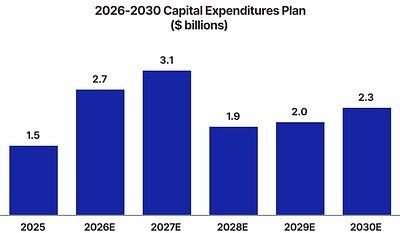
- $12B Investment: Canadian Utilities plans a $12 billion capital expenditure over five years (2026-2030) to expand its regulated infrastructure.
- 6.9% CAGR: Projected compound annual growth rate for the company's rate base, expanding from $16.6B in 2025 to $23.2B by 2030.
- $471M Impairment: Significant write-down on renewable assets due to grid deficiencies and regulatory hurdles.
Experts would likely conclude that Canadian Utilities is strategically pivoting toward regulated infrastructure growth to stabilize profitability amid the challenges of the energy transition, despite short-term financial setbacks in its renewable portfolio.
Canadian Utilities Bets $12B on Grid Growth Amid Financial Headwinds
CALGARY, AB – February 26, 2026 – Canadian Utilities Limited today charted an ambitious path forward, announcing a massive $12 billion, five-year capital expenditure plan aimed at aggressively growing its regulated infrastructure base. The announcement came as the company reported resilient adjusted earnings for 2025, but also revealed a starkly different picture under standard accounting rules, where a nearly half-billion-dollar impairment on renewable assets dragged down its bottom line.
The Calgary-based energy infrastructure giant, a subsidiary of ATCO, posted adjusted earnings of $658 million for 2025, a modest $11 million increase from the previous year. However, its earnings reported under International Financial Reporting Standards (IFRS) told a story of significant challenges, plummeting to $119 million from $480 million in 2024. The divergence underscores a strategic pivot for the company as it navigates the complex realities of the global energy transition.
A Tale of Two Earnings Reports
The chasm between Canadian Utilities' adjusted earnings and its official IFRS results is almost entirely explained by a $471 million non-cash impairment charge recorded in the fourth quarter. While adjusted earnings are designed to show the performance of core, day-to-day operations, the IFRS figure includes one-time charges that reveal deeper strategic and operational pressures.
The bulk of the write-down was tied to the company's Alberta Renewables Portfolio. According to the company's financial disclosures, these assets have been plagued by "elevated curtailment from inadequate transmission infrastructure and electricity grid deficiencies." This means that even when wind and solar assets are capable of generating power, they are being forced to shut down because the provincial grid cannot handle the electricity, a significant operational and financial blow. The impairment highlights a critical bottleneck in Alberta's shift toward green energy, where the pace of renewable generation development has outstripped the grid's capacity to transport the power.
Further write-downs were recognized for certain hydrogen assets, reflecting uncertainty around the development of utility hydrogen regulations, and an aging gas distribution network in Western Australia. The pause of the Alberta Hydrogen Hub project, reportedly due to a lack of government support for related rail infrastructure, signals broader hurdles for cleaner fuel initiatives that depend on extensive public and private sector coordination.
Despite these significant write-downs, the company managed to grow its adjusted earnings in the face of $57 million in headwinds, which included a temporary decrease in the regulated return on equity in Alberta and the conclusion of a regulatory efficiency mechanism.
The $12 Billion Blueprint for Growth
In a decisive move to drive future profitability, Canadian Utilities is shifting its focus squarely onto its regulated utilities. The company unveiled an approximately $12 billion capital expenditure plan for 2026 through 2030, a significant acceleration of investment in its Canadian and Australian operations.
This capital deployment is projected to fuel a consolidated mid-year rate base compound annual growth rate (CAGR) of 6.9%. This growth would expand the company's rate base—the value of assets on which it can earn a regulated return—from $16.6 billion in 2025 to an estimated $23.2 billion by 2030. This growth forecast places Canadian Utilities among the faster-growing North American utilities, comparing favorably to peers like Fortis and Hydro One, which project rate base growth closer to 6%.
Heavily weighted toward its core transmission businesses, the plan allocates approximately $4.9 billion to electric transmission and $2.4 billion to natural gas transmission. This strategic focus on regulated assets, which offer predictable returns set by government authorities, represents a flight to stability amid the volatility experienced in its non-regulated renewable portfolio.
Building Alberta's Future Grid
Two major projects form the backbone of the company's near-term growth strategy in Alberta: the Yellowhead Pipeline Project and the Central East Transfer-Out (CETO) Project.
The Yellowhead Pipeline is the company's largest single growth initiative, a $2.9 billion project to construct 235 kilometers of high-pressure natural gas pipeline from the Peers area to Fort Saskatchewan. With 90% of its capacity already committed by industrial customers, the pipeline is poised to reinforce Alberta's energy security and is expected to enable over $20 billion in downstream industrial investment. After receiving a crucial 'Needs' approval from the Alberta Utilities Commission (AUC) in 2025, the project awaits a final construction and operation permit, with a decision expected in the third quarter of 2026. Construction is slated to begin shortly after, targeting an in-service date in late 2027.
Meanwhile, the $255 million CETO project directly addresses the grid deficiencies that led to the company's renewable energy write-downs. The 135-kilometer, 240kV transmission line, being built in partnership with AltaLink, is designed to reinforce the grid in central east Alberta and improve the transfer of electricity, including from renewable sources, to the rest of the province. With its portion of the line on track to be energized by June 2026, the project represents a critical step in modernizing Alberta's grid to support both industrial growth and renewable energy integration.
Rewarding Shareholder Patience
While navigating a complex operational and financial environment, Canadian Utilities continues to prioritize shareholder returns. On January 8, 2026, the company declared its first-quarter dividend, marking its 54th consecutive year of annual dividend increases—a track record that is the longest of any publicly traded Canadian company.
This commitment to its dividend, backed by a massive investment plan focused on predictable, regulated growth, sends a clear signal of management's confidence. For investors, it suggests a strategy that, while acknowledging the present-day turbulence of the energy transition, is firmly focused on building the foundational infrastructure expected to power the future.