
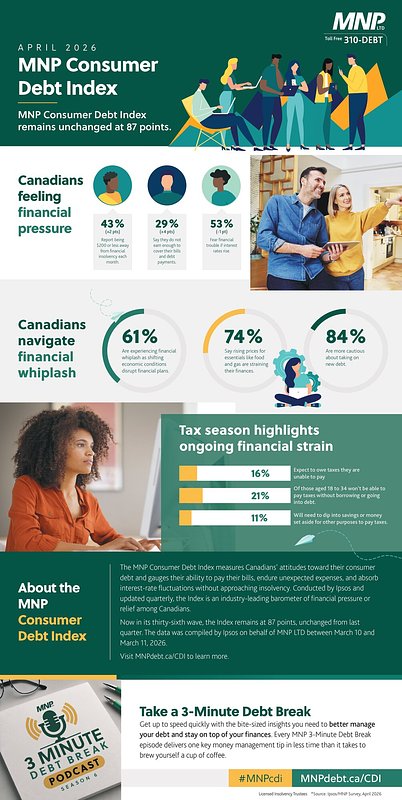
- 61% of Canadians report feeling financial whiplash from economic uncertainty.
- 43% of Canadians are $200 or less away from being unable to meet monthly obligations.
- 69% of Canadians are delaying major life decisions due to economic instability.
Experts warn that persistent financial volatility is pushing many Canadians to the brink of insolvency, with rising costs and interest rate anxiety exacerbating household financial strain.
Canada's 'Whiplash Economy': Millions Strained by Financial Volatility
CALGARY, AB – April 13, 2026 – A pervasive sense of ‘financial whiplash’ is gripping Canadian households as persistent economic uncertainty upends budgets and long-term plans. A staggering three in five Canadians (61%) report feeling the jarring effects of shifting economic conditions, according to the latest MNP Consumer Debt Index. The quarterly report, conducted by Ipsos, paints a stark picture of a nation under pressure, where rising costs for essentials are pushing families to their financial limits and fostering deep-seated caution.
This widespread volatility is forcing a dramatic retreat in household spending. Nearly three-quarters of Canadians (73%) are actively cutting back, while an even larger majority (84%) are now more cautious about taking on new debt. The feeling of running in place is palpable, with 64% of respondents stating they feel they are working harder financially but making no progress. This environment of unpredictability has stalled major life decisions for seven in ten Canadians (69%), who are delaying significant financial moves until the economic landscape feels more stable.
“Many Canadians are not just feeling financial pressure, they are navigating an environment that continues to shift, increasing uncertainty and making it more difficult to plan, budget, and stay ahead financially,” explains Grant Bazian, president of MNP LTD, the country’s largest insolvency firm. “Rising everyday costs and broader global uncertainty are outside of an individual’s control, creating a sense of ‘financial whiplash’.”
On the Brink of Insolvency
While the overall MNP Consumer Debt Index held steady at 87 points, mirroring a 'wait and see' approach from the public, this stability masks a deepening fragility in household finances. The report reveals that more than four in ten Canadians (43%) are just $200 or less away from being unable to meet their monthly financial obligations—a two-point increase from the last quarter. More alarmingly, nearly a third (29%) already do not earn enough to cover their bills and debt payments, a figure that has jumped four points.
These findings are corroborated by wider industry data showing a steady increase in consumer debt loads and delinquency rates. Reports from credit bureaus over the past year have consistently pointed to rising non-mortgage debt, while the Office of the Superintendent of Bankruptcy Canada has recorded a significant uptick in consumer insolvency filings. This suggests that the pressure identified in the MNP index is translating into a greater number of Canadians seeking formal debt relief.
Interest rate anxiety remains a key factor, even with the Bank of Canada recently holding its key rate at 2.25%. More than half of Canadians (53%) fear they will be in financial trouble if rates begin to rise again, and 42% are concerned that higher rates could push them towards bankruptcy. The capacity to absorb even minor increases is minimal; only one in five (20%) believe they could handle an extra $130 in monthly interest payments.
“Even with rates holding steady for now, many Canadians remain uneasy about what comes next,” says Bazian. “With uncertainty around the path of interest rates later this year, households already managing tight budgets may have limited capacity to absorb higher borrowing costs or even sustain them at current levels.”
An Uneven Burden Across the Country
The financial strain is not being felt equally across all demographics and regions. While the average amount Canadians have left at the end of the month has nominally risen to a new high of $1,000, these gains are not universally shared. Younger Canadians and those in middle-income brackets continue to show higher levels of vulnerability.
This disparity is particularly evident in how different groups are weathering the economic storm. Previous data has shown that women and Canadians aged 18 to 34 have less discretionary income and smaller emergency funds, making them more susceptible to financial shocks. The current report reinforces this trend, showing that younger Canadians are among the most likely to be struggling with their financial obligations.
Regionally, the sense of financial whiplash is also varied, with some provinces feeling the turbulence more acutely. In Ontario, for instance, nearly seven in ten residents reported experiencing the disruptive effects of economic volatility, the highest proportion in the country. This highlights how local economic conditions can exacerbate the national trend of financial unease.
Tax Season Exposes Deep Financial Cracks
This year's tax season is serving as a stark litmus test for the financial health of Canadian households. The MNP report found that one in six Canadians (16%) expect to owe taxes they are unable to pay. This is forcing difficult choices: 10% plan to delay their payment while they scramble for funds, and another 6% anticipate they will have to borrow money or go further into debt to settle their bill with the Canada Revenue Agency.
Younger Canadians are disproportionately affected. One in five individuals aged 18 to 34 (21%) report they cannot pay their expected tax bill, underscoring the acute financial pressure on this demographic. For many, a tax liability is not a minor inconvenience but a significant financial crisis that could trigger a cascade of further debt.
“Tax season can act as a real test of household finances,” Bazian notes. He explains that for those already stretched thin, an unexpected tax bill can be the tipping point. “For others, owing money may mean dipping into savings or taking on additional debt, which can add to longer-term financial pressure.”
Seeking a Path Through the Uncertainty
As Canadians grapple with an economy that feels increasingly unpredictable, the reliance on credit to cover daily expenses and obligations is a growing concern. Bazian warns that this can be an early sign that financial pressures are becoming unmanageable and that a deeper assessment of one's financial situation is needed.
“When things feel uncertain or out of your control, it can be overwhelming to know where to start,” says Bazian. “But when someone finds themselves relying more on credit or stretching their finances to keep up with expenses, it can be a helpful moment to pause and reassess.”
For those feeling trapped by debt, federally regulated Licensed Insolvency Trustees (LITs) offer a structured path forward. These professionals are legally required to review an individual's complete financial picture and explain all available debt relief options, from negotiating with creditors to formal solutions like consumer proposals or bankruptcy. This guidance is provided in a non-judgmental environment, aimed at providing clarity and creating a viable plan for financial recovery.
“For those who feel stuck or unsure, speaking with a Licensed Insolvency Trustee can provide clarity and reassurance,” Bazian adds. “These conversations are designed to help individuals understand their full financial picture...so they can explore their options and move forward with a plan that fits their situation.”