
- $1.16 billion: Loan from Canada Infrastructure Bank for the Contrecoeur container terminal.
- 1.15 million TEUs: Annual capacity increase, a 60% boost over current Port of Montreal throughput.
- 2030: Expected operational date for the terminal.
Experts view the Contrecoeur terminal as a strategic investment to enhance Canada's trade capacity, reduce U.S. export dependence, and strengthen global supply chain resilience, though environmental and financial risks remain contentious.
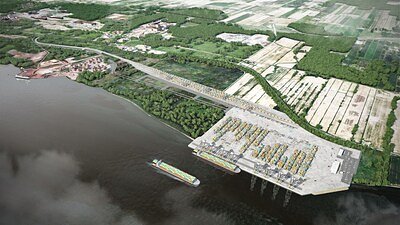
Canada's $1.16B Bet: Contrecoeur Port to Reshape Global Trade
CONTRECŒUR, QC – April 09, 2026 – A monumental step has been taken to reshape Canada's trade future as the Canada Infrastructure Bank (CIB) confirmed a historic $1.16 billion loan to the Montreal Port Authority (MPA) for its new Contrecoeur container terminal. The project, now moving forward, represents the largest port expansion on Canada's east coast and a cornerstone of the nation's strategy to bolster economic growth and supply chain independence.
Identified by the federal government as a project of national importance, the Contrecoeur terminal is designed to directly address long-term capacity constraints at the Port of Montreal. Once operational in 2030, it will add 1.15 million twenty-foot equivalent units (TEUs) of annual capacity—a staggering 60% increase over the port's current throughput. Construction of critical in-water works, including dredging and quay wall construction, has been underway since October 2025.
"Strengthening Canada's ports to expand trade and grow the economy is a core priority for the Canada Infrastructure Bank," said Ehren Cory, CEO of the CIB. "Our loan towards Contrecoeur supports a project of national importance... and will deliver lasting benefits for Canada's economy for decades to come."
A Strategic Gateway for a New Trade Era
The Contrecoeur expansion is more than just an infrastructure upgrade; it is a direct answer to Canada's ambitious national trade strategy. For years, the federal government has sought to reduce its economic dependence on the United States by doubling non-U.S. exports. The new terminal provides the physical capacity to realize that goal.
Strategically located 40 kilometres northeast of Montreal, the terminal will offer the shortest shipping route from North America's industrial heartland to key markets in Europe and the Mediterranean. This positions Montreal as a pivotal gateway for Canadian importers and exporters seeking to diversify beyond traditional trade partners. The project aligns perfectly with federal initiatives like the National Trade Corridors Fund, which aims to eliminate bottlenecks and enhance the flow of goods to international markets.
With the Port of Montreal's existing facilities operating near their functional limits, the expansion is seen as a critical, forward-looking investment. "Canada's trade future depends on infrastructure that is ready before demand arrives—not after," stated Nathalie Pilon, chair of the Montreal Port Authority. "The Contrecœur terminal is exactly that kind of forward-looking investment. It will anchor Montreal's role as a gateway to global markets."
Unpacking the Public-Private Blueprint
The project's financial architecture is a complex tapestry of public investment and private sector commitment. The CIB's $1.16 billion loan is the financial linchpin, designed to minimize the cost of capital and de-risk the project for other partners. It is complemented by a $130 million contribution from the Government of Quebec and $150 million from Transport Canada.
However, the model's defining feature is its reliance on private capital and user-generated revenue. According to the CIB, over 85% of the infrastructure costs will ultimately be borne by the private sector and the port's own autonomous revenues. This public-private partnership (PPP) framework is being positioned as a potential blueprint for future mega-projects across the country.
At the heart of the private-sector side is DP World, the global port operator in exclusive discussions to design, build, finance, operate, and maintain the land-based terminal for a 40-year period. While the public MPA will manage the marine-side construction, DP World will be responsible for the terminal, logistics infrastructure, and ship-loading equipment. This hybrid model leverages public oversight for key assets while harnessing private sector efficiency and capital for operations.
Balancing Progress and Preservation
The project's grand ambitions are matched by significant environmental hurdles. Located on a sensitive stretch of the St. Lawrence River, the expansion has drawn intense scrutiny from environmental groups and local communities. In response, the Impact Assessment Agency of Canada (IAAC) has imposed 388 legally binding conditions that the MPA must meet to proceed.
These conditions are extensive, addressing everything from air and water quality to the protection of at-risk species. A key focus is the mitigation of impact on the critical habitat of the copper redhorse, an endangered fish species found only in this part of Quebec. The MPA's plan includes creating new aquatic grass beds and protective breakwaters. Other measures involve constructing marshes to compensate for lost wetlands, building "bat condominiums" for vulnerable bat species, and implementing a major reforestation plan.
Despite these efforts, the project faces staunch opposition. Environmental organizations like SNAP Québec and the Quebec Environmental Law Centre have challenged the project in court, arguing that the mitigation measures are speculative and may not prevent irreversible harm, potentially violating Canada's Species at Risk Act. They have also questioned the project's economic projections, raising concerns that it could become a financial burden on taxpayers.
Economic Ripples and a Global Operator
Proponents of the terminal point to a wave of projected economic benefits, forecasting over $750 million in annual economic activity once the terminal is operational. This figure captures the impact of higher throughput on terminal operations, inland logistics, and warehousing. The construction phase is expected to generate thousands of jobs, while the operational terminal is projected to support over a thousand direct, permanent jobs and hundreds of thousands more across the national supply chain.
"By expanding capacity at the Port of Montréal, we are strengthening our supply chains, reducing congestion and ensuring Canadian businesses can compete, grow and prosper," said Hon. Steven MacKinnon, Minister of Transport.
The selection of DP World as the prospective operator brings a global heavyweight into the project. The Emirati-owned company operates over 60 terminals worldwide, handling roughly 10% of global container traffic. With a significant existing footprint in Canada—including terminals in Vancouver, Prince Rupert, and Saint John—DP World brings extensive operational expertise and a track record of deploying advanced technologies like automation and AI to boost efficiency.
While the company's history includes controversies, such as a 2006 U.S. port security debate and labor issues in the U.K., its global scale and technological prowess are seen as vital to ensuring Contrecoeur's success. Its commitment to sustainability, including a goal of net-zero emissions by 2050, aligns with the project's stated environmental ambitions, setting the stage for a new, technologically advanced, and strategically vital hub for Canadian commerce.
Topics & Related
Private Equity
AI & Machine Learning
Maritime & Shipping
ESG
Trade Wars & Tariffs
Automation
Corporate Finance
Related Company Pulse