
- 10 books shortlisted for the 2026 Canada Prizes, spanning critical topics like Indigenous resurgence, urban crises, and public discourse.
- 5 winners to be awarded $4,000 each, with at least 2 first-time authors and 1 French-language book guaranteed.
- $123.1 million in federal funding announced in 2024 for SSHRC Insight programs, supporting transformative research.
Experts view the 2026 Canada Prizes shortlist as a reflection of Canada's intellectual engagement with its most pressing societal challenges, emphasizing the vital role of humanities and social sciences in shaping national discourse and policy.
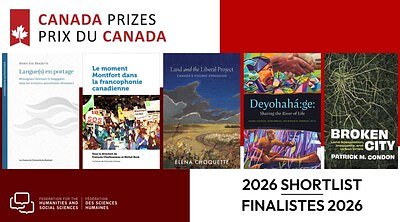
Canada Prizes Shortlist Reveals Nation's Intellectual Vanguard
OTTAWA, ON – March 27, 2026 – The Federation for the Humanities and Social Sciences today unveiled the shortlist for the 2026 Canada Prizes, highlighting ten scholarly books that delve into the nation's most pressing contemporary and historical issues. The announcement sets the stage for a celebration of Canadian intellectual achievement, with five winners to be chosen from a list that spans topics from Indigenous resurgence and colonial history to urban crises and the nature of public discourse.
The finalists, selected from works supported by the Federation's Scholarly Book Awards, represent the pinnacle of research in the humanities and social sciences. The winners will be revealed on June 10 at a 30th Anniversary Gala in Edmonton, a headline event of the Federation's "Big Thinking Summit: Inflection Point."
A Nation at a Crossroads
The theme of the upcoming summit, "Inflection Point," resonates deeply with the works shortlisted for this year's prizes. The ten books, authored in both English and French, collectively paint a picture of a country grappling with its past, navigating a complex present, and contemplating its future. The list demonstrates a clear trend toward scholarship that is not only academically rigorous but also deeply engaged with societal transformation.
Among the finalists, Éléna Choquette’s Land and the Liberal Project: Canada's Violent Expansion and Patrick M. Condon’s Broken City: Land Speculation, Inequality, and Urban Crisis both tackle the foundational and modern challenges of land and inequality. Choquette’s work promises a critical re-examination of Canada's historical expansion, while Condon's addresses the urgent crises facing contemporary cities.
The list also showcases powerful explorations of identity and culture. Paul db Watkins’ Soundin' Canaan: Black Canadian Poetry, Music, and Citizenship investigates the intersections of art and belonging, while Marie-Ève Bradette’s Langue(s) en portage focuses on the literary and linguistic resurgence in the writings of Indigenous women. These books, alongside Susie O'Brien's What the World Might Look Like: Decolonial Stories of Resilience and Refusal, underscore a commitment to amplifying voices and perspectives that are crucial to Canada’s ongoing process of reconciliation and decolonization.
The breadth of inquiry extends to the very fabric of communication and social interaction, with Stéphanie Nutting's Rumeur, potin et parole oiseuse dans le théâtre contemporain d'expression française examining gossip and rumor in contemporary theatre, and Dominique Garand’s Anthologie du pamphlet et de la polémique au Québec de 1800 à 2000 chronicling two centuries of polemical writing in Quebec.
Redefining Scholarly Excellence
This year's shortlist is the product of a newly revitalized awards program. Following a comprehensive review that began in 2021, the Federation relaunched the Canada Prizes in 2024 with a renewed structure and vision. The changes were designed to broaden recognition and embed principles of equity, diversity, inclusion, and decolonization (EDID) into the core of the awards.
Previously, the prizes consisted of two large awards. The new format features five prizes of $4,000 each, a move intended to celebrate a wider array of scholarly contributions. The structure now guarantees that at least two prizes are awarded to first-time authors, fostering new talent, while another is dedicated specifically to a French-language book, reinforcing Canada's linguistic duality.
Perhaps the most significant change is the creation of a single, unified Scholarly Book Awards Academic Council. This body replaces the former separate English and French juries, promoting a more cohesive and inclusive evaluation process that assesses works from across the country against a common standard of excellence defined by their "inspiring, impactful, and transformative" qualities. This evolution reflects a broader shift in academia towards interdisciplinary collaboration and a more holistic understanding of what constitutes groundbreaking research.
The Engine of National Inquiry
The journey of a book to the Canada Prizes shortlist begins long before the announcement. Each of the ten finalists was originally supported by the Federation's Scholarly Book Awards program, an initiative that provides crucial funding to help publish approximately 180 scholarly books each year. This program acts as a vital incubator for Canadian scholarship, ensuring that important research finds its way to publication.
This entire ecosystem of scholarly production and recognition is made possible through the foundational support of the Social Sciences and Humanities Research Council (SSHRC), Canada's federal funding agency for these disciplines. SSHRC's role extends far beyond the Canada Prizes; it is the primary engine driving research across the country through programs like Insight Grants, which fund long-term projects, and Partnership Grants, which foster collaboration between academics and community organizations.
The federal government’s investment through SSHRC, such as the $123.1 million in funding announced in 2024 for Insight programs, is instrumental. It allows scholars to undertake the deep, often multi-year investigations necessary to produce the kind of transformative books celebrated by the Canada Prizes. This sustained funding ensures that Canada maintains a vibrant research culture capable of addressing complex social, cultural, and political questions.
From Scholarship to Societal Impact
While the Canada Prizes celebrate academic achievement, their true significance lies in the connection between scholarly research and the public good. The shortlisted books are not destined to remain in the ivory tower; they are vital contributions to national conversations, capable of informing public policy, shaping cultural understanding, and arming citizens with the knowledge to navigate a world saturated with misinformation.
The "Big Thinking Summit" in Edmonton, where the winners will be announced, is designed to forge precisely these connections. With thematic streams like "Legitimacy at the Edge" and "Networks of Change," the summit explicitly calls on scholars to engage with policymakers and the public to tackle challenges to democracy and rebuild trust in knowledge.
Experts emphasize that the humanities and social sciences are indispensable partners to STEM fields, providing the critical context, ethical frameworks, and human understanding necessary to address multifaceted problems like climate change, public health, and social inequality. The skills fostered by HSS education—critical thinking, sophisticated communication, and adaptability—are increasingly recognized as essential for the modern workforce and for an engaged, resilient citizenry.
As the Canadian academic community and the public await the announcement on June 10, the 2026 Canada Prizes shortlist stands as a powerful testament to the vitality and relevance of the humanities and social sciences. The ten nominated books are more than just scholarly works; they are essential tools for understanding who we are, where we have been, and where we might be headed as a nation.