
- $75M Funding Round: Boston Metal secures $75M to scale green metals production, raising total capital to over $500M.
- 1 Ton of Molten Iron: First industrial-scale MOE cell produced over a ton of molten iron in March 2025.
- $70,000 per Ton: Critical metals like niobium sell for over $70,000 per ton, compared to $900 per ton for steel.
Experts view Boston Metal’s MOE technology as a breakthrough in decarbonizing heavy industry and securing critical metal supply chains, with strong potential to disrupt traditional metallurgy through scalable, cost-effective green production.
Boston Metal Secures $75M to Scale Critical Green Metals Production
WOBURN, MA – May 20, 2026 – Boston Metal, a technology firm aiming to overhaul the global metals industry, today announced it has closed a $75 million funding round, elevating its total capital raised to over $500 million. The infusion of capital, supported by new industrial investor Tata Steel Limited, is earmarked to accelerate the commercial deployment of its groundbreaking Molten Oxide Electrolysis (MOE) platform and expand the production of critical metals vital for the modern economy.
The financing underscores growing confidence in the company's ability to address two of the most pressing challenges in heavy industry: decarbonization and supply chain security. While the long-term vision is to produce zero-carbon “green steel,” this latest investment will focus on a more immediate and highly lucrative market: recovering high-value metals from industrial waste and low-grade ores.
A New Foundation for Metallurgy
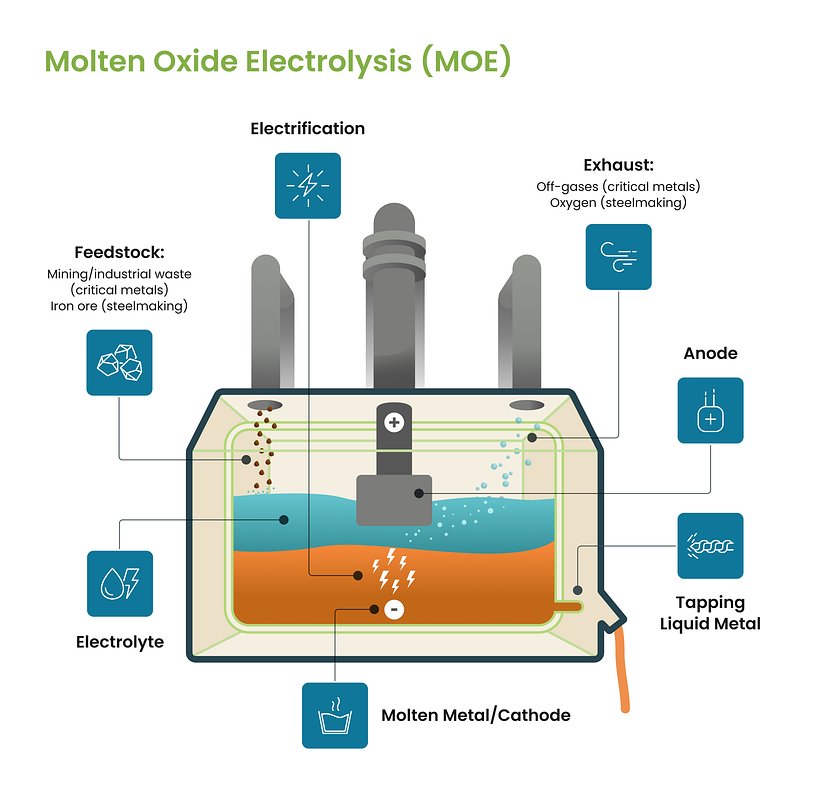
At the heart of Boston Metal’s strategy is its patented Molten Oxide Electrolysis technology, a platform spun out of MIT research in 2013. The process represents a fundamental departure from centuries-old, carbon-intensive smelting methods. MOE uses renewable electricity to process a wide range of metal oxides in a modular, school-bus-sized electrochemical cell operating at approximately 1600°C.
Inside the cell, a current passes through a molten oxide mixture, directly reducing the oxides into pure liquid metal. The only byproduct is pure oxygen, entirely eliminating the direct carbon dioxide emissions that make traditional steelmaking responsible for nearly 10% of the world's total. The key innovation enabling this process is a durable, inert anode capable of withstanding the extreme temperature and corrosive environment without dissolving—a materials science challenge that has stymied metallurgists for decades.
The technology’s readiness is no longer just theoretical. In March 2025, the company successfully commissioned its first industrial-scale MOE cell at its headquarters in Woburn, producing over a ton of molten iron and validating the scalability of its inert anode design. This followed the 2024 launch of its first commercial plant in Brazil, which focuses on extracting valuable metals from mining waste, generating early revenue while refining the technology.
“The world doesn’t just need more metals, it needs smarter, more adaptable ways to produce them,” noted Mark Cupta, Managing Director at Prelude Ventures, an existing investor. “MOE stands out for its flexibility as a true platform technology, capable of operating across multiple metal systems with a high degree of selectivity.”
Fortifying Critical Supply Chains
The new funding will directly scale Boston Metal’s critical metals business, targeting materials like niobium, tantalum, vanadium, and nickel. These metals are the bedrock of modern technology, essential for everything from the high-strength steel in bridges and the superalloys in jet engines to the capacitors in smartphones and the cathodes in electric vehicle batteries.
Global demand for these materials is surging, yet their supply chains are notoriously fragile and fraught with geopolitical risk. Niobium production is dominated by Brazil, while the supply of vanadium is concentrated in China and Russia. Tantalum has long been associated with ethical sourcing concerns in Central Africa. This concentration makes Western economies vulnerable to trade disputes and policy shifts, prompting governments to prioritize the onshoring of secure, reliable production.
Boston Metal’s MOE platform addresses this vulnerability head-on. By efficiently processing low-grade domestic ores and even industrial waste streams—materials conventional processes cannot economically handle—it unlocks entirely new resource pathways. This not only reduces reliance on foreign imports but also aligns with circular economy principles by turning environmental liabilities into valuable assets.
“Critical metals are the new strategic commodities,” said Tadeu Carneiro, CEO of Boston Metal. “MOE is creating a scalable and cost-effective pathway to recover critical, high-value metals, support industrial onshoring and strengthen the secure supply of critical materials needed for advanced technologies, manufacturing and AI.”
The Economic Equation of Green Metals
While the environmental and strategic benefits are clear, the economic viability of MOE is what has attracted over half a billion dollars in investment. The company’s two-pronged strategy—generating early revenue from high-margin critical metals to fund the scale-up of its green steel technology—is a pragmatic approach to disrupting a capital-intensive industry.
Critical metals like niobium can sell for over $70,000 per ton, compared to roughly $900 per ton for steel, making the economics of recovery from waste highly attractive. This provides a crucial financial bridge as the company works toward its goal of delivering cost-competitive green steel technology by 2028.
However, challenges remain. The MOE process is electricity-intensive, requiring approximately four megawatt-hours of energy per ton of steel. Its cost-effectiveness is therefore inextricably linked to the availability of abundant, low-cost renewable electricity. At favorable rates of $20 per megawatt-hour, the energy cost is a competitive $80 per ton of steel. But at higher prices, that cost can quickly become prohibitive, underscoring the parallel need for green energy infrastructure to support green industrial processes.
“The company has built a new metallurgical platform and demonstrated its ability to produce high-quality metals from complex feedstocks; now the focus is commercial production,” stated Rick Cutright, Technology Director at Climate Investment. “Critical metals are the right first market because the need is immediate, the economics are attractive and MOE can expand supply from materials that conventional processes leave behind.”
With this latest funding and strong backing from both climate-focused funds and industrial giants like Tata Steel, Boston Metal is poised to move from demonstration to commercial deployment, marking a pivotal step in the quest to forge a cleaner and more secure industrial future.