
- $100B: Brazil's credit card receivables market targeted by BlackOpal's GemStone product
- $200M: Anchor facility provided by Mars Capital Advisors for the initiative
- 70%: Portion of Brazilian credit card transactions structured into installment payments
Experts view BlackOpal's GemStone as a groundbreaking institutional-grade product that structurally mitigates credit risk in emerging markets, offering a secure and transparent way to access high-yield Brazilian credit card receivables through blockchain technology.
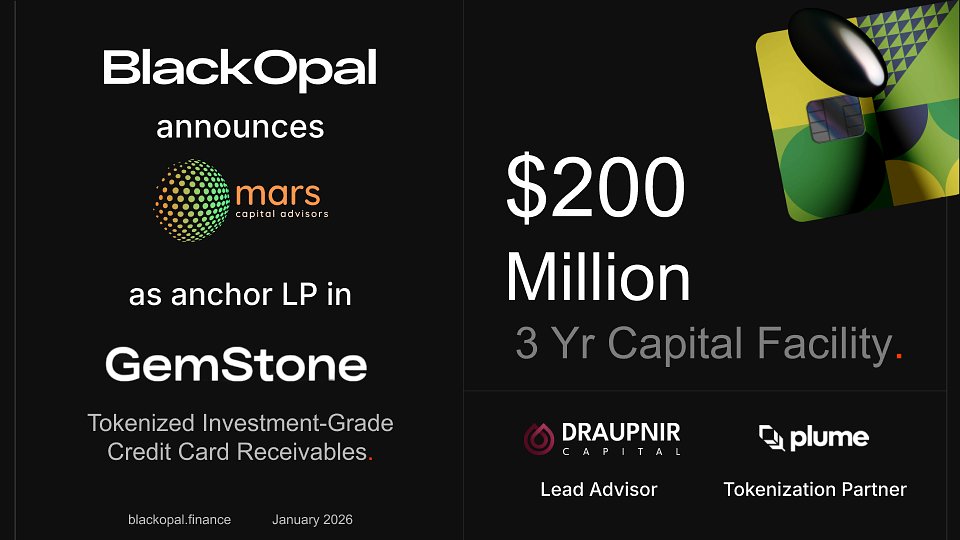
BlackOpal Unlocks Brazil's $100B Market with Tokenized Receivables
DELAWARE CITY, Del. – January 08, 2026 – In a significant move bridging traditional finance with blockchain technology, payments finance platform BlackOpal has launched a new institutional product, GemStone, backed by a $200 million anchor facility from Swiss asset manager Mars Capital Advisors. The initiative aims to tokenize a slice of Brazil's massive $100 billion credit card receivables market, offering global investors access to emerging market yields while attempting to structurally engineer out the associated credit risk.
The new product is deployed on Plume Network, a blockchain specializing in tokenizing Real-World Assets (RWAs), and represents one of the most substantial institutional pushes into on-chain private credit to date. The deal signals growing confidence from established financial players in using blockchain to unlock liquidity and create novel investment vehicles.
Engineering Risk Out of Emerging Markets
For decades, the high yields offered by emerging market assets have been a siren song for institutional investors, often tempered by the accompanying risks of currency fluctuations, regulatory instability, and, most critically, credit defaults. BlackOpal's GemStone product is designed to directly address this central challenge by fundamentally altering the risk equation.
The structure's innovation lies in its multi-layered approach to security. Instead of underwriting the creditworthiness of individual merchants, BlackOpal purchases the credit card receivables as a 'True Sale.' This legal mechanism ensures the assets are fully separated from the merchant's balance sheet, insulating investors from the originator's potential bankruptcy. Ownership is then immutably registered on Brazil's Central Bank C3 Registry, a sophisticated system that provides a verifiable, state-level record of title.
This registry is the lynchpin of the entire structure. It prevents the same receivable from being sold twice and provides a clear chain of ownership that is recognized by the Brazilian financial system. Collection is further de-risked by bypassing the merchant entirely. Payments are routed automatically from the card-issuing banks through the settlement infrastructure of payment giants Visa and Mastercard, flowing directly to the asset holder.
"GemStone represents a fundamental rethinking of emerging market credit," said Jason Dehni, CEO of BlackOpal, in a statement. "We don't underwrite merchants. We don't take credit risk. We purchase receivables as True Sale that settle through Visa and Mastercard payment rails, with ownership locked at the Central Bank level. The structure is designed so that collection is not a question of 'if' but 'when.' This is what institutional-grade emerging market yield should look like."
This methodology is not entirely new for the company. Its predecessor product, LiquidStone, reportedly delivered high risk-adjusted yields with zero defaults using an identical framework, providing a track record that likely proved crucial in securing the new institutional facility.
Brazil: A Unique Proving Ground for Financial Innovation
The selection of Brazil as the target market is no accident. The country's unique consumer behavior and advanced financial infrastructure have created a fertile ground for such an instrument. A deeply ingrained culture of paying in installments means that approximately 70% of all credit card transactions are structured into payment schedules of up to 12 months. This creates a predictable, large-scale demand for working capital from merchants who wish to receive their cash upfront, giving rise to a highly regulated and automated $100 billion receivables financing market.
While this market is sophisticated, it exists within a broader economy where consumer credit carries significant risk. Brazilian revolving credit card interest rates have soared above 400% annually, contributing to high levels of household indebtedness and default. However, BlackOpal's model is designed to be insulated from this direct consumer risk. Because the receivable itself—the promise of future payment backed by the card network's settlement process—is the asset, the structure is not dependent on the individual consumer's repayment behavior in the same way a traditional lender would be.
This combination of a massive, liquid asset class and a robust regulatory framework that supports secure, verifiable ownership transfer makes Brazil an ideal testbed. "BlackOpal has built exactly the kind of infrastructure we look for: real assets, real cash flows, and structural protections that eliminate traditional credit risk," commented Rick Pearson, CEO of Mars Capital Advisors. "Brazilian credit card receivables are a massive, liquid asset class that has been underserved by institutional capital. GemStone changes that."
A Milestone for Real-World Asset Tokenization
The transaction is being hailed as a landmark moment for the burgeoning Real-World Asset (RWA) sector, which seeks to bring tangible, off-chain assets like real estate, art, and private credit onto the blockchain. The involvement of Mars Capital, a firm with approximately $2 billion in assets under advisory, and Draupnir Capital, a strategic advisory firm focused on Web3 private credit, lends significant institutional credibility.
The technological backbone for the product is Plume Network, a Layer 2 blockchain built specifically for RWAs. Plume has focused heavily on institutional requirements, obtaining ISO certifications for information security and privacy management and reportedly becoming the first blockchain to secure a registration transfer agent qualification from the U.S. SEC. This focus on built-in compliance and security is critical for attracting risk-averse institutional capital to the on-chain world.
"Tokenization only matters when it's applied to assets worth owning," stated Teddy Pornprinya, Co-Founder and CBO of Plume. "GemStone is exactly what Real World Assets should be: institutional-grade yield, transparent structure, and global accessibility. BlackOpal is setting the standard for what tokenized credit products can achieve."
Boris Redfern, Head of Capital Markets of Draupnir Capital, which acted as Sole Lead Advisor, echoed this sentiment, noting that the structure transforms the investment proposition. “GemStone shows what happens when emerging market yields are engineered as well as underwritten,” he said. “By structurally mitigating credit risk, BlackOpal has created an investment-grade product that global allocators can scale into with confidence.”
With an asset capacity stated to exceed $1 billion, GemStone is positioned as a primary vehicle for institutions seeking to tap into this market. The successful launch and scaling of this facility could serve as a powerful blueprint for tokenizing other traditionally inaccessible asset classes, further blurring the lines between decentralized and traditional finance.