
- 156-mile-long: The Indian River Lagoon, a critical estuary, is suffering from severe degradation.
- $8 billion annually: The lagoon's economic value through fishing, recreation, and tourism.
- 4,000 species: The lagoon's biodiversity at risk due to environmental collapse.
Experts agree that the restoration of Bird Island demonstrates a successful model of nature-based engineering and public-private collaboration, offering a replicable blueprint for rescuing Florida's ailing coastal ecosystems.
Bird Island Reborn: A Model for Rescuing Florida's Ailing Coast
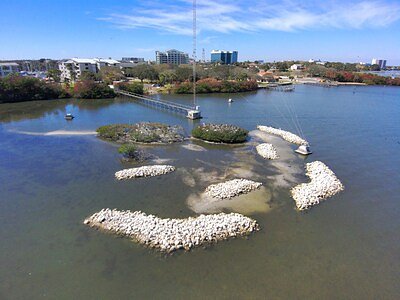
MELBOURNE, FL – March 04, 2026 – In a significant victory for one of North America’s most vital estuaries, the restoration of Bird Island in the Indian River Lagoon is now complete. The project, a collaboration between the Florida Fish and Wildlife Conservation Commission (FWC) and environmental firm BlueTerra, stands as a critical intervention to save a key bird sanctuary from being washed away and offers a powerful blueprint for battling the widespread environmental degradation threatening Florida's coastlines.
Engineered by WSP, the project fortifies the island against the persistent threats of erosion, storm surges, and rising water levels. For years, these forces have been chipping away at the small but crucial piece of land, jeopardizing its role as a safe nesting and roosting site for iconic species like brown pelicans, herons, and egrets. The successful restoration is more than just a construction project; it's a calculated effort to turn back the tide of ecological decline in a lagoon that is both a natural treasure and a system in crisis.
A Lagoon on Life Support
The Indian River Lagoon, a 156-mile-long estuary designated as an ecosystem of national significance, is in a state of profound distress. Valued at over $8 billion annually for its contribution to Florida's economy through fishing, recreation, and tourism, the lagoon has been suffering from decades of cumulative damage. Its waters have been choked by excess nutrients from agricultural runoff, aging septic systems, and urban stormwater, fueling devastating harmful algal blooms (HABs).
These blooms have created vast dead zones by blocking sunlight essential for the lagoon's seagrass meadows, which serve as the primary food source for manatees and a nursery for countless fish species. The resulting loss of seagrass has been catastrophic, contributing to unusual mortality events for manatees and disrupting the entire food web. The lagoon's floor, once sandy, is now coated in a thick layer of muck—a mixture of silt and decayed organic matter—that smothers bottom-dwelling life and further degrades water quality. This slow-moving environmental collapse has put the lagoon's immense biodiversity, which includes over 4,000 species, at severe risk.
Engineering a Natural Defense
Faced with the imminent loss of Bird Island, the restoration project deployed a suite of nature-based engineering solutions designed to work with the environment, not against it. The initiative represents a shift toward building resilient, living shorelines rather than relying on traditional hard structures like seawalls, which can often exacerbate erosion elsewhere.
"Our scope of work included the removal and reuse of damaged oyster walls around the island, dredging and reuse of fill material to enhance the shoreline's elevation, installing new oyster reefs comprised of limestone boulders and bedding stone, and planting large red mangrove trees behind the new reefs to enhance shoreline resiliency," explained Kevin Perry, BlueTerra's Director of Marine Construction.
The centerpiece of this strategy is the installation of new oyster reefs. Far from being simple piles of rock, these reefs are dynamic biological systems. Oysters are prodigious filter feeders, with a single adult capable of filtering up to 50 gallons of water per day. Collectively, the new reefs will act as a natural water purification system, removing excess nutrients and particulates that fuel algal blooms. Simultaneously, their complex, hard structure dissipates wave energy, providing a formidable natural breakwater that protects the newly rebuilt shoreline from erosion. These reefs also create critical, three-dimensional habitat for commercially and recreationally important species like crabs, shrimp, and juvenile fish.
To rebuild the island's lost elevation, the project carefully dredged material from the surrounding lagoon floor and repurposed it to heighten the landmass, ensuring it remains a viable high ground for nesting birds. Behind the protective oyster reefs, large red mangrove trees, donated by the Marine Resources Council which owns the land, were planted. The mangroves' dense, interlocking root systems will act as a living net, binding the soil and further stabilizing the shoreline while providing essential nursery habitat for marine life.
A Blueprint for Collaborative Conservation
The success of the Bird Island project highlights the power of public-private partnerships in tackling complex environmental challenges. The project brought together the regulatory and conservation oversight of the FWC, the specialized marine construction and ecological expertise of BlueTerra, the precision engineering of WSP, and the community-focused stewardship of the Marine Resources Council. This multi-stakeholder model is increasingly seen as essential for executing large-scale restoration in an era of limited public funds and complex logistical hurdles.
The project aligns perfectly with the FWC's broader statewide strategy to protect and restore critical habitats. The agency frequently leverages federal funding sources, such as the State Wildlife Grants Program and the Coastal Wetlands Act, to partner with private firms and non-profits to achieve its conservation goals. By entrusting the execution to a specialized company like BlueTerra, the state can ensure projects are completed efficiently and with the latest techniques in ecological engineering.
"This project represents a meaningful investment in the health of the lagoon and the protection of one of its important rookery islands," stated Caity Savoia, Biological Administrator for FWC's Aquatic Habitat Conservation & Restoration Section. Her comments underscore the project's direct contribution to the state's mandate to preserve Florida's natural heritage.
For BlueTerra, a company launched in 2025 with a mission to restore ecosystems and bolster coastal resilience, the Bird Island project serves as a flagship demonstration of its capabilities. It showcases a forward-thinking approach that integrates nature-based solutions to create synergistic benefits across habitats, improving water quality, protecting wildlife, and strengthening coastlines against climate change impacts.
While the restoration of a single island cannot solve the Indian River Lagoon's systemic problems overnight, it serves as a tangible and inspiring symbol of progress. The project provides a tested, effective, and replicable model for how targeted, science-based interventions can reclaim lost habitats and build resilience in a fragile ecosystem. For the pelicans, herons, and egrets that depend on Bird Island, this effort ensures they will have a safe harbor for generations to come, standing as a testament to what can be achieved when human ingenuity is dedicated to healing the natural world.