
- 81.8% of patients with moderate to severe tinnitus reported clinically significant symptom reduction after 12 weeks of Lenire treatment.
- 23.8-point average reduction on the Tinnitus Handicap Inventory (THI), surpassing the clinically significant threshold by over threefold.
- €40 million in financing secured by Neuromod Devices to support U.S. expansion and VA system integration.
Experts conclude that Lenire's bimodal neuromodulation technology offers a highly effective, replicable treatment for tinnitus, backed by robust clinical evidence and FDA approval, representing a significant advancement in the field.
Beyond the Ring: Lenire Builds Mountain of Evidence for Tinnitus Relief
NEW YORK, NY – February 17, 2026 – For the estimated 25 million American adults plagued by the persistent ringing, buzzing, or hissing of tinnitus, a growing body of evidence suggests a new technology is delivering consistent and significant relief. A second major real-world study, peer-reviewed and published in The American Journal of Audiology, has confirmed the effectiveness of Lenire, a novel medical device that combines sound with gentle tongue stimulation to soothe the phantom sounds of tinnitus.
The study, conducted at New York Hearing Doctors, found that 81.8% of patients with moderate to severe tinnitus reported a clinically significant reduction in their symptoms after 12 weeks of treatment. These results not only offer hope to a long-underserved patient population but also reinforce the device's performance outside the controlled confines of a clinical trial, demonstrating its replicability in everyday clinical practice.
A Growing Mountain of Evidence
The latest research, titled "Bimodal Neuromodulation for Tinnitus in a Clinical Practice Setting," analyzed the outcomes of 140 patients treated with Lenire between May 2023 and January 2024. The findings were striking: on average, patients experienced a 23.8-point reduction on the Tinnitus Handicap Inventory (THI), a standardized scale from 1 to 100 that measures the condition's impact. A reduction of just seven points is considered clinically significant, meaning the results surpassed this threshold more than threefold.
This data is not an anomaly. It closely mirrors the results of a prior real-world analysis published in Nature Communications Medicine, which showed a 91.5% success rate, and is consistent with the large-scale TENT-A3 clinical trial that paved the way for Lenire's U.S. Food and Drug Administration (FDA) approval in March 2023. The consistency across multiple studies is a crucial validator for any new medical technology, suggesting that the benefits are not a fluke but a predictable outcome of the therapy.
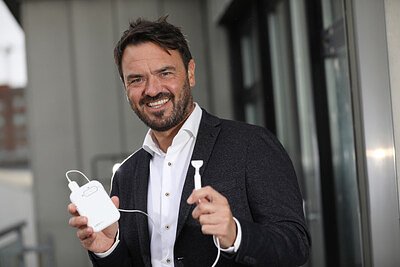
Lenire's technology is based on bimodal neuromodulation. Patients use wireless headphones that play a sequence of audio tones while a proprietary device, called the Tonguetip®, delivers mild, safe electrical pulses to the surface of the tongue. The theory is that this simultaneous stimulation of two different nerve pathways helps the brain "retrain" itself, reducing its focus on the phantom tinnitus sounds. The at-home treatment typically involves two 30-minute sessions per day for 12 weeks, managed under the care of an audiologist.
"New York Hearing Doctors stay on the cutting-edge of tinnitus care through the introduction of modern technologies like Lenire and leveraging research to consistently refine our treatment methodologies," said the study's author, Dr. Craig Kasper, founder of New York Hearing Doctors. "The combination of our personalized approach to tinnitus care and the remarkable effectiveness of Lenire, we are seeing life-changing treatment outcomes for our patients."
From Debilitating Noise to a Quieter Life
The clinical statistics translate into profound real-world benefits. Tinnitus is more than a minor annoyance; for many, it's a debilitating condition linked to anxiety, depression, and insomnia. It is also the single most prevalent service-connected disability among U.S. veterans, affecting millions who have served.
The study's findings showed that after 12 weeks of using Lenire, the majority of patients who started with moderate or worse tinnitus no longer fell into the "severely impacted" category. This shift represents a significant improvement in quality of life, a sentiment echoed by those who have undergone the treatment.
"Lenire was nothing less than a game-changer in my life," said Richard Bistrong, a patient treated at New York Hearing Doctors. "I went from debilitating, almost catastrophic tinnitus, that required medication to treat the depression and anxiety, to being able to enjoy life again after four months of Lenire. Three years later, I can enjoy my life and not worry about my tinnitus."
Access to this potentially life-changing treatment is expanding. Lenire is available through a growing network of specialized clinics across the U.S. and Europe. Crucially, it is also an approved treatment option through the U.S. Department of Veterans Affairs, providing a direct pathway to care for one of the most affected communities.
Reshaping the Tinnitus Treatment Landscape
For decades, the tinnitus treatment landscape has been dominated by management strategies like sound-masking devices and Cognitive Behavioral Therapy (CBT), which help patients cope with the sound rather than directly treating it. While valuable, they leave many searching for more direct relief. Lenire's arrival, backed by a unique regulatory status and robust funding, signals a potential paradigm shift.
The device received a De Novo grant from the FDA, a classification reserved for novel technologies without a pre-existing equivalent on the market. This is a more rigorous pathway than the more common 510(k) clearance and required extensive data from the TENT-A3 trial to prove both safety and effectiveness, specifically demonstrating its superiority over sound-only therapy. This FDA designation gives Neuromod Devices, the Irish company behind Lenire, a significant competitive advantage in the U.S. market.
Investors have taken notice. Neuromod has secured over €40 million in financing in recent years, including a €30 million round in April 2023 explicitly aimed at funding its U.S. launch and expansion into the VA system. This financial backing underscores confidence in the company's strategy to capture a significant share of the untapped tinnitus market.
"The consistency of the real-world outcomes...demonstrates the replicability and scalability of Lenire as a tinnitus treatment option for the over 740 million people worldwide living with tinnitus," stated Dr. Ross O'Neill, Neuromod's founder and CEO. "By working closely with our network of providers, we are seeing market-surpassing patient outcomes...positioning Lenire and bimodal neuromodulation as a leading tinnitus treatment option."
With a growing body of evidence, a unique FDA approval, and a clear strategy for market penetration, the technology is poised to move from a novel intervention to a potential standard of care, offering a new dimension of hope for millions seeking silence.