
- 21%: Global employee engagement rate, costing the economy $438 billion annually (Gallup 2025).
- 0%: Cost to employers for Chime Workplace, funded by merchant interchange fees.
- No-fee: Chime’s secured credit-building card helps employees improve credit without debt risk.
Experts agree that holistic financial wellness platforms like Chime Workplace are becoming essential for employers to address systemic financial stress, boost productivity, and reduce turnover.
Beyond the Paycheck: Employers Embrace All-in-One Financial Wellness
NEW YORK, NY – February 23, 2026 – By Brian Richardson
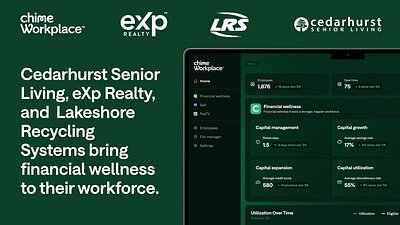
A significant shift is underway in the world of corporate benefits, as employers increasingly recognize that an employee's financial health is inextricably linked to their productivity, engagement, and loyalty. Fintech giant Chime is capitalizing on this trend, with its enterprise division, Chime Enterprise, announcing that Cedarhurst Senior Living, eXp Realty, and LRS (Lakeshore Recycling Systems) have adopted its comprehensive financial wellness suite, Chime Workplace. The move highlights a broader industry migration away from single-purpose perks like standalone earned wage access (EWA) toward holistic, no-cost platforms designed to tackle the root causes of financial stress.
These new partnerships, spanning the diverse sectors of senior care, real estate, and waste management, underscore a shared challenge: a modern workforce grappling with rising living costs and persistent financial anxiety. For businesses, the stakes are enormous. According to Gallup's 2025 'State of the Global Workplace' report, chronically low employee engagement—hovering at just 21%—is estimated to drain the global economy of $438 billion annually. This widespread disengagement is a clear signal of a workforce under strain, and companies are now treating employee financial wellness as a core business imperative.
A Strategic Shift from Perk to Platform
For years, Earned Wage Access was hailed as a revolutionary benefit, allowing employees to tap into their pay as they earned it. However, many employers are now concluding that EWA alone is a temporary fix for a systemic problem. The market is evolving, with forward-thinking organizations seeking integrated solutions that offer both immediate relief and tools for long-term financial stability.
"Earned wage access is an important first step, but on its own is no longer enough," said Jason Lee, Chief of Chime Enterprise. "Employers are moving beyond short-term fixes to holistic platforms that reduce financial stress and support productivity at scale. Chime Workplace gives enterprises a practical, scalable foundation to strengthen workforce readiness without added complexity or cost."
This sentiment is echoed by the companies implementing the platform. For Cedarhurst Senior Living, a St. Louis-based operator where staff reliability is paramount to resident care, the move was a strategic investment in their frontline teams. Allie Rapini, Director of Human Resources, noted the seamless transition from a previous EWA-only provider. "We recognized that comprehensive financial wellness tools can play an important role in strengthening retention and supporting employees through real-life financial needs," Rapini stated. "The transition...was seamless and efficient, allowing us to enhance our benefits offering without disrupting operations or the high standards of care our residents and families expect."
Similarly, LRS, a major Midwest recycling and waste services provider, identified a direct link between the financial health of its field-based workforce and operational safety. "We see the connection between employee financial health and overall well-being and safety," said Dr. Robert Rustman, Vice President of Human Resources at LRS. After evaluating several options, the company chose Chime's integrated approach. "Chime's comprehensive, fee-free approach stood out as the right solution for us at this time, offering practical support that meets the everyday financial needs of our workforce today and over the long term."
Empowering Employees with Foundational Tools
At the heart of Chime Workplace is a suite of integrated, fee-free financial tools designed to build a foundation for financial health. Unlike many EWA providers that may charge for instant transfers or use tipping models, Chime’s MyPay at Work offers on-demand pay access at no cost to the employee. This immediate liquidity is coupled with powerful tools for building long-term stability.
The platform includes a high-yield savings account, which requires a Chime Checking Account and boasts an APY significantly higher than the national average, encouraging employees to build an emergency fund. Perhaps most critically, it also features a secured credit-building card. This tool allows employees to build a positive payment history with all three major credit bureaus without the risk of accumulating interest or debt, a crucial feature for workers who may have thin or damaged credit files. Access to better credit can unlock more favorable rates on future loans, reducing long-term financial burdens.
For employers, the platform provides an administrative portal with anonymized, aggregated data on workforce financial health. This allows HR leaders to track engagement with the tools and measure improvements in key areas like savings growth and credit score trends, providing tangible proof of the program's impact on employee well-being.
Disrupting the Market with a 'No-Cost' Model
While the benefits for employees are clear, Chime Enterprise's most disruptive feature may be its business model. The company offers the Chime Workplace suite at no direct cost to employers. This approach removes a significant barrier to entry for businesses, especially those with large frontline workforces and tight budgets. Instead of charging a per-employee-per-month (PEPM) fee common among other benefits providers, Chime leverages the same merchant-funded model that powers its consumer business.
When an employee uses their Chime card for a purchase, Chime receives a small percentage of the transaction value, known as an interchange fee, from the merchant. Multiplied across millions of transactions, these fees generate the revenue needed to support the platform, effectively subsidizing the cost for both the employer and the employee. This model creates a powerful value proposition: employers can offer a robust, high-impact benefit that boosts retention and productivity without adding a new line item to their budget.
This strategy positions Chime Enterprise as a formidable competitor in the crowded HR technology space. While many vendors focus on a single niche—be it financial coaching, student loan repayment, or budgeting apps—Chime’s all-in-one, free-to-implement platform offers a compellingly simple solution to a complex problem. The adoption by companies as varied as Cedarhurst, eXp Realty, and LRS demonstrates that the need for foundational financial support transcends industry lines. This strategic pivot suggests that for a growing number of businesses, investing in their workforce's financial stability is no longer just a benefit—it is the bedrock of a resilient and productive enterprise.