
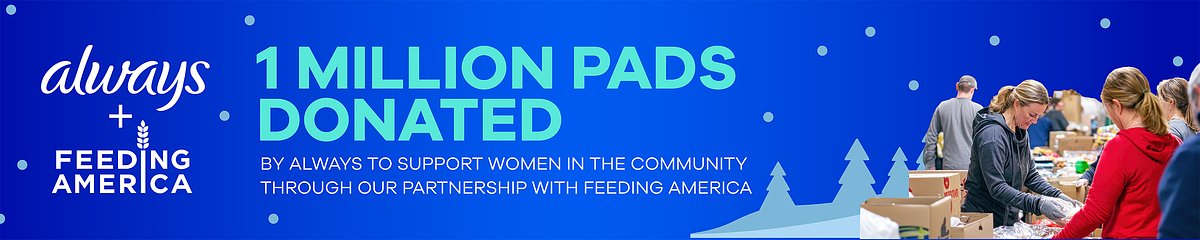
- 1 million period pads donated by Procter & Gamble’s Always brand to Feeding America
- Nearly two in five menstruating individuals struggle to afford period products in the U.S.
- One in five American girls has missed school due to lack of access to menstrual products
Experts would likely conclude that corporate logistics and nonprofit partnerships are creating a sustainable, scalable model to address period poverty, integrating essential hygiene products into existing supply chains to promote dignity and equity.
Beyond the Food Bank: How Corporate Logistics Are Tackling Period Poverty
CINCINNATI, OH – November 26, 2025 – As the holiday season approaches, Procter & Gamble’s Always brand announced a donation of one million period pads to Feeding America. While on the surface a straightforward act of corporate philanthropy, the initiative pulls back the curtain on a far more complex and strategic intersection of logistics, social equity, and the evolving role of corporations in addressing deep-seated community needs.
This partnership moves beyond simple charity, showcasing an innovative model where corporate supply chains and non-profit distribution networks merge to tackle a pervasive but often invisible crisis: period poverty. For the millions of Americans making impossible choices between buying food and essential hygiene products, this collaboration represents a critical lifeline.
The Hidden Tax on Dignity
Period poverty—the lack of access to menstrual products, education, and sanitation—is a significant public health issue in the United States. Recent studies paint a stark picture: nearly two in five menstruating individuals struggle to afford period products. This isn't a niche problem; it's a systemic barrier affecting health, education, and economic stability. Statistics reveal that one in five American girls has missed school or left early due to a lack of access to pads or tampons, creating educational disparities that can have lifelong consequences.
The problem is exacerbated by economic policy. Menstrual products are not covered by supplemental nutrition programs like SNAP and are still subject to sales tax in many states—a levy often dubbed the “tampon tax.” For families already navigating financial precarity, a situation amplified during the holidays by rising utility costs and seasonal expenses, these essential items become an unaffordable luxury. The result is that period products are consistently among the most requested non-food items at food banks nationwide.
The consequences extend beyond physical health risks, such as infections from using unsafe alternatives like rags or paper towels. Research has strongly correlated period poverty with increased rates of depression and anxiety. The inability to manage menstruation with dignity directly impacts an individual's confidence and ability to participate fully in school, work, and society.
From PR to Persistent Strategy
In an era of heightened consumer scrutiny, a one-off donation can easily be dismissed as a public relations maneuver. However, P&G’s commitment appears to be part of a larger, sustained strategy. The partnership between Always and Feeding America began in 2018, and since then, the brand has donated tens of millions of products through its #EndPeriodPoverty initiative.
“For more than 40 years, Always has stood beside generations of girls and women, championing their confidence and well-being,” said Balaka Niyazee, senior vice president of North America feminine care at Procter & Gamble. “This holiday donation through the Feeding America network will reach households across the country, including communities where access to these essentials is most limited, underscoring our continued dedication to supporting girls and women nationwide.”
This long-term approach reflects a broader trend in the new economy where corporate social responsibility (CSR) is becoming deeply integrated into brand identity and business strategy. It’s a recognition that sustainable growth is tied to the health of the communities a company serves. Other industry players have adopted similar models; U by Kotex, for example, is a founding partner of the Alliance for Period Supplies, which has also distributed tens of millions of products. This industry-wide movement signals a shift from reactive giving to proactive, strategic investment in social equity.
Innovating the Humanitarian Supply Chain
The most compelling innovation in this story may be logistical. Feeding America, an organization built to combat hunger, has evolved its operational mandate. Its sprawling network—comprising 200 food banks and 60,000 local pantries and meal programs—was designed to move perishable and non-perishable food efficiently. Now, that same infrastructure is being leveraged to distribute other essentials, transforming food banks into holistic community resource hubs.
“At a time when many families are facing uncertainty and managing tough choices such as balancing food with other essentials, we are grateful for long-standing partners like Always who understand that prioritizing dignity and increasing access to resources is critical to supporting overall health and wellbeing,” noted Lauren Biedron, Senior Vice President of Corporate Partnerships at Feeding America.
This evolution is a powerful example of strategic adaptation. By integrating non-food items like menstrual products, diapers, and other hygiene goods into their distribution channels, organizations like Feeding America are addressing the interconnected nature of poverty. A family that cannot afford food is also unlikely to be able to afford tampons or soap. By providing these items together, the partnership removes the need for individuals to make impossible choices and offers a more comprehensive form of support.
This model provides a blueprint for the future of corporate-nonprofit collaboration. It demonstrates how a company’s core competency—in P&G’s case, manufacturing and supply chain management—can be paired with a nonprofit’s deep community reach and distribution expertise. The result is a highly efficient system for social good that delivers not just products, but also the dignity, health, and opportunity necessary for individuals to thrive.