
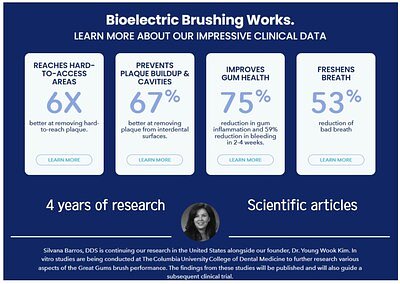
- 6x more effective: Removes plaque six times more effectively in hard-to-reach areas
- 53% reduction in halitosis: Claims to reduce bad breath by 53%
- 75% improvement in gum inflammation: Studies show a 75% improvement in gingival inflammation indices
Experts view the bioelectric toothbrush as a promising innovation with strong clinical evidence supporting its effectiveness in plaque removal and gum health, particularly in hard-to-reach areas.
Beyond the Bristles: Microcurrent Toothbrush Aims to Reset Oral Care
SAN FRANCISCO, CA – December 29, 2025 – In a market saturated with vibrating heads and oscillating bristles, a San Francisco-based startup is introducing a fundamentally different approach to dental hygiene. Great Gums Inc. has officially launched its bioelectric toothbrush in the United States, a device that eschews brute force for a gentle, invisible force: microcurrents. The company claims its technology can remove plaque six times more effectively in hard-to-reach areas and significantly improve gum health, potentially disrupting a multi-billion dollar industry that has long relied on mechanical scrubbing.
The announcement positions the device as a solution to the persistent problem of inadequate plaque removal, a primary factor in oral diseases that the World Health Organization estimates affect 3.5 billion people globally. While sonic and electric toothbrushes have offered improvements over manual brushing, Great Gums argues that their core limitation remains a reliance on physical contact. Their bioelectric toothbrush, now available to U.S. consumers, promises to clean where bristles can't reach.
A Shock to the System: The Science of Bioelectric Brushing
At the heart of the Great Gums toothbrush is a technology that feels more at home in a medical lab than a bathroom cabinet. Instead of simply scrubbing surfaces, the device generates a safe, imperceptible electromagnetic field around the bristles. This field delivers an astonishing 10 million waves of microcurrents per second, creating an environment that actively disrupts and detaches the sticky biofilm of plaque from the tooth's surface.
This foundational technology is the culmination of years of research, originating in the doctoral work of Dr. Young Wook Kim at the University of Maryland. Dr. Kim, a specialist in biofilm treatment systems and co-founder of Great Gums Inc., focused on using bioelectric effects to solve oral health challenges. The principle is rooted in the broader field of microcurrent therapy, a non-invasive treatment used in medicine to promote tissue repair and reduce inflammation by using low-level electrical currents that mimic the body's own natural signals.
"Bioelectric technology provides gentle yet effective plaque removal, particularly in gum-sensitive areas," said Dr. Kim in the company's press release. "Our research suggests that microcurrent-based cleaning can address oral health challenges that traditional mechanical brushing cannot solve."
By operating at a subsensory level, the microcurrents work without causing any sensation to the user. The company states this method is particularly effective for those with sensitive gums or complex dental work, such as braces, implants, and bridges, where nooks and crannies provide a haven for plaque buildup that bristles often miss. The technology also claims to combat bad breath by more effectively removing the anaerobic bacteria responsible for producing odor-causing compounds, with studies pointing to a 53% reduction in halitosis.
Scrutinizing the Science: From Lab Bench to Bathroom Sink
Bold claims in the health and wellness space demand rigorous scientific validation. Great Gums Inc. bases its assertions on a foundation of peer-reviewed research, developed in partnership with prestigious institutions including the Columbia University College of Dental Medicine and Yonsei University College of Dentistry in Korea.
One key study, published in the journal Bioengineering in October 2023, investigated the biofilm removal efficacy of a bioelectric toothbrush. The research found that the device demonstrated "significantly higher" efficiency in removing oral biofilm compared to a standard manual toothbrush, showing between 104% and 215% greater effectiveness depending on testing conditions. The authors concluded that the bioelectric effect represents a "novel solution for plaque issues."
Another crucial, examiner-blind clinical trial published in the International Journal of Environmental Research and Public Health in 2021 provides further nuance. The study, which involved 40 volunteers with gingivitis, evaluated a microcurrent toothbrush using similar technology. While it found no statistically significant difference in the overall plaque index reduction compared to a control brush, it did uncover a significant benefit in a critical area: the spaces between the teeth. The trial reported a marked decrease in the gingival index (a measure of gum inflammation) on these hard-to-reach interproximal surfaces. This supports the company's core claim of superior cleaning in difficult areas, with researchers concluding the technology can be safely used to reduce gingivitis. The same studies reported a 75% improvement in gingival inflammation indices following regular use.
This body of research, spearheaded by Dr. Kim, who holds over 160 patents related to the technology, forms the scientific backbone of the company's market entry. By publishing in peer-reviewed journals, the company is attempting to distinguish its product from a long line of oral care gadgets that have relied more on marketing buzz than on clinical evidence.
A Startup's Gambit: Challenging the Oral Care Goliaths
With its U.S. launch, Great Gums Inc. is stepping into an arena dominated by giants like Philips and Procter & Gamble's Oral-B. Co-founded by digital health veteran Mark Goldstein and technologist Dr. Kim, the startup is pursuing a classic disruption strategy: introducing a novel technology that redefines the problem. Instead of a better motor, they’re offering a different mechanism of action altogether.
The company is not entering the U.S. market untested. The bioelectric toothbrush has already seen significant success in South Korea, a market known for its tech-savvy consumers and high standards for personal care products. Since 2020, over 600,000 units have been sold there, generating more than 20,000 online reviews and allowing the company to refine the product through 12 iterations to enhance performance and reduce cost.
"Our success in Asia has demonstrated strong market demand for effective oral health solutions," said Young Wook Kim, co-founder of Great Gums Inc. "We are confident that U.S consumers here will respond to our scientifically validated approach without relying on increased physical force."
Further bolstering its disruptive potential is its accessible price point. The "Great Gums One" model is available for under $30, placing it in direct competition with mid-range electric toothbrushes and premium manual brushes, rather than positioning it as a high-end luxury item. This pricing aligns with the company's ambitious vision of embedding its bioelectric technology into all toothbrushes by 2027.
As the product becomes available directly to consumers through the company's website, its real-world performance will be put to the test. The journey from promising clinical trials and successful overseas launches to widespread adoption in the competitive American market will ultimately determine if this bioelectric buzz represents a true paradigm shift in how people care for their teeth.