
- Regulatory Gray Area: The FDA lacks a formal definition for 'functional food' or 'functional beverage', leading to misclassification risks. - Certification Gap: Many functional teas are manufactured without the rigorous certifications required for dietary supplements, posing safety and compliance risks. - Market Shift: Brands are increasingly prioritizing certified manufacturing as a competitive advantage, with certifications like SQF Level 2 becoming key differentiators.
Experts emphasize that the lack of clear regulatory definitions and proper certifications in the functional tea market poses significant risks to consumer safety and brand integrity, urging stricter compliance to ensure product efficacy and trust.
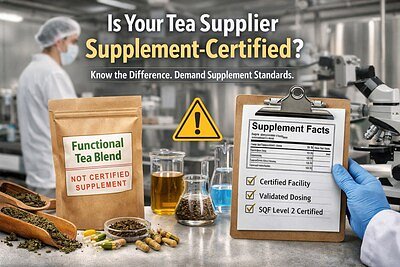
Beyond the Brew: The Certification Crisis in Functional Tea
POUGHKEEPSIE, N.Y. – March 31, 2026 – As consumers increasingly reach for teas infused with everything from stress-busting adaptogens to immunity-boosting vitamins, a critical question is brewing beneath the surface of the booming functional beverage market: Are these products what they claim to be? A growing number of industry experts and regulators are sounding the alarm over a significant compliance gap, where products marketed as 'functional' are being manufactured without the rigorous certifications required for dietary supplements, posing potential risks to consumers and brands alike.
One of the companies raising this concern is Caraway Tea Company, a Poughkeepsie-based manufacturer. In a recent announcement, the company urged brands to look closer at their supply chains, highlighting a widespread assumption that simply adding a functional ingredient is enough to enter the wellness space. The reality, however, is far more complex and governed by strict regulatory frameworks.
"Not all functional teas are created equal," said Gina Caraway, CEO of Caraway Tea Company. "There's a significant difference between a product that contains added ingredients and one that is manufactured under certified supplement standards. That distinction matters for safety, compliance, and brand integrity."
The Blurring Line Between Beverage and Supplement
The core of the issue lies in a regulatory gray area. The U.S. Food and Drug Administration (FDA) does not have a formal legal definition for "functional food" or "functional beverage." Instead, products fall into one of two primary categories: "conventional foods" or "dietary supplements." A conventional beverage is consumed for taste, aroma, or hydration and displays a "Nutrition Facts" panel. A dietary supplement, however, is intended to supplement the diet, contains specific dietary ingredients, and must feature a "Supplement Facts" panel.
The distinction is critical because the manufacturing and labeling requirements for each are vastly different. Dietary supplements must be produced according to Current Good Manufacturing Practices (cGMPs) that ensure identity, purity, strength, and composition. This includes validating that the amount of an active ingredient, like vitamin C or ashwagandha, listed on the label is consistently present in every serving.
According to FDA guidance published in 2014, a product's classification hinges on its "intended use," which is determined by its name, packaging, marketing claims, and even serving size. Simply adding a vitamin to a product widely seen as a beverage doesn't automatically make it a dietary supplement, especially if it's marketed to quench thirst. This ambiguity has led to what some industry insiders describe as a "Wild West" environment, where brands may inadvertently or intentionally misclassify their products, leading to a host of potential problems.
The Unseen Risks of Uncertified Manufacturing
When a functional tea containing active ingredients is produced in a facility that is not certified for supplement manufacturing, it introduces significant risks. Without the stringent protocols of a supplement-certified facility, brands may face several critical issues.
First is the inability to legally use a "Supplement Facts" panel. This panel is the consumer's primary tool for understanding the dosage of active ingredients. Without it, claims of a product's functional benefits become difficult to substantiate. Furthermore, the lack of validated dosing processes means the amount of an ingredient can vary wildly from one batch to the next, or even from one tea bag to another. A consumer might be getting far less of an ingredient than promised, rendering the product ineffective, or potentially more, which could pose safety concerns.
Insufficient quality control and traceability systems are another major hazard. Certified supplement manufacturers are required to maintain comprehensive records that trace every raw material from its source to the finished product on the shelf. This ensures that if a problem arises, such as contamination or an incorrect ingredient, a swift and targeted recall can be executed. In an uncertified environment, this level of control and accountability is often absent, leaving both the brand and the consumer exposed.
Compliance as a Competitive Edge
As regulatory scrutiny from the FDA and major retailers intensifies, brands are discovering that robust compliance is more than a legal hurdle—it's a powerful strategic advantage. Choosing a manufacturing partner with the right credentials is fast becoming a key differentiator in a crowded marketplace.
"Brands are investing heavily in innovation and marketing, but manufacturing is where trust is truly built," Caraway added. "Choosing a certified supplement partner isn't just a technical decision - it's a strategic one."
Certifications like the SQF (Safe Quality Food) Level 2, Code 31 for Dietary Supplements, which Caraway Tea Company holds, are globally recognized benchmarks that signal a manufacturer's commitment to the highest standards of safety and quality. For brands, partnering with such a facility de-risks their business. It ensures their products are compliant, their claims are defensible, and they meet the increasingly stringent vendor requirements of major retail channels like Whole Foods, Target, and e-commerce giants like Amazon, which are actively working to protect their customers and reputations.
By prioritizing certified manufacturing, brands can build a foundation of trust with consumers who are becoming more educated and discerning about the wellness products they purchase. This focus on quality and transparency can translate directly into stronger brand loyalty and a more sustainable position in the market.
A Market Maturing Beyond the Hype
The push for greater transparency and certification signals a broader maturation of the functional wellness industry. The initial gold rush, characterized by explosive growth and bold marketing claims, is giving way to a new era defined by scientific rigor, accountability, and consumer safety. The ongoing public discussions held by the FDA concerning the definition and regulation of dietary ingredients are a clear indicator of this evolving landscape.
Companies at the forefront of this shift are adopting more sophisticated production models. Caraway Tea Company’s "Leaf-to-Lab" approach, for example, combines traditional botanical expertise with the scientific precision of supplement manufacturing. This integrated method ensures that active ingredients can be successfully incorporated into complex formats like tea while maintaining consistency, efficacy, and full regulatory compliance.
Ultimately, the conversation being elevated by industry leaders is not about stifling innovation but about ensuring its integrity. As the demand for products that genuinely support health and well-being continues to grow, the brands that thrive will be those that prove their commitment to quality from the source to the shelf, ensuring that what's promised on the box is precisely what's delivered in the cup.