
- 90% accuracy: Fifth Third's AI correctly identifies customer intent 90% of the time.
- 2.4 million users: The AI serves over 2.4 million monthly users.
- 1 billion interactions: The system handles more than a billion interactions annually.
Experts would likely conclude that Fifth Third's AI-powered conversational banking represents a significant step toward redefining user interaction with financial institutions, balancing innovation with the critical need for security and trust.
Beyond the App: Fifth Third’s AI Signals a New Era of Conversational Banking
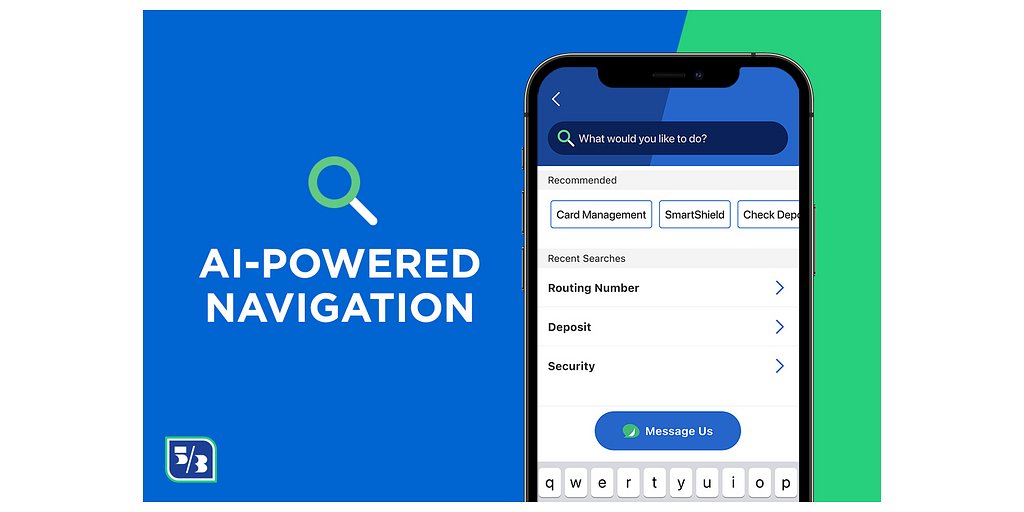
CINCINNATI, OH – June 17, 2026 – For most of us, mobile banking is a quiet, transactional affair: a series of taps, swipes, and scrolls through static menus to check a balance or pay a bill. Fifth Third Bank, however, is betting that the future of banking sounds less like a tap and more like a conversation. The financial institution today announced the launch of an AI-powered interface within its mobile app, designed to let customers navigate their finances using their own words.
This move by the 168-year-old bank, which recently became the nation's ninth-largest following its merger with Comerica, is more than just a slick feature update. It represents a deliberate step toward fundamentally changing the user interface of banking itself. By allowing customers to type simple commands like “replace card” or “find the closest branch,” the bank aims to dismantle the rigid structure of traditional app navigation and replace it with a dynamic, intuitive dialogue. It’s a development that challenges us to consider not just how we manage our money, but how we relate to the institutions that hold it.
From Taps to Talk: Redefining the Banking Interface
At its core, the new capability is a sophisticated search and command function. Powered by advanced language understanding models, it interprets a customer’s typed request and guides them directly to the correct screen or function. The system is an evolution of Jeanie®, the bank’s existing AI chatbot, which has been quietly learning from millions of customer interactions since its launch in 2020. The bank reports that Jeanie® now correctly identifies customer intent 90% of the time—a testament to the deep learning that underpins this new, more ambitious interface.
“AI is a powerful tool, but in banking it has to be applied with discipline because customers rightly expect speed, accuracy and reliability every time,” said Ben Hoffman, chief strategy officer and head of consumer products at Fifth Third. “This is the first step toward changing the interface of banking itself — from static screens and taps to customers using their own words.”
The goal is to create a more fluid and efficient experience. Instead of a customer hunting through menus to find the page for disputing a charge, they can simply type “dispute a transaction” and be taken there instantly. This integration of natural language processing directly into the app’s framework is what separates it from many standalone chatbots. It’s not an add-on; it’s a new layer of navigation woven into the existing digital infrastructure that serves over 2.4 million monthly users and handles more than a billion interactions annually.
The Human Element in a Digital-First World
While the technology is complex, the stated goal is simplicity. In a world saturated with digital demands, the promise of making a necessary chore like banking “fade into the background” is compelling. Fifth Third’s focus on user experience is not new; the bank rolled out over 400 enhancements to its mobile app in 2025 and was recognized by J.D. Power for offering the top mobile banking app among regional banks that same year. This new AI layer is built upon that award-winning foundation.
For the average person, the immediate benefit is the reduction of friction. Finding an ATM, transferring funds between accounts, or locking a misplaced card becomes a matter of a few typed words rather than a multi-step process. This streamlined interaction is particularly crucial as banking apps become increasingly feature-rich and, consequently, more complex to navigate. By putting a conversational layer on top, the bank hopes to make its growing set of capabilities more accessible to everyone, regardless of their technical proficiency.
This focus on a seamless experience reflects a broader strategic understanding: in modern finance, the quality of the digital front door is as important as the soundness of the vault. The bank's success hinges not just on its financial products but on its ability to integrate them smoothly into the daily lives of its customers.
The High Stakes of AI: Navigating Privacy, Security, and Trust
The engine driving this convenience is data—specifically, “hundreds of millions of customer interactions” that have trained the AI models. This fact inevitably raises important questions about privacy and security, the bedrock of any banking relationship. As financial institutions embrace AI, they enter a new frontier of responsibility, where the systems that provide convenience must also guarantee protection.
Fifth Third leadership emphasizes that “safety and soundness are paramount” in their approach to AI. The institution has reportedly been proactive in addressing the novel risks associated with advanced AI, with its internal teams filing patents on technologies designed to prevent common AI pitfalls like “hallucinations” (when an AI generates false information) and to protect against malicious actors attempting to “jailbreak” the system. This reflects a growing awareness across the industry that deploying AI requires building new kinds of digital guardrails.
Further demonstrating this commitment, the bank recently joined Project Glasswing, a cybersecurity consortium led by the AI safety and research company Anthropic. This gives Fifth Third access to cutting-edge AI models specifically designed to identify security vulnerabilities in software code. Such proactive security measures are becoming non-negotiable as AI systems become more deeply embedded in critical infrastructure, handling sensitive personal and financial data. The challenge for the entire sector lies in balancing rapid innovation with the unwavering trust that customers place in their banks.
The Dawn of 'Agentic Banking' and What Comes Next
Perhaps the most significant aspect of this launch is what it signals for the future. Hoffman describes the new interface as a “foundation for future agentic experiences where customers can ask the bank to take action, and the bank can complete that action safely, securely and reliably.”
This concept of “agentic banking” represents a paradigm shift. It envisions an AI that doesn’t just guide you to the right screen but acts as a true digital agent, capable of understanding a complex request and executing the necessary tasks on your behalf. This aligns with broader industry forecasts, which predict that AI agents will soon handle a significant portion of customer interactions, moving from simple queries to proactive financial management.
Fifth Third’s roadmap includes expanding these AI capabilities into more complex areas like account opening, fraud resolution, and even personalized financial advice. Each interaction with the new interface is another data point, refining the bank's understanding of customer needs and paving the way for an AI that can anticipate needs and act on them. This evolution from a reactive tool to a proactive partner could one day transform the fundamental relationship between individuals and their financial institutions, creating a system that is not only easier to use but deeply integrated into our financial well-being.