
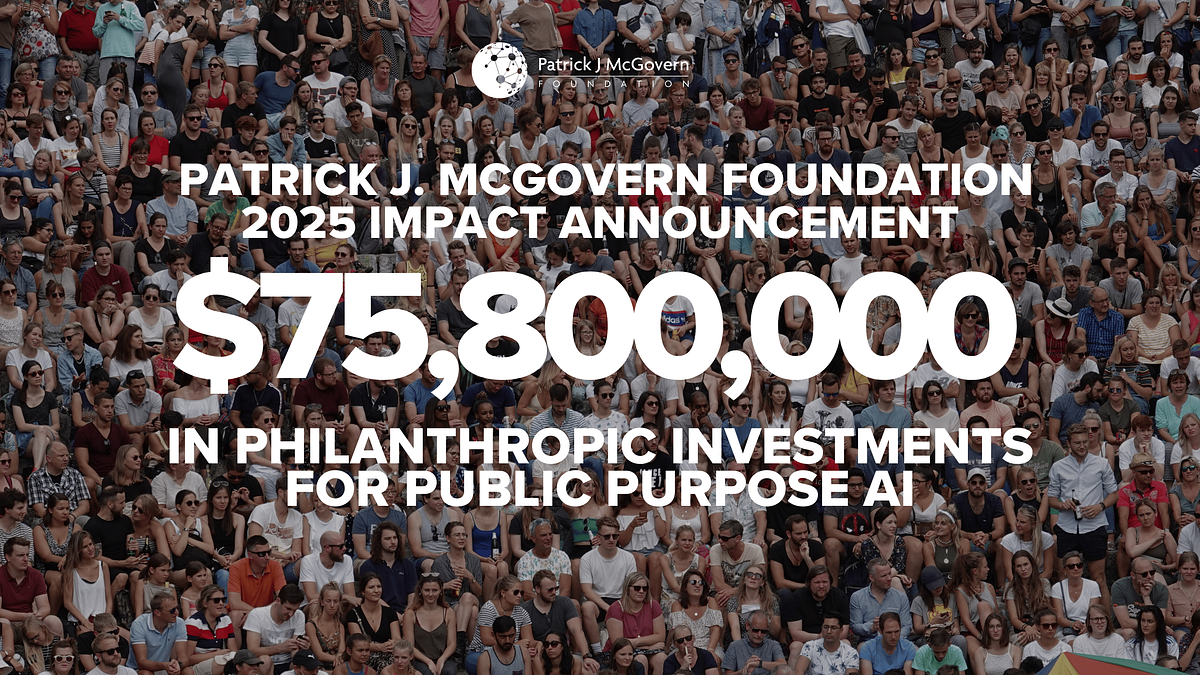
- $75.8 million: The Patrick J. McGovern Foundation's commitment across 149 grants to advance AI for public good.
- 13 countries: The global reach of the funding, targeting areas like climate resilience, health equity, and human rights.
- $500 million: The foundation's total investment in public-purpose AI over the past decade.
Experts agree that this initiative is crucial for ensuring AI serves humanity by fostering equitable, community-driven development and mitigating risks like bias and misinformation.
Beyond the AI Race: A $75.8M Bet on AI for Public Good
BOSTON, MA – December 16, 2025 – While governments and corporations engage in a high-stakes “global AI race,” the Patrick J. McGovern Foundation (PJMF) is making a monumental bet on a different kind of competition: the race to ensure artificial intelligence serves humanity. The foundation today announced a $75.8 million commitment distributed across 149 grants, a strategic push to build the civic and public infrastructure needed to guide AI’s development toward equity and human well-being.
The funding supports a diverse array of organizations in 13 countries, targeting critical areas such as climate resilience, health equity, human rights, and independent journalism. This investment moves beyond simply funding technology, aiming instead to empower the communities, newsrooms, clinics, and classrooms that will ultimately determine whether AI concentrates power or expands human agency.
“Innovation does not end when a technology is created. It continues through the choices societies make about how those advances are governed and used in the real world,” said Vilas Dhar, President of the Patrick J. McGovern Foundation, in a statement. “This 2025 commitment reflects our conviction that communities are not downstream consumers of innovation; we are co-creators of how technology shapes everyday life.”
A New Philanthropic Blueprint
This $75.8 million commitment, part of a $500 million investment in public-purpose AI over the past decade, signals a shift in modern philanthropy. Instead of acting as a passive checkbook, PJMF is taking an active role in shaping the technological frontier. The foundation’s model combines financial support with direct technical assistance from in-house data science and AI teams, who advise grantees on everything from data governance to risk assessment.
This hands-on approach aims to build a robust “public architecture” for AI. It fosters collaboration by creating communities of practice and convenings like Fund.AI, which brought together over 150 foundations to unlock new investments for nonprofits. The goal is to create a resilient ecosystem where mission-driven organizations can leverage AI on their own terms, rather than being forced to adopt commercial tools that may not align with their values.
This strategy is a direct counter-narrative to the profit-driven development dominating the AI landscape. It reframes AI not as a product to be consumed, but as essential civic infrastructure, akin to public utilities or libraries, that requires public participation and oversight to function for the common good.
Bridging the Global AI Divide
A significant portion of the funding is directed at bridging the growing chasm between the Global North and the Global South in the age of AI. Experts have warned that AI could exacerbate global inequality, concentrating benefits in countries with the capital and infrastructure to lead development. PJMF’s grants directly confront this challenge by investing in local capacity and context-specific solutions.
For example, a $333,333 grant to Givedignifiedwork, Inc. (Karya) will support bringing crowdsourced AI data collection to Ethiopia, creating dignified digital work and more equitable datasets. In India, the Digital Green Foundation received $600,000 to improve its AI-powered advisory platform for small-scale farmers, enhancing climate resilience and livelihoods. In Africa, Jacaranda Health was awarded $600,000 to expand its AI-enabled maternal health platforms.
This focus on global equity has been praised by international leaders. “Across the UN system, we see a growing need for institutions that can guide technological change toward human well-being,” noted Amandeep Singh Gill, the UN’s Special Envoy for Digital and Emerging Technologies. Abhishek Singh, CEO of the IndiaAI Mission, added that the commitment “strengthens the broader global movement to ensure that AI delivers meaningful impact, especially for the Global South.”
These initiatives are crucial for avoiding a new wave of “AI colonialism,” where solutions designed in Silicon Valley are imposed on diverse global communities. By funding organizations like the Brain Builders Youth Development Initiative in Nigeria ($150,000) to create AI literacy content rooted in local culture, the foundation is seeding a future where AI development is decentralized and inclusive.
Building Guardrails for a Responsible Future
Beyond fostering positive applications, the grants are also dedicated to building the essential guardrails needed to mitigate AI’s risks. As AI systems are integrated into high-stakes domains like criminal justice, finance, and healthcare, the potential for embedded bias and a lack of accountability poses a serious threat to civil liberties.
Several grants directly support the watchdogs and policymakers working on this front. The ACLU Foundation received $500,000 to advance civil rights through AI policy analysis and discrimination testing. Amnesty International was granted $750,000 to support its program investigating the use of automated systems by states. Another grant of $400,000 to Thorn will help create safeguards to reduce the risk of generative AI being used to create child sexual abuse material (CSAM).
This work extends to the global policy stage. Dhar’s own participation in the United Nations Secretary-General’s High-Level Advisory Body on Artificial Intelligence underscores the foundation’s commitment to weaving community interests into international governance frameworks. The foundation is directly funding this architecture, with a $1,000,000 grant to the United Nations Office for Digital and Emerging Technologies to develop institutional blueprints for AI centers that can bridge the global AI divide.
Empowering Journalism in the Age of AI
In an era of rampant misinformation, a significant pillar of PJMF’s strategy is to fortify media and journalism. Recognizing that a healthy democracy depends on an informed public and a robust press, the foundation is investing heavily in equipping newsrooms with the tools to use AI responsibly and to hold the technology itself accountable.
Vivian Schiller, Vice-President & Executive Director of Aspen Digital, highlighted the importance of this support, stating, “This commitment from the Patrick J. McGovern Foundation enables newsrooms, mission-driven local organizations, and civic actors to put technology to work on their own terms. It is an investment in public trust.”
Grants include $600,000 to the International Consortium of Investigative Journalists (ICIJ) to enhance its AI-powered Datashare platform, which helps reporters analyze massive document leaks. MuckRock Foundation, a nonprofit that helps journalists with public records requests, received $500,000 to expand its AI-enabled investigative tools. Other grants to organizations like The Conversation US, the Poynter Institute, and Trusting News focus on deepening public understanding of AI and training journalists to cover its complexities with nuance and accuracy.
This dual approach—providing AI tools for investigation while also funding AI literacy—aims to create a more resilient information ecosystem capable of navigating the challenges of an AI-suffused world. The race to build AI may be dominated by a select few, but this broad-based investment underscores a more profound truth: ensuring that technology serves humanity will require the active participation of all of us.