
- 55-hectare area submerged near Devghar between 1990 and 2022 due to rising sea levels and erosion.
- 84 lives lost in the 2023 Irshalwadi landslide triggered by extreme rainfall.
- 3-year pilot project launched in Raigad district to empower local communities in climate action.
Experts agree that Raigad's grassroots climate initiative represents a critical shift toward inclusive, community-led climate governance, particularly for vulnerable groups like women and indigenous populations, offering a scalable model for the Global South.
Beyond Summits: Raigad's Grassroots Climate Plan Forges a New Path
MUMBAI, India – January 20, 2026 – In a significant shift from high-level policy discussions to ground-level action, a pioneering climate initiative has been launched in Maharashtra’s Raigad district. The three-year pilot project, spearheaded by Project Mumbai as part of its Mumbai Climate Week initiative, aims to fundamentally reshape climate governance by placing it directly in the hands of the communities most affected—particularly women and indigenous groups.
Formally inaugurated as a curtain-raiser to Mumbai Climate Week 2026, the Raigad Climate Action Planning initiative moves beyond generic environmentalism to embed gender justice and indigenous knowledge into the core of climate planning. This effort represents a bold attempt to create a replicable, bottom-up model that could redefine climate resilience not just for Maharashtra, but for developing nations across the Global South.
The Climate Frontline
The choice of Raigad district is no accident. This coastal region is a microcosm of the intense and multifaceted climate challenges confronting India. It is a frontline where the abstract threat of climate change manifests as a daily reality. Research has documented alarming coastal inundation, with one study highlighting the submergence of a 55-hectare area near Devghar between 1990 and 2022, a stark indicator of rising sea levels and extreme shoreline erosion.
Extreme weather events have also left deep scars. In 2020, Cyclone Nisarga made landfall in the district, causing widespread devastation. More recently, in July 2023, the tragic landslide in Irshalwadi village, triggered by incessant heavy rains, claimed 84 lives, underscoring the lethal combination of changing weather patterns and local vulnerabilities. These events disproportionately impact the region's tribal populations and traditional livelihoods, such as the fishing communities in Uran who face dwindling catches due to a combination of climate change and industrial pressures.
It is within this context of acute vulnerability that the need for a new approach to climate action becomes undeniable. Top-down solutions often fail to account for the nuanced realities and deep-seated knowledge present in these communities. The Raigad initiative seeks to correct this by building a framework from the ground up.
A New Blueprint for Action
At the heart of the project is a commitment to being 'gender-responsive' and 'community-led'—terms that represent a radical departure from conventional climate strategy. This approach recognizes that climate change is not a neutral force; its impacts are filtered through existing social and economic inequalities, making women and marginalized groups exceptionally vulnerable. Gender-responsive planning, therefore, means actively integrating women's unique experiences, knowledge, and leadership into every stage of the process, from design to implementation.
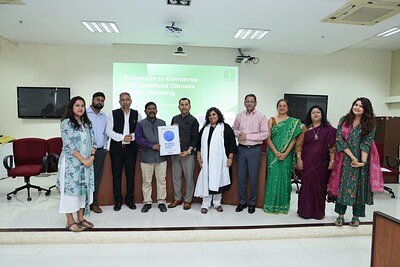
Speaking at the launch event held at the Tata Institute of Social Sciences (TISS), Shishir Joshi, Founder of Mumbai Climate Week, emphasized this paradigm shift. "Climate action in India cannot succeed if it remains confined to policy rooms and global summits," he stated. "Real solutions will emerge from districts, villages, and communities—especially from women and indigenous groups who experience climate impacts first-hand. The Raigad initiative reflects the spirit of Mumbai Climate Week: localising climate action, democratising decision-making, and building models that are just, inclusive, and scalable."
This sentiment was echoed by Prof. M. Mariappan, Officiating Vice Chancellor of TISS, a key partner in the project. "Women play a critical role in building resilience and shaping adaptation efforts, often drawing on deep community knowledge and care practices," he said. "Climate action planning must therefore centre community voices while also addressing structural inequalities."
In practice, this involves training Village Development Committees, integrating climate goals into Panchayat-level plans, and creating platforms like the 'Conference of Panchayats'—a counter-narrative to global COPs where local leaders can shape their own climate discourse.
The Power of Partnership and Policy
This ambitious undertaking is powered by a strategic coalition that bridges academia, government, and civil society. Led by TISS, the project brings together the Maharashtra State Climate Action Cell (SCAC), Asar Social Impact Advisors, Waatavaran Foundation, and the Policy & Development Advisory Group, with support from the University of Toronto India Foundation.
This multi-stakeholder model is crucial for the project's success, ensuring that grassroots efforts are supported by technical expertise and aligned with state-level policy. The initiative is designed to directly strengthen Maharashtra's State Action Plan on Climate Change 2.0 (SAPCC 2.0), which explicitly calls for localizing climate action and mainstreaming the role of women and youth.
Shri Abhijit Ghorpade, Director of the State Climate Action Cell, who inaugurated the initiative, affirmed its alignment with the government's vision. By empowering district, village, and Panchayat-level planning, the Raigad pilot provides a tangible pathway for implementing the state's broader climate objectives, transforming policy goals into community-driven outcomes.
From Local Success to a Global Model
While groundbreaking, the Raigad pilot is part of a growing movement across India that recognizes the power of decentralized climate governance. In another part of Maharashtra, Dawwa village in Gondia district, led by its first woman Sarpanch, became the first in India to win the Climate Action Special Panchayat Award for its work in solar irrigation and eco-farming. Similarly, Palli gram panchayat in Jammu and Kashmir achieved carbon neutrality through community-led efforts, while Meenangadi in Kerala has pioneered a grassroots carbon-neutral project.
These examples demonstrate the immense potential held within India's Panchayati Raj Institutions to drive effective and sustainable climate action. The Raigad project builds on these precedents, aiming to create a structured, well-documented, and scalable model that can be adapted by other districts facing similar challenges.
The upcoming Mumbai Climate Week, scheduled for February 17-19, 2026, will serve as a global platform to showcase these locally rooted solutions. By amplifying the voices and successes from places like Raigad, the event aims to champion a narrative of climate leadership from the Global South—one that is defined not by grand pledges, but by tangible, equitable, and community-owned progress.