
- 14% more likely to hold a liquor license and 9% more likely to offer catering for diversified restaurants vs. single-channel counterparts
- 28% more likely to have been in business for over a decade and 18% more likely to employ 40+ staff for retention-focused restaurants
- 37% less likely to use structured loyalty programs for fast-casual/quick-service operators
Experts agree that the success of independent restaurants hinges on access to strategic systems, diversification, and customer retention—not just ambition or hard work.
Beyond Ambition: The 'Capability Gap' Dividing Restaurants
SAN FRANCISCO, CA – February 17, 2026 – For independent restaurant owners, long hours and a passion for food have always been prerequisites for survival. However, a new national report suggests that ambition and effort alone are no longer enough to guarantee success, revealing a widening “capability gap” that separates businesses stuck in a daily struggle from those positioned for sustainable growth.
The report, titled From Survival to Scale: Building Stronger, More Resilient Restaurant Businesses, was released by the Silicon Valley startup MarketStreet. Based on a survey of nearly 1,000 independent restaurant operators, it argues that the key differentiator is not a lack of drive, but a lack of access to the strategic systems, advisory support, and operational tools that allow a business to scale effectively.
“The widening divide among independent restaurants isn’t about ambition,” said Adam Fletcher, CEO at MarketStreet, in the report's release. “It’s about access to the systems and strategic support that allow operators to move from constant firefighting to intentional growth.” This conclusion reframes the narrative around restaurant failure, shifting focus from individual shortcomings to systemic barriers.
The Widening Divide: Beyond Hard Work
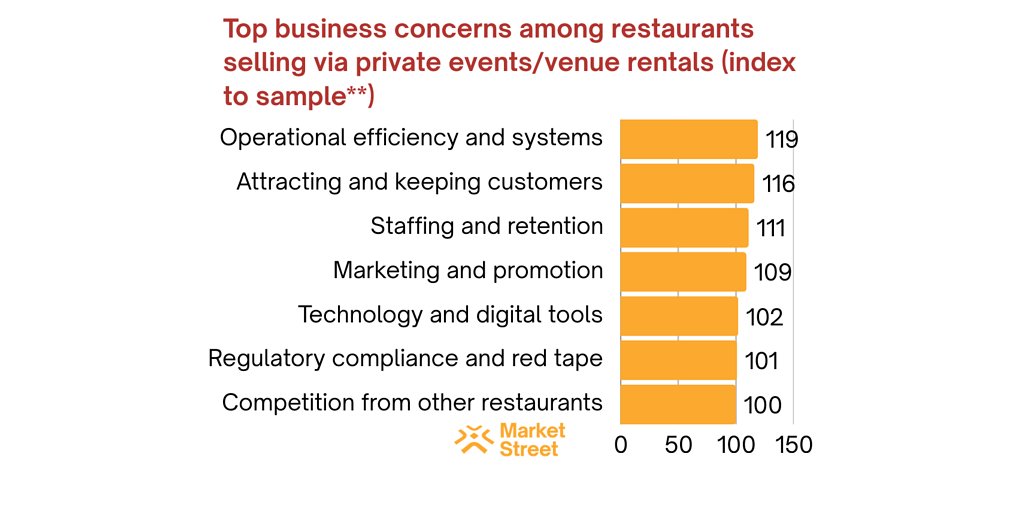
The MarketStreet study, which surveyed 969 owners operating between two and five locations, pinpoints several key areas where this capability gap manifests. The findings indicate that restaurants demonstrating resilience and sophistication are those that have successfully diversified their revenue streams, sought external guidance, and implemented structured customer retention strategies.
Channel diversification emerged as a powerful signal of operational maturity. Restaurants operating across multiple channels—such as catering, delivery, wholesale, and private events—showed significantly greater stability. According to the data, these diversified businesses were 14% more likely to hold a liquor license and 9% more likely to offer catering than their single-channel counterparts. Conversely, operators relying on a single source of revenue were far more likely to cite owner burnout, cash flow instability, and rising food costs as their primary concerns, suggesting diversification is a crucial hedge against market volatility.
Another critical factor is the use of advisory support. The report found that owners who work with business advisors, coaches, or mentors are disproportionately represented in the more mature, diversified segments of the market. These operators are more inclined to focus on strategic planning, financial tracking, and margin management. In contrast, those without such guidance reported being consumed by daily operational pressures and persistent staffing issues.
Customer retention also stands out as a powerful, yet underutilized, driver of long-term success. Retention-focused restaurants were 28% more likely to have been in business for over a decade and 18% more likely to employ 40 or more staff. Despite this, the report notes a significant blind spot in the industry, finding that fast-casual and quick-service operators—who face intense competition and margin pressure—are 37% less likely to use structured loyalty programs.
A Systemic Challenge in a Crowded Field
The concept of a 'capability gap' resonates deeply within an industry where the failure rate is notoriously high, with some estimates suggesting nearly 80% of restaurants close within their first five years. The report’s findings align with persistent industry-wide pressures, including soaring food and labor costs, intense competition from large chains, and chronic staffing shortages that have plagued the sector for years.
What the report effectively does is contextualize these struggles not as isolated incidents of mismanagement but as symptoms of a systemic problem: a lack of accessible, system-level support. While a chef may have mastered the kitchen, they often lack the business acumen or resources to navigate complex financial planning, digital marketing, and multi-channel logistics.
This challenge has not gone unnoticed, and a complex ecosystem of solutions has emerged to address it. The technology sector offers a vast array of restaurant management platforms like Toast, Square, and Lightspeed, which integrate point-of-sale, inventory management, and customer relationship tools into a single system. These platforms aim to provide the operational backbone that the MarketStreet report identifies as essential.
Beyond technology, a robust network of advisory services already exists. The Small Business Administration (SBA) offers programs like Small Business Development Centers (SBDCs) and SCORE, which provide free or low-cost mentorship and business planning assistance specifically tailored for entrepreneurs, including restaurateurs. Private consulting firms also offer specialized expertise in everything from menu engineering to cost optimization, providing the strategic guidance that many operators need to transition from survival to growth.
Pillars of Resilience: Diversification and Retention
Digging deeper into the report's findings, the emphasis on revenue diversification and customer retention highlights a fundamental shift in the restaurant business model. The era of relying solely on dine-in traffic is fading, replaced by a hybrid approach that builds financial resilience.
Diversification acts as a critical buffer. By adding revenue streams like branded retail products, catering services, or wholesale accounts, restaurants can stabilize cash flow and reduce their dependence on the unpredictable nature of daily foot traffic. This strategy allows them to leverage their core culinary assets in new ways, reaching customers beyond the four walls of their establishment and creating a more robust financial foundation.
Simultaneously, a disciplined focus on customer retention is proving to be one of the most effective economic levers an operator can pull. Industry experts have long noted that acquiring a new customer can cost five times more than retaining an existing one. The report reinforces this by linking retention strategies directly to longevity and workforce size. By implementing structured loyalty programs, personalized marketing, and exceptional service, restaurants can build a dedicated customer base that provides consistent revenue and acts as a powerful marketing engine through word-of-mouth referrals. This transforms retention from a simple marketing tactic into a core tenet of financial strategy.
From Insight to Action
Ultimately, the report serves as both a diagnosis and a call to action. It highlights a clear path forward for independent operators by identifying practical, often low-cost, improvements. These include fundamentals like menu engineering to optimize profitability, activating simplified loyalty programs to encourage repeat business, and engaging with accessible advisory programs like those offered by the SBA.
Companies like MarketStreet, with its platform of AI-powered tools and a community-based network, represent a growing movement to democratize access to the strategic capabilities once reserved for large, well-funded chains. By providing tools for simplified marketing, peer-to-peer support, and operational intelligence, such platforms aim to level the playing field, allowing independent owners to compete more effectively.
For the thousands of independent restaurants that form the backbone of local economies, the message is clear: the path from day-to-day survival to long-term scale is paved not just with passion, but with strategic systems, community support, and a relentless focus on building a resilient and diversified business.