
- $1.2M Grant: The Leon Levine Foundation awarded Basta a $1.2 million grant to boost career opportunities for first-generation college students in the Carolinas.
- 52% Underemployed: 52% of bachelor's degree holders in the Carolinas are underemployed one year after graduation.
- 31% Graduation Rate: Only 31 out of every 100 ninth graders in the Carolinas earn a degree or valuable industry credential within six years.
Experts agree that Basta's data-driven approach, combining AI-powered career navigation with personalized coaching, offers a promising solution to bridge the gap between education and meaningful employment for first-generation students in the Carolinas.
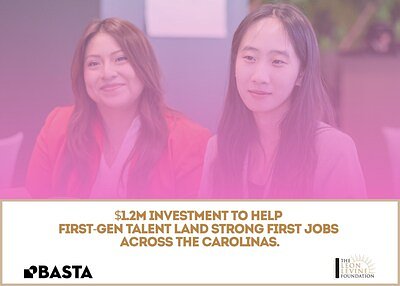
Basta's $1.2M Grant to Boost Economic Futures in the Carolinas
NEW YORK, NY – February 17, 2026 – A major $1.2 million grant from The Leon Levine Foundation is set to supercharge efforts to connect first-generation college students in the Carolinas with career-launching jobs, tackling a persistent gap between earning a degree and securing long-term economic mobility. The recipient, Basta, a national non-profit specializing in career navigation, will use the catalytic funding to expand its technology-driven model across North and South Carolina.
The initiative arrives at a critical juncture for the region and the nation. While the Carolinas are experiencing robust economic growth, a staggering 52% of bachelor's degree holders find themselves underemployed one year after graduation, working jobs that don't require their qualifications. For first-generation students, who often lack the social capital and professional networks of their peers, this challenge is even more acute.
"At The Leon Levine Foundation, we believe talent is everywhere, opportunity is not," said Tom Lawrence, president and CEO of The Leon Levine Foundation. "Basta helps close that gap by meeting students where they are and building a bridge to meaningful careers. By strengthening the systems that surround them, this approach creates lasting pathways to self-sufficiency."
The Carolina Conundrum: A Wealth of Talent, A Shortage of Pathways
The Carolinas represent a region of immense potential and urgent need. North Carolina's economy is diversifying rapidly into high-demand sectors like advanced manufacturing, biotechnology, and information technology, with Charlotte standing as the nation's third-largest financial hub. Similarly, South Carolina is a hotspot for aerospace, automotive manufacturing, and technology. Yet, a significant portion of the local talent pool is at risk of being left behind.
According to Carolina Demography, an estimated 49% of North Carolina's next generation of students are likely to be the first in their families to attend college. This represents a massive, motivated, and often untapped reservoir of human capital. However, the path from campus to a strong first job remains fraught with obstacles. Data indicates that in the Carolinas, only 31 out of every 100 ninth graders will successfully earn a degree or a valuable industry credential within six years, with the odds being even lower for students from low-income or first-generation backgrounds.
"First-generation students have the talent and drive, but the pathway from education to employment is still too fragmented," said Sheila Sarem, founder and CEO of Basta. "By partnering with regional institutions and employers, we're building a clearer, more coordinated route to strong first jobs—one students can navigate with real support and measurable outcomes."
Beyond the Degree: A New Model for Career Navigation
Basta’s approach is not to create another standalone program, but to provide an "infrastructure layer" that strengthens the existing career services ecosystem. The core of this model is Seekr, a proprietary platform powered by millions of data points from over 30,000 first-generation career journeys. This technology combines AI-driven precision matching with personalized coaching and direct connections to employers.
This model is uniquely positioned to address the seismic shift in hiring practices toward skills-based assessment. According to the National Association of Colleges and Employers (NACE), 70% of employers now use skills-based hiring for entry-level roles, a significant jump from previous years. The emphasis is moving away from GPA and toward a candidate's demonstrated capabilities. However, research shows that less than 40% of graduating seniors are even familiar with the term "skills-based hiring," creating a dangerous knowledge gap.
Basta's platform directly confronts this by helping students identify, articulate, and demonstrate the job-relevant skills they have acquired through coursework, projects, and part-time jobs—experiences that traditional hiring systems often overlook. By providing personalized guidance, the organization helps students translate their academic learning into the language that employers in sectors like cleantech, finance, and healthcare understand and value.
A Strategic Investment in Regional Prosperity
The $1.2 million grant is a cornerstone of The Leon Levine Foundation’s broader strategy to foster economic self-sufficiency across the Carolinas. The Charlotte-based foundation, with assets now totaling nearly $2 billion, has made "career-connected learning" a regional priority. It views this investment not as simple charity, but as a strategic move to unlock the full economic potential of the region's diverse population.
By investing in organizations like Basta, the foundation aims to build a more resilient and equitable workforce pipeline that can meet the demands of the Carolinas' booming industries. The partnership is designed to create a virtuous cycle: students gain access to high-quality careers, employers gain access to a diverse and capable talent pool, and the regional economy benefits from increased productivity and reduced inequality.
The work is already taking root through pilot programs with partners like Morris College in South Carolina, a historically Black college, and KIPP Pride High School in North Carolina. These initial collaborations demonstrate the model's flexibility in serving students at different stages of their educational journey, from high school preparation to post-secondary career launch. Basta is now extending an open invitation to other HBCUs, colleges, universities, and community organizations to join the initiative and help scale its impact.
Building a Replicable Blueprint for the Future
This expansion into the Carolinas is more than a regional project; it is a testbed for a national solution. Basta and The Leon Levine Foundation are committed to a data-driven approach, planning to convene partners later this year to exchange findings, share best practices, and refine their strategies based on real-world outcomes.
The initiative is slated to conclude in 2027 with the development of a comprehensive impact evaluation and a detailed expansion roadmap. The ultimate goal is to create a proven, replicable blueprint that can be adapted by other states facing similar challenges in bridging the gap between education and employment. By meticulously documenting what works, the partnership aims to provide a clear path for other regions to follow, transforming how the nation supports its next generation of talent.
This long-term vision underscores the ambition of the project: to not only change the trajectory for thousands of students in the Carolinas but to fundamentally reshape the landscape of economic opportunity for first-generation graduates across the country.