
- 900,000 AI-optimized cores in Cerebras’s WSE-3 chip, enabling unprecedented memory bandwidth for AI inference.
- Order of magnitude increase in speed and performance for generative AI applications.
- 25 kilowatts of power consumption for the Cerebras CS-3 system, highlighting the high-performance demands of the new architecture.
Experts view this AWS-Cerebras collaboration as a strategic breakthrough in AI inference, leveraging specialized hardware to overcome critical bottlenecks and potentially redefine real-time AI capabilities.
AWS Taps Cerebras to Shatter AI Speed Limits in the Cloud
SEATTLE, WA – March 13, 2026 – Amazon Web Services (AWS) and AI hardware innovator Cerebras Systems have announced a landmark collaboration poised to fundamentally reshape the performance landscape for generative AI. In a strategic move to address one of the industry's most significant bottlenecks, the two companies are joining forces to deliver what they claim will be the fastest AI inference solutions available, set to be deployed on the Amazon Bedrock platform in the coming months.
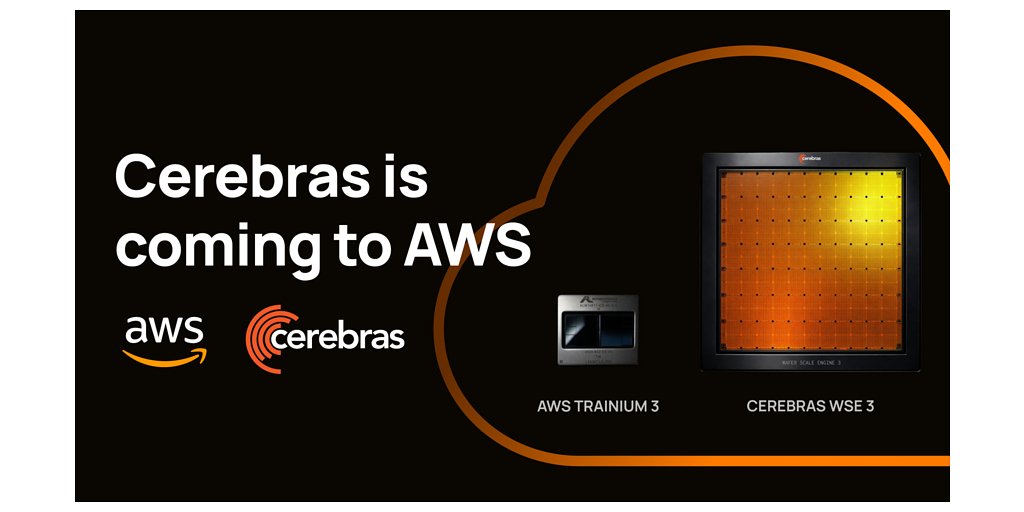
The partnership introduces a novel architecture called “inference disaggregation,” which combines AWS’s custom Trainium AI accelerators with the record-breaking power of Cerebras’s CS-3 systems. This hybrid approach aims to deliver an “order of magnitude” increase in speed and performance for demanding generative AI applications and large language model (LLM) workloads, potentially redrawing the boundaries of what is possible in real-time AI.
The Architecture of Speed: Disaggregating Inference
At the heart of the collaboration is a sophisticated technique that deconstructs the AI inference process into its two core stages: prompt processing, or “prefill,” and output generation, or “decode.” These stages have vastly different computational profiles, a challenge that has traditionally forced a one-size-fits-all hardware approach. This new solution, however, assigns each stage to a specialized processor best suited for the task.
Prefill, which involves processing the user’s initial input prompt, is a computationally intensive and highly parallel task. For this, the solution leverages AWS Trainium, Amazon’s purpose-built AI chip designed for scalable and cost-efficient processing of parallel workloads. By dedicating Trainium servers to this compute-heavy stage, the system can rapidly process large and complex prompts.
Decode, the process of generating the AI’s response token by token, is the more significant bottleneck in interactive applications. This stage is inherently serial and intensely memory-bandwidth dependent. Here, the Cerebras CS-3 system takes center stage. The CS-3 is powered by the Wafer Scale Engine 3 (WSE-3), the world’s largest single chip. Packing 900,000 AI-optimized cores and an unprecedented 44 gigabytes of on-chip SRAM, the WSE-3 provides thousands of times more memory bandwidth than the fastest GPUs. This architecture is uniquely suited to accelerate the memory-bound decode phase, dramatically reducing the latency between generated tokens.
“Inference is where AI delivers real value to customers, but speed remains a critical bottleneck for demanding workloads like real-time coding assistance and interactive applications,” said David Brown, Vice President of Compute & ML Services at AWS. “What we're building with Cerebras solves that: by splitting the inference workload across Trainium and CS-3, and connecting them with Amazon’s Elastic Fabric Adapter, each system does what it's best at. The result will be inference that's an order of magnitude faster and higher performance than what's available today."
Linking these two specialized computing environments is Amazon’s Elastic Fabric Adapter (EFA), a high-performance network interface that enables low-latency, high-bandwidth communication, ensuring the seamless handover from prefill to decode without creating a new bottleneck.
A Strategic Gambit in the Cloud AI Arms Race
This partnership is more than a technical achievement; it represents a significant strategic maneuver by AWS in the hyper-competitive cloud AI market. By building a differentiated, high-performance stack, AWS is mounting a direct challenge to Nvidia's long-standing dominance in the AI hardware space. As the AI industry matures, the inference market—where models are deployed at scale—is projected to become a far larger economic prize than the training market, and this collaboration is squarely aimed at capturing a significant share.
The Cerebras WSE-3’s design, which avoids reliance on the High-Bandwidth Memory (HBM) that is a key component of traditional GPUs, also offers a strategic advantage. It sidesteps a major cost driver and a well-known supply chain constraint that has impacted the entire industry, providing a potential pathway to more predictable and cost-effective scaling.
The solution will be available exclusively through Amazon Bedrock, AWS’s fully managed service for generative AI. This integration positions Bedrock as a premier destination for enterprises seeking top-tier performance, strengthening its competitive posture against rivals like Microsoft Azure and Google Cloud. For Cerebras, the alliance provides immediate access to AWS’s vast global customer base, validating its wafer-scale technology and granting it unparalleled distribution without the capital-intensive need to build its own cloud infrastructure.
“Partnering with AWS to build a disaggregated inference solution will bring the fastest inference to a global customer base,” said Andrew Feldman, Founder and CEO of Cerebras Systems. “Every enterprise around the world will be able to benefit from blisteringly fast inference within their existing AWS environment.”
Unleashing the Next Wave of AI Applications
The promise of dramatically faster and more efficient inference extends far beyond benchmarks. This leap in performance is expected to unlock a new generation of AI applications that are currently constrained by latency and cost. For developers and end-users, this translates into AI that feels truly interactive and instantaneous.
Real-time coding assistants, for example, could offer suggestions and complete complex code blocks with no perceptible delay, fundamentally changing the developer workflow. Interactive applications, from hyper-responsive chatbots to dynamic content generation tools, could operate with the fluidity of a local application. The most profound impact, however, may be on the burgeoning field of agentic AI.
Agentic AI systems, which can autonomously perform complex, multi-step tasks, are heavily dependent on the speed and cost of inference. Each “thought” or step an agent takes requires a separate inference call. The high latency and cost of current systems make sophisticated agents impractical for many use cases. By drastically reducing both, the AWS-Cerebras solution could fuel a mass migration of AI startups and enterprises toward developing and deploying these advanced autonomous systems.
The credibility of the underlying technology is bolstered by the high-profile companies already leveraging the hardware. Leading AI labs like OpenAI, Cognition, and Mistral are using Cerebras to accelerate their most demanding workloads, while Anthropic has committed to using AWS Trainium for training its frontier models. Later this year, AWS also plans to offer leading open-source LLMs and its own Amazon Nova models on the new Cerebras-powered infrastructure.
Navigating the Path to Implementation
While the potential is immense, the deployment of such a novel, heterogeneous computing solution is not without its challenges. Integrating two distinct processor architectures requires sophisticated software orchestration to ensure workloads are managed seamlessly. However, AWS aims to abstract this complexity from the end-user by delivering the solution as a managed service through Amazon Bedrock, allowing developers to access its power via a simple API call without managing the underlying infrastructure.
Furthermore, high-density, high-performance hardware like the Cerebras CS-3 has significant power and cooling requirements. The WSE-3 chip alone can consume around 25 kilowatts of power, necessitating robust data center infrastructure. The successful deployment of these systems at scale within AWS data centers is a testament to the sophistication of Amazon’s engineering and operational capabilities.
As the generative AI industry continues its explosive growth, performance and cost-efficiency have become the critical factors for widespread adoption. This collaboration between a cloud giant and a hardware innovator represents a bold bet that specialized, disaggregated architecture is the key to unlocking the next frontier of artificial intelligence. The industry will be watching closely as this powerful new solution becomes available to builders and enterprises on AWS in the coming months.