
- Global sales increase in 2024: Modest rise driven by inventory replenishment
- EV adoption slowdown: Consumer interest cooling in key markets like North America and Europe
- Average new vehicle price: Pushed to historic highs due to rising costs and inflation
Experts agree the automotive industry is at a critical crossroads, facing economic headwinds, geopolitical tensions, and shifting consumer demand, requiring strategic recalibration of electrification and global competition strategies.
Auto Leaders to Tackle Global Industry Crossroads at NYIAS Panel
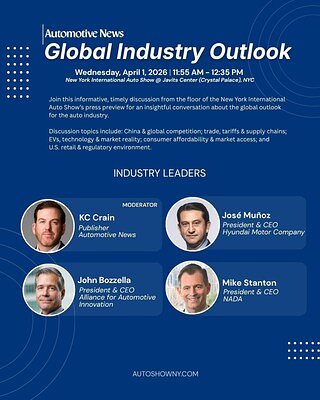
NEW YORK, NY – March 27, 2026 – As the global automotive industry navigates one of its most turbulent periods in decades, the New York International Auto Show (NYIAS) is set to host a pivotal new discussion. Titled the "Automotive News Global Industry Outlook," the panel will convene top executives from manufacturing, policy, and retail to dissect the complex forces reshaping the future of mobility.
The high-stakes session, scheduled for the show's press preview on April 1, will be moderated by KC Crain, publisher of Automotive News. The panel features a trio of influential voices: José Muñoz, president and CEO of Hyundai Motor Company; John Bozzella, president and CEO of the Alliance for Automotive Innovation; and Mike Stanton, president and CEO of the National Automobile Dealers Association (NADA). According to the show's organizers, the discussion aims to tackle a "period of uncertainty and transition," covering everything from the trajectory of electric vehicles and global competition to the intricate web of trade, tariffs, and the regulatory environment in the United States.
An Industry at a Crossroads
The timing of the panel could not be more critical. The automotive sector is currently grappling with a potent mix of economic headwinds and geopolitical friction that is testing its resilience. Persistently high interest rates and stubborn inflation have tightened consumer wallets, making new vehicle purchases a more daunting proposition. While global sales saw a modest increase in 2024, driven largely by the replenishment of once-depleted inventories, analysts warn of sluggish growth ahead as weaker consumer confidence takes hold.
This economic strain is compounded by a volatile geopolitical landscape. The ongoing threat of trade wars and tariffs between major economic blocs like the United States, China, and the European Union creates profound instability. These policies disrupt intricate global supply chains, drive up the cost of raw materials and components, and ultimately risk raising vehicle prices for consumers. In response, many automakers are undertaking costly and complex shifts toward localizing production and de-risking their supply chains, moving away from over-reliance on any single region. This strategic pivot, while necessary for long-term stability, adds another layer of complexity to an already challenging operational environment.
The Electric Vehicle Recalibration
At the heart of the industry's current transition is the massive, capital-intensive shift toward electrification. However, the path to an all-electric future has proven to be less linear than initially projected. The panel is set to directly address how automakers are "recalibrating electrification strategies amid uneven consumer demand." After an initial surge, EV adoption momentum has slowed in key markets, including parts of North America and Europe.
Several factors are contributing to this cooling of consumer interest. The upfront cost of EVs remains a significant barrier for many households, a problem exacerbated by high interest rates on auto loans. Furthermore, persistent "range anxiety" and concerns about the availability and reliability of public charging infrastructure continue to weigh on the minds of potential buyers. In a notable market reversal, this has led to a renewed interest in traditional internal combustion engine (ICE) vehicles and, particularly, hybrids, which are increasingly seen as a practical and affordable bridge technology. In response, automakers are adjusting course. While long-term commitments to electrification remain, many are tempering short-term production targets, diversifying their powertrain offerings to include more hybrids, and intensifying efforts to reduce the production costs of their EV platforms to achieve price parity with gasoline-powered counterparts.
Navigating Global Competition and Trade Winds
The conversation in New York will also delve into the intensifying "competition from emerging global players." This is largely a reference to the meteoric rise of Chinese automakers, who are rapidly asserting their influence on the global stage. Companies like BYD have leveraged state support, cost-effective manufacturing, and rapid innovation cycles to dominate their domestic market and are now aggressively expanding into Europe and other regions.
This new wave of competition presents a formidable challenge to established automakers in the U.S., Europe, Japan, and South Korea. Chinese brands are not only competing on price but are also proving to be formidable innovators, particularly in EV battery technology and in-car software. The competitive pressure is forcing legacy manufacturers to accelerate their own development cycles and re-evaluate their cost structures. The dynamic is further complicated by trade policy. The imposition of tariffs on Chinese-made EVs by the U.S. and Europe is a defensive measure aimed at protecting domestic industries, but it also risks escalating trade disputes and further fragmenting the global market, impacting everyone from parts suppliers to consumers. The panel will likely explore how Western automakers and policymakers can navigate this new competitive reality while fostering domestic innovation and manufacturing.
The View from the Showroom Floor
Ultimately, these high-level global shifts have a direct impact on consumers and the dealerships that serve them—a perspective that NADA's Mike Stanton is uniquely positioned to provide. The issue of vehicle affordability is now front and center. A combination of rising manufacturing costs, investments in new technology, and inflationary pressures has pushed the average transaction price for a new vehicle to historic highs, pricing many potential buyers out of the market.
For dealers, the transition to EVs presents both opportunities and significant challenges. It requires substantial investment in specialized service equipment, extensive training for technicians and sales staff, and the installation of on-site charging infrastructure. Furthermore, dealers are on the front lines of consumer education, tasked with explaining the nuances of EV ownership, from battery life and home charging setups to navigating the still-developing public charging network. The panel's discussion will undoubtedly touch on how the retail environment must adapt and what support dealers need from manufacturers and policymakers to ensure a smooth and successful transition for the car-buying public.
The "Automotive News Global Industry Outlook" promises to be more than just an academic discussion; it will be a real-time barometer of the health and direction of one of the world's most vital industries. The strategies and solutions debated by Muñoz, Bozzella, and Stanton will offer crucial insights into how the sector plans to navigate the bumpy road ahead, shaping the vehicles people will drive—and the prices they will pay for them—for years to come.