
- 65% of Austria's gas imports came from Russia in 2023, highlighting the nation's energy dependency.
- 128-meter-thick carbonate reservoir in the Reifling Formation yielded methane gas after acidization stimulation.
- 75% interest held by ADX Energy, with MCF Energy holding the remaining 25% stake in the Welchau project.
Experts view the Austrian gas discovery as a strategic step toward European energy security, though they caution that its long-term viability depends on balancing energy needs with environmental and regulatory challenges.
Austrian Gas Discovery Ignites European Energy Security Dialogue
VANCOUVER, BC – February 16, 2026 – A promising natural gas discovery in the Austrian Alps is sending ripples through the European energy sector, offering a potential boost to the continent's long-standing quest for energy independence. MCF Energy Ltd. announced today that initial testing at its Welchau-1 well has successfully recovered hydrocarbon gas at the surface, a significant milestone that could unlock a new domestic energy source for Austria and the wider region.
The announcement comes at a critical time, as Europe continues to navigate a complex energy landscape shaped by geopolitical instability and a strategic pivot away from historical suppliers. The Welchau project, operated by ADX Energy with a 75% interest alongside MCF Energy's 25% stake, represents a tangible step in developing indigenous resources to enhance security of supply.
A Technical Breakthrough in the Alps
The positive result stems from the resumption of testing on the Reifling Formation, a 128-meter-thick carbonate reservoir. According to the company's press release, the recovery of methane gas marks the first time hydrocarbons have been flowed from this specific formation within the Welchau anticline or the surrounding basin, representing a significant technical breakthrough.
To achieve this, the operator employed a well stimulation technique known as acidization. A relatively modest volume of six cubic meters of acid was injected into the reservoir. This process is designed to dissolve carbonate rock and clear pathways, enhancing the formation's natural permeability. The fact that a small treatment prompted a previously unresponsive reservoir to flow is considered a highly encouraging sign of the reservoir's potential productivity. The presence of CO2 alongside the methane gas confirmed a successful reaction between the acid and the carbonate rock.
These initial results are described as encouraging because they confirm the presence of mobile hydrocarbons—specifically methane, the primary component of natural gas. While the well was drilled to test deeper gas and condensate potential, this shallow success in the Reifling Formation adds a new and potentially valuable dimension to the project's overall resource profile.
De-Risking the Prospect and Boosting Confidence
For the partners involved, this initial gas flow significantly de-risks the Welchau prospect. The confirmation of movable hydrocarbons validates the geological models and enhances the commercial attractiveness of the entire structure. Operator ADX Energy has previously highlighted Welchau's multi-faceted potential, with this latest development reinforcing its strategic approach.
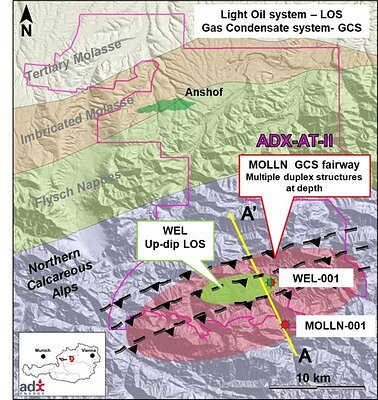
The Reifling Formation is interpreted to be situated near the oil-water contact for a potential light oil accumulation mapped approximately 500 meters updip from the current well location. This suggests the possibility of a substantial light oil resource that could be targeted with future appraisal drilling, such as a sidetrack well. Furthermore, the original well plan targeted deeper gas-condensate zones, which remain prospective targets for future exploration.
This success validates the technical strategies employed by the operator and opens up multiple development pathways. The positive market reception to the news reflects growing confidence in the project's potential to move from exploration to a commercially viable development. ADX Energy has already secured funding to support its operational campaigns in Austria, with the Welchau testing being a key catalyst in its 2026 growth strategy. A successful outcome here could significantly enhance the asset value for both ADX and MCF Energy, a company founded specifically to bolster Europe's energy security through responsible resource development.
A Strategic Win for European Energy Security?
Zooming out from the specific well site, the Welchau discovery holds considerable strategic importance. Austria, like many of its European neighbors, has been working to reduce its heavy reliance on imported energy. In 2023, Russian gas still accounted for an average of 65% of Austria's gas imports, a dependency that carries significant economic and political risk. Domestic natural gas production currently covers only a fraction of the nation's demand, underscoring the urgent need for new local sources.
A commercially viable field at Welchau could directly contribute to Austria's energy mix, displacing a portion of imports and enhancing its security of supply. While the scale of the resource is yet to be determined, any new domestic production is a step toward greater energy sovereignty. This aligns with the broader European Union strategy of diversifying energy sources and strengthening internal production capabilities.
Although the International Energy Agency (IEA) projects a long-term structural decline in European gas demand due to the green transition, it also emphasizes that natural gas will remain a vital transition fuel for decades. It is crucial for ensuring grid stability alongside variable renewable sources like wind and solar, and for industrial processes that are difficult to electrify. Discoveries like Welchau could therefore provide a cleaner, more secure, and geographically closer source of this essential transition fuel compared to globally sourced Liquefied Natural Gas (LNG).
Navigating the Green Gauntlet
The path forward for Welchau is not without its challenges, particularly concerning environmental and regulatory hurdles. The project exists within the complex dynamic of balancing immediate energy needs with Europe's ambitious long-term climate goals, including Austria's target for carbon neutrality by 2040. Developing new fossil fuel projects, even for a transition fuel like natural gas, inevitably attracts scrutiny from environmental organizations and the public.
The Welchau project has already navigated this terrain. Testing operations were previously halted in early 2025 following objections from environmental non-governmental organizations (ENGOs). However, a ruling by the Upper Austrian State Administrative Court in September 2025 confirmed that ADX Energy could lawfully resume its testing activities. This legal victory highlights the ongoing tension between resource development and environmental protection that defines many new energy projects in Europe.
Ongoing operations will be conducted under a strict regulatory framework governed by Austria's Mineral Resource Act, which requires adherence to stringent environmental and safety standards. The project's ultimate success will depend not only on what lies beneath the ground but also on the operator's ability to manage surface-level stakeholder relations and regulatory requirements.
For now, the focus remains on the well itself. The next steps involve further swabbing operations to clean up the well and attempt to establish a continuous flow of oil or gas. The team will collect fluid samples to analyze hydrocarbon content and type, and conduct pressure tests to understand the reservoir's size and connectivity. These tests, conducted during weekday daylight hours, will provide the critical data needed to determine if the promising initial gas flow at Welchau-1 can be converted into a commercially productive energy asset for Austria.