
- $10 million investment: ATCO Ltd. is investing $10 million for a 40% stake in West Kitikmeot Resources Corp. (WKR).
- $1 billion project: The Grays Bay Road and Port Project (GBRP) has an estimated total cost of $1 billion.
- 2,250 jobs: Construction is projected to create over 2,250 full-time equivalent jobs in Nunavut.
Experts view the Grays Bay Road and Port Project as a strategic nation-building initiative that enhances Canada's Arctic sovereignty, economic potential, and security, though it must navigate significant environmental and regulatory challenges.
ATCO Fuels Arctic Port Project, Bolstering Canada's Northern Strategy
CALGARY, AB – March 23, 2026 – In a move signaling a major push into Canada's final frontier, ATCO Ltd. has announced a multi-million dollar investment into a transformative Arctic infrastructure project, aiming to bolster national sovereignty and unlock the vast economic potential of the North.
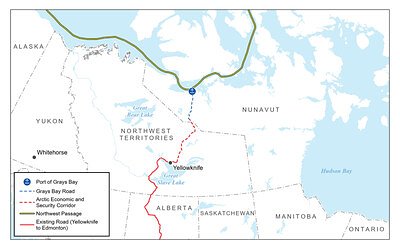
The Calgary-based conglomerate will invest approximately $10 million for a 40 percent ownership stake in West Kitikmeot Resources Corp. (WKR), an Inuit-backed company spearheading the Grays Bay Road and Port Project (GBRP). This ambitious initiative is designed to construct a deepwater port on the Northwest Passage, a 230-kilometre all-season road, and a 6,000-foot airstrip in Nunavut's Kitikmeot region.
More than just a commercial venture, the GBRP is being framed as a nation-building exercise—a critical piece of infrastructure that will provide the first-ever overland road connection between the North American highway system and a deep-water Arctic port.
A Strategic Lifeline to the North
The Grays Bay Road and Port Project represents a monumental undertaking with a price tag estimated at around $1 billion. The project, which has been referred to the Canadian Federal Government's Major Projects Office for accelerated review, is envisioned as a multi-use strategic asset with an expected in-service date of 2035.
Once complete, the deepwater port at Grays Bay will sit strategically halfway between Nome, Alaska, and Nuuk, Greenland, offering a crucial hub along the increasingly navigable Northwest Passage. The all-season road will connect the port inland, linking to the Tibbitt-Contwoyto Winter Road and, by extension, the rest of Canada.
"Investing in essential housing, energy and defence infrastructure that enables economic growth and prosperity is central to ATCO's long-term strategy," said Katie Patrick, Chief Financial and Investment Officer at ATCO, in a statement. "This project broadens our port and logistics assets, connecting northern resources to global markets... we are proud to be a strategic partner in this visionary project, to make it a reality and cement the importance of Canada’s northern territories in national security and identity."
ATCO brings significant experience to the table, with a long history of remote northern operations and a 40 percent interest in global port operator Neltume Ports. This expertise is seen as crucial for navigating the immense logistical challenges of construction in the harsh Arctic environment.
Sovereignty and Security in a Warming Arctic
The Grays Bay project is a cornerstone of Canada's broader strategy to "defend, build, and transform the North." As climate change leads to longer ice-free seasons, the Northwest Passage is becoming a more viable and contested shipping route. The GBRP is explicitly designed with dual military and civilian capabilities, providing a vital foothold for asserting Canadian sovereignty.
The port could serve as a forward operating base for the Canadian Coast Guard, the Royal Canadian Navy, and search and rescue missions, enhancing Canada's ability to monitor and control activity in its internal waters. This physical presence is a direct answer to the growing international interest in the Arctic from both allied and rival nations.
The project's role in national security and its potential to form part of a larger "Arctic Economic and Security Corridor" has garnered support from federal bodies, including the Canada Infrastructure Bank, which has signed a memorandum of understanding to provide funding to accelerate pre-construction development.
An Inuit-Led Vision for Economic Prosperity
At the heart of the project is West Kitikmeot Resources Corp., a private development company whose largest shareholder is an affiliate of the Kitikmeot Inuit Association (KIA). This structure places Indigenous leadership and economic benefit at the forefront of the initiative.
"WKR is thrilled to welcome ATCO as a major investor in our company, joining our Kitikmeot Inuit shareholders," stated Brendan Bell, CEO of West Kitikmeot Resources Corp. "They bring deep experience in northern infrastructure, port operations, and defence. They are a champion for the region and share our vision of Inuit-led Northern security and prosperity."
The primary economic driver for the GBRP is the desire to unlock the rich mineral deposits of the Kitikmeot region and the adjacent Slave Geological Province, which hold significant reserves of zinc, copper, and other critical minerals. The road and port are expected to drastically reduce the cost of exploration and extraction, stimulating private investment that has been historically hindered by a lack of infrastructure.
Economic assessments project that construction alone could create over 2,250 full-time equivalent jobs in Nunavut. Proponents argue the long-term benefits will be even greater, fostering new business opportunities for Inuit firms, improving supply chains, and ultimately lowering the high cost of living in northern communities.
Navigating Environmental and Regulatory Hurdles
Despite the project's powerful backing and strategic importance, the path to completion is fraught with challenges. Building on such a scale in a fragile ecosystem requires navigating a complex and exacting regulatory process.
WKR recently submitted a massive 11-volume, 5,000-page impact statement to the Nunavut Impact Review Board (NIRB). However, the board sent the document back for revisions, requesting more robust scientific data and mitigation plans, underscoring the high level of scrutiny the project faces. The environmental assessment is not expected to be complete until 2027.
Environmental groups and some local community members have voiced significant concerns. The potential impact on caribou migration routes is a major point of contention, as is the effect of increased industrial shipping on marine mammals and the delicate aquatic environment. Advocacy group Oceans North has filed for a judicial review, arguing the current assessment improperly excludes the downstream impacts of shipping and trucking.
While the project promises economic benefits, there are mixed feelings in communities like Kugluktuk. Some residents worry about the trade-offs between jobs and the potential for irreversible harm to the land and wildlife that sustain their traditional way of life. Addressing these concerns and meaningfully integrating Inuit Knowledge into the project's final design will be critical for its ultimate success as the proponents push forward toward a planned 2030 construction start.
Topics & Related
Geopolitics & Trade
Corporate Finance
Financial Services
Manufacturing & Industrial
Related Company Pulse