
- 7 billion litres: Malaysia loses this amount of treated water daily, costing over RM2 billion annually.
- 37.1%: Malaysia's Non-Revenue Water (NRW) rate in 2023, a major focus of the summit.
- RM2.5 billion: Allocated for nationwide aging pipe replacement under Malaysia's 13th Plan.
Experts emphasize that addressing Asia's water crisis requires a combination of technological innovation, sustainable financing, and cross-border collaboration to modernize infrastructure and manage finite resources effectively.
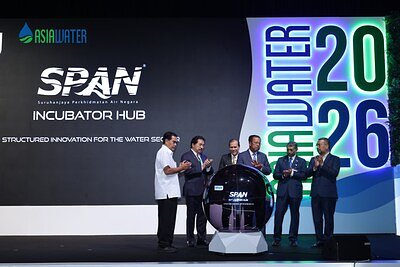
Asia's Water Crisis on Display as Global Summit Tackles Tech Solutions
KUALA LUMPUR, Malaysia – April 07, 2026 – The 14th edition of ASIAWATER officially opened its doors today, drawing over 20,000 global water professionals into the heart of a region grappling with a deepening water security crisis. As industry leaders and policymakers converged at the Kuala Lumpur Convention Centre, the host nation’s struggles provided a stark backdrop: Malaysia is currently losing over seven billion litres of treated water daily, an economic drain exceeding RM2 billion annually.
The event, themed "Building Nations: Leveraging Technology-Driven Water Services for Inclusive Growth," was officiated by YAB Datuk Amar Haji Fadillah bin Haji Yusof, Malaysia's Deputy Prime Minister and Minister of Energy Transition and Water Transformation. In his address, he framed the challenge in no uncertain terms. "Water is the foundation upon which human civilisation is built," Fadillah stated. "Reliable water supply and effective wastewater management underpin public health, sustain industries, safeguard our ecosystems, and enhance the resilience of our communities."
With over 1,000 exhibitors from 52 countries spread across 16,000 square metres, the three-day summit is more than a trade show; it is a critical nexus for a continent at a crossroads, where rapid urbanization and climate change are putting unprecedented strain on finite water resources.
Malaysia's Multi-Billion Ringgit Leak
At the forefront of discussions is Malaysia's battle with Non-Revenue Water (NRW)—treated water that is lost before it reaches the customer. The country's staggering national NRW rate of 37.1% in 2023 is a figure that galvanizes the search for solutions. This loss, primarily due to aging infrastructure, pipe leaks, and inaccurate metering, represents a massive waste of resources and a significant financial burden.
The Malaysian government is fighting back with an ambitious plan to slash the NRW rate to a revised target of 28.8% by 2030. This strategy is supported by significant financial commitments, including a RM2.5 billion allocation for a nationwide aging pipe replacement program under the 13th Malaysia Plan and a further RM1.1 billion in Budget 2024 to address acute water supply issues.
"Addressing NRW requires more than technical solutions alone," Fadillah cautioned, emphasizing the need for "sustainable financing models, effective governance, and close coordination between the Federal and State Governments, as well as industry stakeholders." This comprehensive approach is embedded in the country's long-term Water Sector Transformation 2040 (WST 2040) agenda, which aims to modernize the entire sector.
The Digital Deluge: Tech's Answer to Scarcity
Throughout the exhibition halls, the prevailing narrative is one of technological optimism. The focus has clearly shifted from traditional engineering to a digital-first approach, with smart water networks, AI-powered analytics, and advanced automation taking center stage.
Industry partner Gamuda Berhad showcased its Gamuda Digital Operating System (GDOS), a platform developed with Autodesk that uses Building Information Modelling (BIM) to optimize large-scale water infrastructure projects. The company reported that GDOS identified over 2,600 design issues in the Sungai Rasau Water Supply Scheme, resulting in RM26 million in savings. This demonstrates a tangible return on investment for digitalization.
Meanwhile, smaller, more specialized firms are also making waves. Space-tech innovator Tenchijin Inc. is presenting "KnoWaterleak," a platform that uses satellite data and AI to predict and pinpoint potential water leaks in 100-meter square zones, offering a powerful tool for proactive infrastructure management. Similarly, KROHNE Malaysia is displaying advanced flowmeters like the WATERFLUX 3070, which integrates pressure and temperature sensors to provide real-time data crucial for early leak detection.
This push for innovation is being formally institutionalized. A key highlight of ASIAWATER 2026 is the launch of the Incubator Hub by the National Water Services Commission (SPAN). The hub is designed to be a catalyst for the water sector, creating a structured platform to fast-track the adoption of new technologies and support the industry's transition towards a knowledge-based system.
A Regional Crisis Demands a United Front
While Malaysia’s challenges are acute, they are symptomatic of a wider regional malaise. Southeast Asia is confronting what experts call a "triple water crisis" of excess (flooding), scarcity (drought), and pollution, all exacerbated by climate change and rapid, often unplanned, urbanization.
The Asian Development Bank (ADB) has painted a sobering picture, estimating an annual financing gap of over $150 billion required to meet the region's water and sanitation needs. Current spending covers less than 40% of the necessary investment, threatening to reverse developmental gains.
In this context, ASIAWATER serves as a vital platform for collaboration. "These challenges cannot be addressed in isolation," noted Tan Sri Abdul Rahman Mamat, Chairman of Informa Markets Malaysia, in his welcome address. "They require coordinated action across governments, industry, technology providers, and the research community."
The event facilitates this through more than 60 specialized conferences and technical sessions, including a Regional Water Expert Dialogue and the Smart Water Networks Forum. These platforms are designed to bridge the gap between high-level policy, academic research, and real-world implementation, fostering the cross-border partnerships needed to tackle shared environmental threats.
Fadillah reinforced this view, highlighting the event's role in positioning Malaysia as a regional leader. "Platforms such as ASIAWATER play an important role in positioning Malaysia as a regional hub for water innovation, knowledge exchange, and industry collaboration," he said.
As the summit unfolds, it is clear that the solutions being forged in Kuala Lumpur are intended to ripple across the continent. The newly launched SPAN Incubator Hub embodies this forward-looking strategy. Its framework includes the SPAN Innovative & Technology Exchange (SPITE) to connect operators with solution providers and a proposed Water Innovation Fund to support pilot projects. SPAN is currently finalizing the fund's governance structure, with a potential initial allocation of up to RM1 million for 2026.