
- Peak Torque: Ascentiz-H hip module generates 36 Nm, with a power density of 52 Nm/kg
- Knee Support: Ascentiz-K knee module reduces knee cartilage pressure by 50%
- AI Accuracy: Motion Cortex recognizes motion scenarios with 99.5% accuracy
Experts would likely conclude that Ascentiz's modular exoskeleton represents a significant advancement in wearable robotics, offering a more natural and adaptable human augmentation solution compared to traditional exoskeletons.
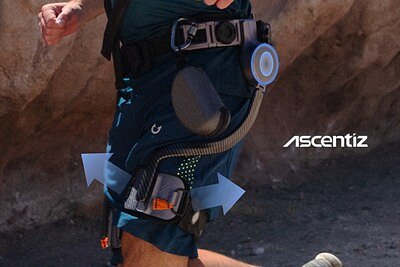
Ascentiz's Modular Exoskeleton Redefines Human Augmentation at CES
LAS VEGAS, NV – January 09, 2026 – Amid the dazzling displays of future technology at CES 2026, a startup founded just three years ago is making a profound statement about the future of human movement. Ascentiz, a pioneer in wearable robotics, has officially unveiled its groundbreaking modular exoskeleton system, a platform designed not just for rehabilitation or heavy industry, but for empowering everyday individuals to run faster, climb higher, and move with less effort. The system, comprising the Ascentiz-H hip module and Ascentiz-K knee module, challenges the one-size-fits-all approach of previous exoskeletons with a sophisticated, biomechanically intelligent design.
This launch signals a potential shift in the wearable robotics landscape, moving advanced physical augmentation from the confines of labs and specialized worksites into the realm of consumer electronics and daily life. With a design that is both lightweight and powerful, Ascentiz aims to deliver on a long-held promise: technology that seamlessly integrates with the human body to unlock new physical potential.
A Tale of Two Joints: Precision at the Hip, Power at the Knee
The core innovation behind the Ascentiz platform lies in its "dual-drive" philosophy. Rather than using a single type of motor for the entire lower body, the company's engineers recognized that the hip and knee have fundamentally different biomechanical needs. This insight led to the development of two distinct modules, each optimized for its specific joint.
The Ascentiz-H hip module is engineered for speed and responsive control. It utilizes a high-torque, quasi-direct-drive system that provides exceptional backdrivability, meaning the device responds fluidly to the user's natural movements rather than fighting against them. Generating a peak torque of 36 Nm with an impressive power density of 52 Nm/kg, the hip module is designed to amplify the user's power during dynamic activities. The company claims this system can reduce leg effort by up to 35% during demanding tasks like running and stair climbing, making strenuous exercise feel significantly easier.
In contrast, the Ascentiz-K knee module is built for strength, stability, and endurance. It employs a robust cable-drive transmission capable of delivering high, sustained torque—up to 48 Nm. This design is crucial for activities that place heavy loads on the knee, such as descending steep hills, carrying heavy backpacks, or holding a weighted stance. By decoupling the motor's mass from the moving limb, the cable-drive system enhances comfort and shock absorption. The results are significant, with Ascentiz reporting a 50% reduction in knee cartilage pressure and a 30% decrease in wasted energy from the body's center-of-mass shift.
"The hip and knee serve fundamentally different biomechanical roles," explained Feng Sha, Co-founder of Ascentiz, in the company's announcement. "The hip requires speed and precision; the knee demands torque and stability. By tailoring each module's drive system, we achieve a natural, powerful assist—never robotic."
The 'Motion Cortex': An AI Brain for Bionic Legs
Governing this sophisticated hardware is an equally advanced AI system dubbed the "Motion Cortex." This centralized AI acts as the brain of the exoskeleton, ensuring the mechanical assistance is delivered intuitively and intelligently. Trained on a massive dataset of over 690,000 gait cycles, the AI can recognize more than seven distinct motion scenarios—including walking, running, climbing, and descending—with 99.5% accuracy.
This high level of recognition allows the system to switch between assistance modes in under 200 milliseconds, a speed that is virtually imperceptible to the user. Whether a person is transitioning from a flat path to a steep incline or breaking into a run, the Motion Cortex anticipates the change and adjusts the torque and timing of its support accordingly. This adaptive capability is what separates the Ascentiz system from more rigid exoskeletons, promising an experience that feels like a natural extension of the body rather than a machine strapped to it.
The system features several modes tailored to different needs, including an "Ease Mode" for light daily support, an "ACC Mode" that dynamically adapts to a varied commute, and even a "Train Mode" that provides controlled resistance for strength-building exercises. This versatility is powered by a unified data and power bus that allows the hip and knee modules to be used independently or together, all managed by the same intelligent core.
Challenging the Status Quo in Wearable Tech
For years, the exoskeleton market has been dominated by large, heavy-duty systems designed for two primary markets: medical rehabilitation (like those from ReWalk Robotics) and industrial labor (like those from Sarcos and Ekso Bionics). While revolutionary in their own right, these devices are often too cumbersome, specialized, and expensive for general consumer use.
Ascentiz is entering a burgeoning new segment focused on consumer and "prosumer" applications. Its CES debut places it in direct conversation with other innovators like Sumbu and Hypershell, who are also targeting outdoor enthusiasts and everyday users. However, Ascentiz's modularity presents a key strategic advantage. Users can purchase the hip or knee module separately based on their needs—for instance, a runner might opt for the hip module, while a hiker might choose the knee module for joint protection. They can also be combined for full lower-body support.
Furthermore, the system's focus on portability is a game-changer. The entire combined system weighs just 1.75 kilograms and can be folded to the size of an A4 sheet of paper, making it easy to pack for a trip or carry in a backpack. Early hands-on reports from the CES floor have praised this design, with one attendee noting it was "significantly lighter, more comfortable, and far quicker to attach" than competing devices. This emphasis on user-centric design, from the eco-friendly memory foam padding to the all-day, IP54-rated battery, clearly positions the product for a mainstream audience.
From Crowdfunding Success to Consumer Reality
While Ascentiz is a young company, founded in 2023, its path to CES has been marked by strong early indicators of market demand. In November 2025, the company launched a Kickstarter campaign that quickly became the most-funded exoskeleton project in the platform's history, a powerful validation of its vision for accessible human augmentation.
This pre-launch success demonstrates a clear public appetite for technology that can enhance physical capabilities in practical ways. The target applications extend far beyond extreme sports. Ascentiz envisions its system being used to boost occupational endurance for workers who are on their feet all day, to help commuters navigate their cities with less fatigue, and to allow people of all fitness levels to enjoy outdoor adventures like hiking and skiing with greater confidence and less strain.
By combining joint-specific engineering, predictive AI, and a truly modular design, Ascentiz is not just launching a new product; it is presenting a compelling vision for the future of personal robotics. Its debut at CES 2026 may well be remembered as the moment when the power of exoskeletons finally stepped out of the factory and into the wider world.