
- $11.55 million contract awarded to HDT Robotics for Hunter WOLF prototypes in 2024
- Up to 2,195 systems potentially acquired by the Army under S-MET Increment II
- 900 kg (2,000 lbs) payload capacity for 72-hour missions
Experts agree that the Hunter WOLF represents a mature, field-ready solution for reducing soldier burden and enhancing operational reach, with its modular design and proven capabilities making it a strong contender in the Army's modernization efforts.
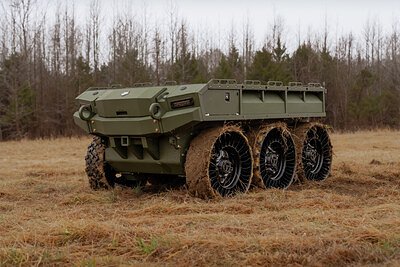
Army's Elite Warriors Test Robotic Mule in Modernization Push
FORT POLK, LA – May 04, 2026 – Soldiers from the U.S. Army's elite 10th Mountain Division are putting the Hunter WOLF unmanned ground vehicle (UGV) through its paces here, marking the second intensive training and evaluation event in just one month. The exercise underscores the Army's accelerating drive to integrate mature robotic platforms that can lighten the immense physical load on dismounted soldiers and enhance their capabilities in the world's most demanding environments.
The training, conducted by manufacturer HDT Robotics, provides a critical hands-on opportunity for an infantry unit renowned for its rapid deployment and expertise in complex, mountainous terrain. For these soldiers, the promise of a robotic "mule" is not a futuristic novelty but a potential solution to the age-old challenges of warfighting on foot.
Lightening the Infantry's Burden
The core mission of the Hunter WOLF is to unburden the modern soldier. Designed as a rugged, multi-mission UGV, it aims to reduce workload, extend operational reach, and keep troops safer by carrying the heavy gear essential for sustained operations. With a 6x6 wheeled chassis, it can haul supplies, function as a mobile power station, and even transport casualties, all while keeping pace with infantry units.
During the Fort Polk evaluation, soldiers are operating the Hunter WOLF in a variety of real-world scenarios. The vehicle's modular design is a key focus, allowing troops to quickly reconfigure it for different tasks. Configurations being tested include:
- Mobile Communications Hub: Mounting two AN/VRC-158 tactical radios to extend command and control networks.
- Sustainment Powerhouse: Carrying five Universal Battery Chargers (UBCs) to keep essential electronics powered in the field, along with a 60-gallon water purification system.
- Logistics and Fire Support: Using extended cargo rails to transport heavy equipment, food, water, and even systems like loitering munitions that are typically too heavy for dismounted units to carry.
- Casualty Evacuation (CASEVAC): Equipping the platform to rapidly transport a wounded soldier from the point of injury.
- Mobile Power Export: Providing a 15kW inverter to offload AC power, turning the vehicle into a mobile generator for field operations.
This versatility is particularly crucial for the 10th Mountain Division, whose operational profile demands adaptability in austere environments where traditional vehicle support is limited or impossible. The ability to haul hundreds of pounds of gear over rough terrain allows small units to maintain their lethality and endurance without being weighed down.
"Training events like this show how adaptable the Hunter WOLF's modular design is across different mission requirements," said John Conway, VP of Business Development, Robotics at HDT Robotics, in a statement. "Soldiers are able to configure it quickly and apply it to operational tasks without adding complexity."
A Race to Field Proven Technology
The repeated engagement with the 10th Mountain Division is more than just a training exercise; it's a key phase in a high-stakes competition. The Hunter WOLF is a contender in the U.S. Army's Small Multipurpose Equipment Transport (S-MET) Increment II program. This initiative seeks to field a next-generation robotic vehicle capable of carrying approximately 900 kg (nearly 2,000 lbs) of a squad's gear for a 72-hour mission, a significant upgrade over the first-generation systems.
In October 2024, HDT Robotics secured an $11.55 million contract to deliver Hunter WOLF prototypes for government testing as part of this program. The company emphasizes that its platform is not a developmental concept but a mature, Technology Readiness Level (TRL)-9 solution ready for immediate deployment.
"The Hunter WOLF is a proven platform that's ready to support operations today. It's not a concept still in development like other options," noted Tom Van Doren, President, Robotics Sector at HDT Robotics. "Training directly with units like the 10th Mountain Division ensures the system continues to meet operational requirements and provides a dependable solution the military can confidently deploy."
Success in the S-MET Increment II evaluation could lead to a major production contract in late Fiscal Year 2027, with the Army planning to acquire up to 2,195 systems. This makes the feedback from the soldiers at Fort Polk invaluable, as it will directly influence one of the Army's most significant ground robotics acquisitions.
A Competitive and Evolving Battlefield
HDT Robotics is not alone in the push to supply the Army with robotic workhorses. The military UGV market is a crowded and competitive field. American Rheinmetall Vehicles is also developing a prototype for the S-MET Increment II program, setting up a direct competition. Meanwhile, General Dynamics Land Systems was the victor of the S-MET Increment I contract, and is currently delivering hundreds of its own UGVs to the Army.
The international landscape is equally dynamic, with companies like Estonia's Milrem Robotics and its THeMIS UGV seeing service in multiple countries, including Ukraine. These platforms, like the Hunter WOLF, offer modular, multi-mission capabilities, highlighting a global trend toward robotic ground support.
This competitive environment is driving innovation forward, pushing for systems with greater payload, better power management, lower acoustic signatures, and more sophisticated autonomous features. The Army's strategy appears to leverage this competition to ensure it fields the most capable and reliable systems possible. The service is also exploring an expanded role for these platforms beyond logistics, with an armed version of the Hunter WOLF recently spotted in exercises, suggesting a future where these robotic vehicles could provide direct fire support in addition to carrying supplies.
Reshaping the Future of Ground Warfare
The Hunter WOLF evaluation is a tactical-level event with strategic implications, fitting squarely within the U.S. Army's broader Robotic and Autonomous Systems (RAS) strategy. This doctrine aims to fundamentally reshape ground combat by using machines to perform tasks that are dull, dirty, or dangerous, thereby protecting soldiers and increasing the effectiveness of human-machine teams.
The Army's RAS strategy outlines five key goals: increasing situational awareness, lightening soldier loads (both physical and cognitive), sustaining the force, facilitating movement, and protecting the force. The Hunter WOLF directly addresses several of these, particularly lightening the load and sustaining the force with its cargo and power capabilities.
These soldier-led evaluations are part of what Army leaders call a "campaign of learning." By placing prototypes and mature systems into the hands of end-users early and often, the Army gathers crucial data to refine requirements and ensure that the technology it ultimately fields is not just advanced, but practical and effective in the chaos of combat. The feedback from the 10th Mountain Division's soldiers will help determine not just which UGV is chosen, but how it will be integrated into doctrine, tactics, and procedures for light infantry units across the force. This ongoing training at Fort Polk is a critical step in turning the concept of robotic warfare into a battlefield reality.