
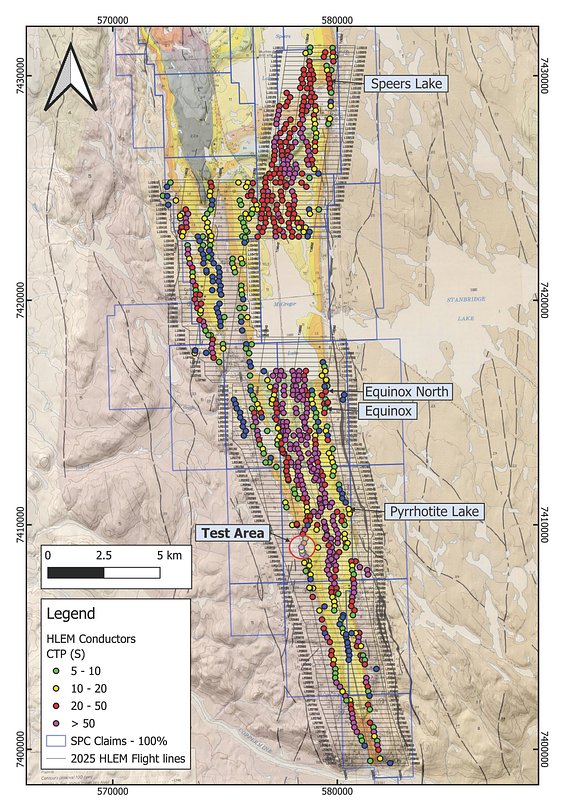
- 85 strong conductors identified by the Xcalibur HELITEM system, suggesting high potential for copper, nickel, and PGM deposits.
- 7.5-meter intercept in past drilling with 6% copper and 2.7% nickel concentrations.
- 1,400 kilometers of survey lines flown to map the Muskox Intrusion.
Experts view this discovery as a significant breakthrough in critical mineral exploration, leveraging advanced technology to unlock a historically underexplored Arctic deposit with major implications for global green energy supply chains.
Arctic Awakening: New Tech Unlocks Critical Mineral Trove in Nunavut
NEW YORK, NY – December 08, 2025 – In the vast, frozen expanse of Nunavut, Canada's northernmost territory, a story of technological innovation and resource discovery is unfolding. SPC Nickel Corp., a Canadian exploration firm, has announced findings that could breathe new life into one of the world's most intriguing, yet underexplored, geological formations. Using a state-of-the-art airborne electromagnetic survey, the company has identified dozens of highly conductive targets across its Muskox Project, signaling the potential for a massive deposit of copper, nickel, and platinum-group metals (PGMs) – minerals essential for the global transition to a green economy.
The announcement represents more than just promising survey lines on a map; it's a case study in how modern innovation can re-evaluate historical assets, turning forgotten prospects into headline-grabbing opportunities. By applying a 21st-century technological lens to a 1.27-billion-year-old geological giant, SPC Nickel is making a bold play that could have significant implications for the future of critical mineral supply chains.
A Modern Lens on a Historic Giant
The Muskox Intrusion is no secret to geologists. First seriously explored in the 1950s by mining titan Inco, this immense layered mafic-ultramafic body snakes across the tundra for 125 kilometers. Its sheer scale and geological makeup have long drawn comparisons to Russia's legendary Norilsk-Talnakh deposit, the world's largest source of nickel, copper, and palladium. The Norilsk district is a behemoth, holding an estimated 40% of the world's platinum-group metals and 35% of its nickel. The suggestion that a similar geological system exists in a stable, Tier-1 jurisdiction like Canada is tantalizing.
Historical exploration at Muskox, while sporadic, hinted at this potential. Past drilling campaigns in 1987 and 2007 returned spectacular, high-grade intercepts, including one section of 7.5 metres containing over 6% copper and 2.7% nickel. However, these finds were never systematically followed up, leaving the district's true potential largely a matter of speculation. The immense logistical challenges and high costs of operating in the Arctic, combined with technological limitations of the time, left the giant sleeping.
"For the first time in more than two decades, we have a modern, high-resolution geophysical dataset," commented Grant Mourre, President and CEO of SPC Nickel, in a recent statement. This new data, he explained, shows how numerous strong targets are distributed along the intrusion, many coinciding with previously identified high-grade surface mineralization. It's this fusion of old data and new technology that forms the foundation of the company's renewed optimism.
The Technological Game-Changer
The key to unlocking Muskox's potential lies in the technology SPC Nickel deployed: the Xcalibur HELITEM system. This helicopter-flown, time-domain electromagnetic (EM) survey represents a generational leap over older geophysical methods. Where previous surveys could only scratch the surface, modern systems like HELITEM can penetrate deeper into the earth with far greater clarity, effectively creating a high-resolution MRI of the subsurface geology.
Flying over 1,400 kilometers of survey lines, the system bombarded the ground with electromagnetic pulses and measured the response. Highly conductive materials, like the massive sulphide bodies that host rich copper-nickel-PGM deposits, light up like beacons. The results were striking: the survey identified 85 strong conductors, with preliminary modeling of select targets revealing exceptionally conductive sources. One anomaly, for instance, registered a strength of 800 siemens—a value so high it pushes the limits of what the system can resolve.
Alan King, a geophysical consultant for the company, noted the significance of this, stating, "The modeled anomalies... both indicate very conductive sources that are at or near the upper limits of the conductance resolution of the HELITEM EM system." He added that these signals could represent the flat tops of even larger, thicker conductive bodies that older systems would have been unable to detect. This suggests the historical drilling may have only grazed the edges of a much larger mineralized system. For SPC Nickel, these 85 conductors are not just anomalies; they represent a "pipeline of high-quality, drill-ready targets" for its planned 2026 exploration program.
Fueling the Future: Critical Minerals in High Demand
The timing of SPC Nickel's findings could not be more opportune. The global economy is in the midst of an unprecedented energy transition, and the minerals targeted at Muskox are at its very core. Copper, the workhorse of electrification, is essential for everything from electric vehicle motors and charging stations to wind turbines and grid upgrades. Nickel is a primary ingredient in the high-performance lithium-ion batteries that power the EV revolution, with demand projected to soar through the next decade.
Meanwhile, PGMs like platinum and palladium remain critical for catalytic converters that reduce emissions in traditional vehicles, and they are poised for a new role in the burgeoning hydrogen economy, where platinum is a key catalyst in fuel cells. As Western nations race to secure stable, ethical supply chains for these critical minerals, the prospect of a major new domestic source in North America carries immense strategic weight. A discovery at Muskox would help de-risk supply chains currently reliant on a few dominant, and in some cases geopolitically fraught, regions.
The Arctic Challenge: From Discovery to Development
Despite the promising data and compelling market drivers, the path from a geophysical anomaly to a producing mine is long, expensive, and fraught with risk—especially in the Arctic. The Muskox Project lies in the remote Kitikmeot Region of Nunavut, an area with no roads and limited infrastructure. All personnel, equipment, and supplies must be brought in by air or by a short-seasonal sealift, dramatically increasing costs and logistical complexity. The harsh climate limits the effective field season to just a few months each year.
Furthermore, any development must navigate a complex regulatory landscape that includes federal, territorial, and Inuit authorities. The Nunavut Agreement grants the Inuit extensive rights over land and resources, making community engagement and partnership not just a matter of corporate social responsibility, but a fundamental requirement for success. Securing a social license to operate through benefit-sharing agreements and local employment is paramount.
Finally, there is the financial reality. Mineral exploration is a capital-intensive endeavor. While SPC Nickel has successfully funded its recent survey, advancing to a large-scale drill program in 2026 and beyond will require significant investment. The company's ability to attract this capital will depend on its ability to convince the market that the potential reward at Muskox justifies the considerable risk. For investors and industry observers, the upcoming drill program will be the ultimate test, transforming these promising digital signals into tangible geological proof.