
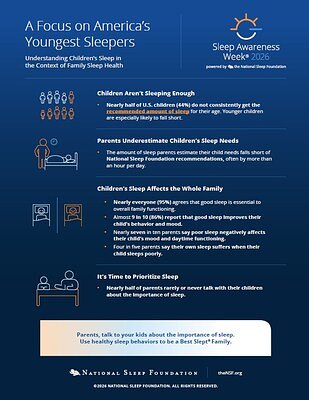
- 44% of U.S. children do not consistently get the recommended amount of sleep for their age.
- 95% of parents agree that good sleep is essential to overall family functioning.
- Children who get less than the recommended nine hours of sleep per night have less gray matter in crucial brain areas.
Experts emphasize that chronic sleep deprivation in children has severe long-term consequences for cognitive and physical health, and closing the knowledge gap among caregivers is critical for improving sleep habits and overall family well-being.
America's Sleepy Kids: A Worsening Public Health Crisis
WASHINGTON, D.C. – March 05, 2026 – A startling new report paints a restless picture of America's youth, revealing a silent public health crisis unfolding in bedrooms across the nation. New data from the National Sleep Foundation's (NSF) 2026 Sleep in America® Poll indicates that nearly half of all children in the United States are not getting the sleep they need, with profound consequences for their development, academic performance, and the well-being of their entire families.
The poll, released to mark Sleep Awareness Week®, found that a staggering 44% of U.S. children do not consistently get the recommended amount of sleep for their age. The issue is particularly acute among younger children, and the effects are creating a ripple of exhaustion throughout the American household.
A Nation of Tired Children
The NSF's findings highlight a critical disconnect between children's biological needs and their daily reality. A key part of the problem is a significant "knowledge gap" among caregivers. The poll revealed that many parents underestimate their child's sleep requirements, often by more than an hour per night, when compared to evidence-based guidelines from the NSF, which align with recommendations from the American Academy of Pediatrics and other leading health bodies.
This lack of awareness has direct consequences. "When nearly half of U.S. children aren't getting the sleep they need, and at the same time many parents aren't championing evidence-based recommendations, we're facing a knowledge gap that challenges public health," said Joseph Dzierzewski, PhD, SVP of Research and Scientific Affairs at the National Sleep Foundation. "Poor sleep in childhood is linked to impaired learning, emotional dysregulation, and long-term health consequences. Closing this gap starts with education, and it starts at home."
Compounding the issue, nearly half of all parents surveyed admitted they rarely or never talk with their children about the importance of sleep, treating it as an afterthought rather than a fundamental pillar of health on par with nutrition and exercise.
The Hidden Toll on Brains and Bodies
Beyond next-day grogginess and irritability, the long-term consequences of chronic sleep deprivation in children are severe and can alter their developmental trajectory. A growing body of scientific research shows that insufficient sleep can inflict lasting damage on a child's cognitive and physical health.
Studies have linked poor sleep in school-aged children to significant differences in brain structure, particularly in regions responsible for memory, attention, and inhibition control. Research from the National Institutes of Health has shown that children who get less than the recommended nine hours of sleep per night have less gray matter in these crucial brain areas—structural differences that can persist for years. This can manifest as difficulty with problem-solving, impaired memory consolidation, and a shorter attention span, directly impacting academic performance.
Emotionally, sleep-deprived children are less equipped to manage stress and regulate their feelings, leading to increased mood swings, frustration, and impulsivity. Over time, this chronic lack of rest is associated with a higher risk of developing mental health conditions, including anxiety and depression. Physically, inadequate sleep disrupts the production of growth hormones and is linked to a greater risk of obesity, type 2 diabetes, and cardiovascular problems later in life.
The Ripple Effect: When Kids Don't Sleep, No One Does
The NSF poll makes one thing clear: a child's sleep problem is a family sleep problem. The data shows that the effects of a child's restless night reverberate through the entire household. An overwhelming 95% of parents agree that good sleep is essential to overall family functioning, yet many are caught in a cycle of exhaustion. Four out of five parents reported that their own sleep suffers when their child sleeps poorly, leading to increased parental stress and strained family dynamics.
"We're seeing more signals this year that prompt us to double-down on helping parents and caregivers set the tone for healthy sleep in the household," said John Lopos, CEO of the National Sleep Foundation. Lopos emphasized that while every family is different, the decision to prioritize sleep and model healthy habits can have a lifelong positive impact.
This cycle—where a tired child disrupts parents, who then become too stressed and exhausted to enforce consistent sleep routines—can be difficult to break. It transforms bedrooms into nightly battlegrounds and erodes the collective well-being of the family unit.
An Unequal Rest: The Stark Disparities in Childhood Sleep
The crisis of childhood sleep deprivation is not distributed equally. Research reveals deep and troubling disparities along socioeconomic and racial lines. Children from lower-income families and racial or ethnic minority groups are significantly more likely to experience insufficient and poor-quality sleep.
Studies show that Black and Latinx youth consistently get less sleep than their White peers, a disparity that can begin in early infancy. Factors contributing to this sleep gap are complex and systemic, including crowded or noisy living conditions, neighborhood safety concerns that limit outdoor play, and heightened household stress. For instance, data has shown that children in families living at or below the federal poverty line have drastically higher rates of sleep deprivation than children in more affluent households. This unequal access to rest can exacerbate existing educational and health inequalities, creating a disadvantage that follows children throughout their lives.
Empowering Parents: Closing the Sleep Gap at Home
While the statistics are daunting, the National Sleep Foundation stresses that change is possible and that parents are the most powerful agents for improvement. The key is transforming sleep from a nightly negotiation into a celebrated family value. This begins with open communication and establishing a household culture that prioritizes rest for everyone.
Experts urge families to adopt evidence-based sleep practices together. This includes setting a consistent sleep and wake schedule for all family members, even on weekends, to stabilize the body's internal clock. Creating a device-free buffer zone of at least 60 minutes before bed is crucial, as the blue light and stimulating content from screens can sabotage sleep. Instead, families can establish a shared wind-down ritual, such as reading, listening to calm music, or light conversation.
Other foundational habits include ensuring daily exposure to sunlight in the morning, regular physical activity, and avoiding large meals or caffeine in the hours before bed. By modeling these behaviors, parents not only improve their own sleep but also provide a powerful, living example for their children, teaching them that prioritizing rest is a vital act of self-care that benefits the entire family.