
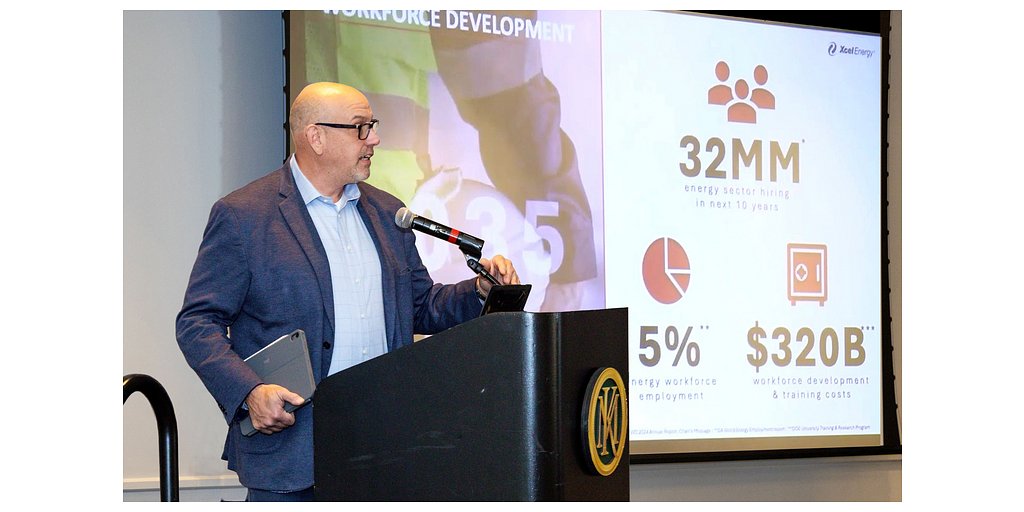
- 32 million infrastructure-related jobs needed in the U.S. over the next decade to cover retirements and growth (Brookings Institution).
- 56% of the U.S. energy workforce has less than 10 years of service, rising above 60% in critical roles like engineers and line workers (CEWD).
- Nearly half of the energy workforce is aged 45 or older, risking a massive loss of institutional knowledge (PwC).
Experts warn that the U.S. energy sector faces a structural talent shortage, requiring urgent investment in modern training and workforce development to maintain grid reliability and meet growing demand.
America's Silent Crisis: Workforce Gap Threatens Energy Future
WILLIAMSBURG, VA – April 23, 2026 – At a recent industry conference, a stark warning was issued not about failing technology or geopolitical threats, but about a far more foundational challenge: the people who keep the lights on. Dr. Anthony W. Gagliardo, a veteran executive from the nuclear energy, aerospace, and aviation sectors, delivered a sobering message that the greatest threat to America’s energy future is a deepening workforce readiness crisis.
Speaking at an event hosted by Index AR Solutions, Gagliardo, who has led workforce modernization initiatives at institutions like NASA’s Jet Propulsion Laboratory and Xcel Energy, framed the current moment as a perilous crossroads. “Historic trends indicate that many of today’s companies will not survive today’s rate of exponential change, and likely won’t be in business in 15 to 20 years,” Gagliardo stated. “It’s not a failure to innovate. It’s an inability to support and adapt to change.”
His message highlights a growing consensus among industry analysts: while utilities race to modernize an aging grid and meet unprecedented demand, they are simultaneously facing a catastrophic loss of human capital.
The Looming Talent Chasm
The scale of the workforce challenge is staggering. The nation’s critical infrastructure is aging, with much of the electrical transmission system dating back to the 1950s and 1960s. Simultaneously, after decades of flat growth, electricity demand is surging, driven by the explosive growth of energy-hungry data centers, the electrification of transport, and a resurgence in domestic manufacturing. Utilities are tasked with expanding capacity, hardening the grid against new threats, and maintaining near-perfect reliability, all at once.
However, the workforce needed to execute this monumental task is rapidly shrinking. According to research from the Brookings Institution, the U.S. will need to fill an estimated 32 million infrastructure-related jobs over the next decade just to cover retirements and growth. The problem is particularly acute in the energy sector. Data from the Center for Energy Workforce Development (CEWD) reveals a dramatic experience gap: 56% of the U.S. energy workforce has less than 10 years of service. In critical roles like engineers and line workers, that figure climbs above 60%.
This "compressed experience curve," as Gagliardo calls it, is the result of a looming retirement wave. With nearly half of the energy workforce aged 45 or older, according to PwC, utilities are facing the imminent departure of their most experienced employees. This exodus threatens to drain decades of institutional knowledge—the kind of hands-on, hard-won expertise that isn't written down in manuals.
“Rather than a cyclical hiring issue, this is a long-term structural talent shortage,” said Gagliardo, underscoring that the problem requires a fundamental shift in how the industry attracts, trains, and retains talent.
A New Blueprint for Building Expertise
The traditional model of workforce development—relying on classroom lectures, long apprenticeships, and knowledge passed down from seasoned veterans—is no longer sufficient to bridge the widening proficiency gap. Gagliardo argues for a modern approach built on adaptive curriculum pathways, immersive simulation, and learning integrated directly into the flow of work.
This new model leverages technology not as a replacement for human skill, but as an accelerator of it. He challenged industry leaders to rethink how people gain experience, pointing to the potential of immersive, multimodal tools to build proficiency faster and more safely than ever before. These technologies, including augmented reality (AR) and virtual reality (VR), allow new technicians to practice complex, high-stakes procedures in a safe, controlled digital environment before ever touching live equipment.
“The multi-modal learning tools being developed and deployed by companies like Index AR Solutions are going to be key to how we solve these acute workforce challenges,” Gagliardo explained.
This approach is gaining traction across the industrial landscape. Companies are increasingly turning to AR platforms that can overlay digital instructions, diagrams, and expert guidance directly onto a worker’s field of view. This "assisted reality" helps reduce errors, improve first-time fix rates, and provides on-demand support for a geographically dispersed workforce, a challenge Gagliardo helped tackle during his time transforming training systems for the FAA.
From Cost Center to Capital Investment
For decades, many organizations have treated employee training as an operational expense—a line item in the operations and maintenance (O&M) budget that is often first to be cut during lean times. Gagliardo advocates for a radical reframing: viewing strategic workforce development as a capital investment, on par with upgrading a substation or building a new transmission line.
By capitalizing training initiatives, utilities can secure more stable, long-term funding streams, enabling them to strategically scale their workforce in lockstep with critical infrastructure projects. This approach not only ensures that new assets are supported by a proficient workforce but also delivers tangible returns through enhanced safety, improved operational performance, and greater system reliability. This ultimately benefits customers, who see greater value and performance from their rate-based infrastructure investments.
The federal government is also signaling the national importance of this issue. Landmark legislation like the Infrastructure Investment and Jobs Act (IIJA) and grant programs from the Department of Labor are channeling billions of dollars toward building the skilled workforce needed to modernize the country. These funds create new opportunities for utilities to secure financial support for innovative training programs that incorporate advanced technologies.
Gagliardo urged organizations to scrutinize whether their current employee development strategies are robust enough to support their capital growth demands and resilience goals. The risk of inaction is immense, but the opportunity for those who adapt is equally significant.
“We are approaching a huge opportunity,” Gagliardo concluded. “And it’s through the use of cognitive science and experiential learning techniques being brought to life by companies like Index AR Solutions that companies will reimagine the way they train and skill.” The challenge is clear: the future of the nation's energy grid depends less on the silicon in its microchips and more on the skills of the hands that build and maintain it.