
- AI-driven platform targets futures, forex, and spot markets
- Focus on risk-adjusted metrics like Sharpe Ratio and maximum drawdown
- Regulatory scrutiny on 'black box' AI models and systemic risks
Experts view AlphaGainium's AI platform as a competitive differentiator in quantitative trading, but caution that its success hinges on transparent risk management and human-AI collaboration to navigate regulatory and systemic challenges.
AlphaGainium's AI Platform Aims to Redefine Quantitative Trading
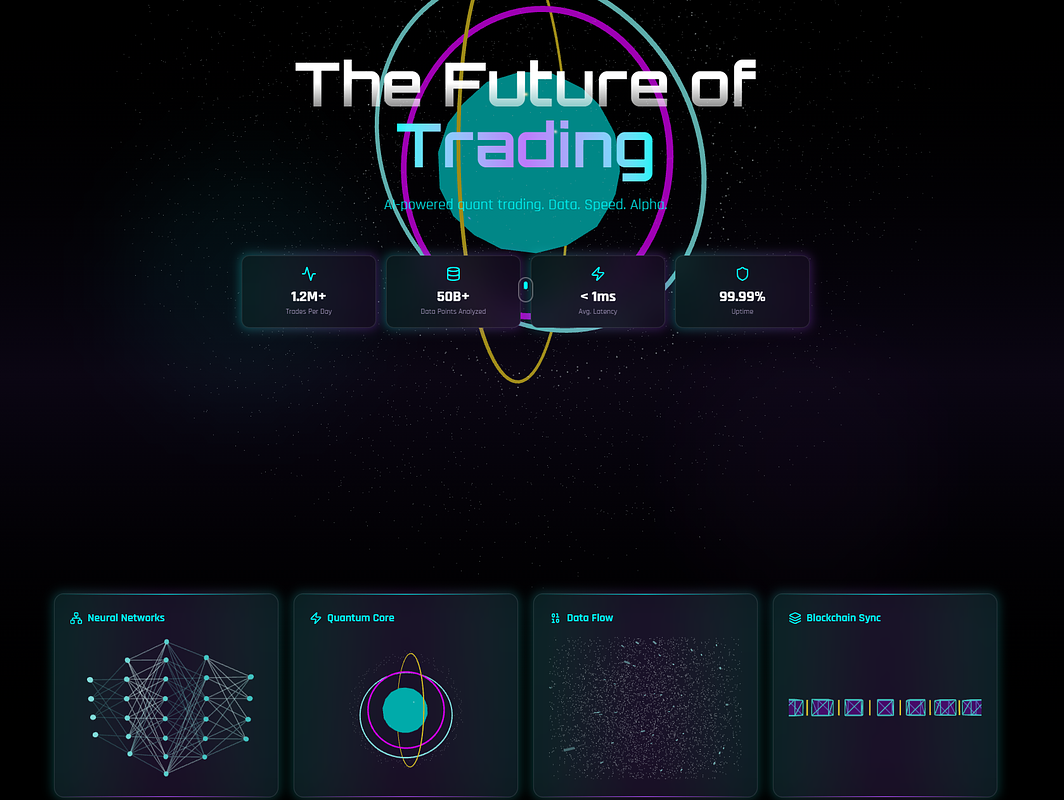
SAN FRANCISCO, CA – January 12, 2026 – Quantitative trading firm AlphaGainium announced today the launch of a new artificial intelligence-driven platform, aiming to carve out a competitive edge in the high-stakes world of automated finance. The multi-asset platform, which targets futures, forex, and spot markets, promises to deliver higher investment returns by replacing discretionary human decisions with systematic, data-centric strategies.
In a statement, the firm detailed a system built to capitalize on market opportunities through a combination of sophisticated financial modeling and high-speed execution. The platform's core design emphasizes the analysis of price movements, liquidity conditions, and broader market signals to inform its trading logic. By processing information in near real-time, AlphaGainium's technology is designed to dynamically adjust its strategies as market conditions evolve, a capability the firm positions as critical in today's fast-moving financial environment.
This launch places AlphaGainium squarely in the center of a seismic shift within the financial industry, where the pursuit of 'alpha'—excess returns above a market benchmark—is increasingly dependent on computational power and algorithmic prowess.
The AI Edge in a Crowded Field
AlphaGainium enters a fiercely competitive arena populated by established quantitative giants like AQR Capital Management and WorldQuant, as well as nimble algorithmic specialists such as XTX Markets. In this environment, a company's success hinges on its technological differentiators. While AlphaGainium's press release remains tight-lipped on its proprietary methods, the technologies underpinning such platforms are becoming more understood.
Modern AI-quant systems frequently employ a suite of advanced techniques. Machine learning and deep learning models are used to identify complex, non-linear patterns in vast financial datasets that would be invisible to human analysts. Natural Language Processing (NLP) algorithms sift through terabytes of unstructured data—from news articles and regulatory filings to social media sentiment—to gauge market mood and predict price-moving events. Some advanced platforms even utilize reinforcement learning, a type of AI where models learn and optimize trading strategies through trial and error in simulated market environments.
"The game is no longer just about having the fastest connection to the exchange," noted one industry analyst. "It's about having the smartest algorithms that can process the widest array of data, including alternative datasets like satellite imagery or supply chain logistics, and act on it intelligently."
The performance of these platforms is judged by a rigorous set of metrics. Investors look beyond simple returns to risk-adjusted measures like the Sharpe Ratio, the profit factor, and maximum drawdown, which indicates the largest potential loss from a peak. The very name 'AlphaGainium' signals the firm's core promise: to consistently generate alpha in a market where it is notoriously elusive.
Beyond the Hype: Navigating Risk and Regulation
While the promise of AI-driven profits is compelling, the rapid proliferation of such technology brings significant challenges and risks. Regulators worldwide, including the U.S. Securities and Exchange Commission (SEC) and the Commodity Futures Trading Commission (CFTC), are intensifying their scrutiny of algorithmic trading.
A primary concern is the "black box" problem. Many advanced AI models operate in ways that are not fully interpretable by their human creators, making it difficult to explain why a specific trade was executed. This lack of transparency poses a major challenge for compliance, risk management, and accountability, especially when an algorithm contributes to market instability or incurs massive losses.
In response, there is a growing regulatory push for 'Explainable AI' (XAI) in finance, which would require firms to provide clear justifications for their models' decisions. AlphaGainium's mention of "integrated risk management mechanisms" to monitor exposure and volatility speaks directly to these concerns, but the effectiveness of such safeguards in the face of unforeseen 'black swan' events remains a critical question for the entire industry.
Furthermore, the widespread adoption of similar AI strategies by multiple firms could inadvertently create new forms of systemic risk. If numerous algorithms are trained on similar data and react to market signals in the same way, it could lead to herd-like behavior, amplifying volatility and potentially triggering flash crashes. The ethical dimension also looms large, from ensuring fairness and eliminating bias in AI models to determining accountability when autonomous systems fail.
The Human Element in an Automated Age
The ascent of platforms like AlphaGainium inevitably raises questions about the future of financial professionals. The archetypal trader, once reliant on instinct and relationships, is being supplanted by a new breed of professional: the 'quant'—a hybrid expert with deep knowledge of finance, computer science, and mathematics.
Rather than signaling the end of human involvement, this trend represents a fundamental evolution of roles. The focus is shifting from manual trade execution to strategy design, model supervision, and risk oversight. Human experts are needed to define the investment theses that guide the AI, to interpret the outputs of complex models, and to intervene during moments of extreme market stress or when the models operate outside their intended parameters.
The skill set in demand has transformed. Firms are now aggressively recruiting talent with backgrounds in data science, machine learning, and high-performance computing, often competing directly with major tech companies. The ideal team for a modern quant firm is a multidisciplinary unit where financial domain experts collaborate closely with AI researchers and software engineers to build, test, and deploy trading strategies.
This new paradigm of human-AI collaboration is becoming the standard for sophisticated investors. The machine offers scale, speed, and the ability to analyze data far beyond human capacity, while the human provides strategic direction, ethical judgment, and the crucial ability to ask the right questions. As the financial services landscape continues its rapid digitization, the success of firms like AlphaGainium will depend not only on the sophistication of their code but on their ability to master this delicate and powerful synergy between human intellect and artificial intelligence.