
- 600 hours saved annually: AI platform recovered 600 working hours for the procurement team in one year.
- 98% efficiency improvement: Workflow efficiency improved by 98% after AI implementation.
- 22% procurement cost reduction: Achieved through supplier consolidation and data-driven insights.
Experts would likely conclude that AI-driven data structuring and analysis can transform legacy manufacturing operations by unlocking historical data, significantly improving efficiency, and reducing costs.
AI Unlocks 70 Years of Data, Saving Manufacturer 600 Hours Annually
CHICAGO, IL – February 03, 2026 – A 70-year-old manufacturing firm has turned decades of dormant engineering data into a powerful efficiency engine, recovering 600 working hours in its procurement department over a single year. Dairy Conveyor Corporation (DCC), now also known as DCC Automation, a specialist in hygienic conveyor systems, achieved a remarkable 98% improvement in workflow efficiency by implementing an artificial intelligence platform from the Chicago-based technology firm CADDi. The success story offers a compelling blueprint for how legacy industries can unlock immense value trapped within their own historical records.
The Weight of a Legacy
Founded in 1954, Dairy Conveyor Corporation built its reputation on designing and manufacturing high-performance, custom conveyor systems for the dairy, food, and beverage industries. As an engineer-to-order (ETO) manufacturer, its core business involves creating unique solutions for each client. While this model fosters innovation, it also creates a significant data management challenge. Over seven decades, the company accumulated a vast and fragmented archive of more than 400,000 engineering drawings, purchasing records, and design specifications.
This trove of information, distributed across disparate digital folders and physical files, represented a wealth of institutional knowledge. However, its unstructured and siloed nature made it a liability rather than an asset. For the engineering and procurement teams, finding relevant historical data was a painstaking manual process. Locating a similar past design, verifying a component's specifications, or referencing a previous purchasing decision involved time-consuming searches with inconsistent results. This bottleneck not only slowed down project timelines but also hindered the ability to reuse prior work, leading to duplicated effort and missed cost-saving opportunities. For a procurement team handling projects that could involve up to 800 separate line items, the inefficiency was a significant operational drag.
AI as the Digital Archaeologist
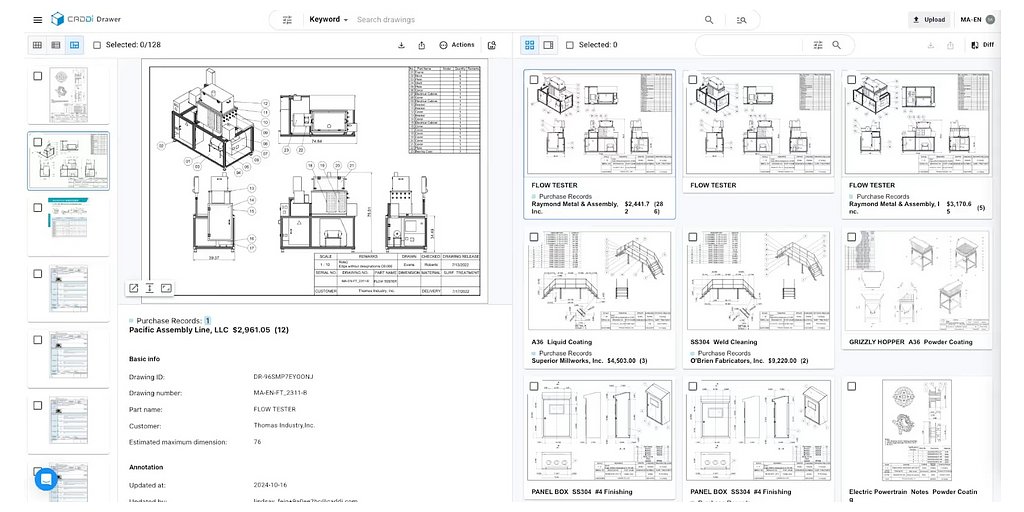
To address this deep-seated challenge, DCC turned to CADDi, a technology company specializing in AI-powered data platforms for manufacturing. The company implemented CADDi Drawer, a cloud-based solution designed specifically to act as a digital archaeologist for engineering data. The platform's AI-enabled software ingests and analyzes vast quantities of unstructured information, including legacy blueprints, PDFs, and specification sheets, that are common in established manufacturing environments.
The system works by automatically scanning these documents, using advanced algorithms to extract critical details like dimensions, materials, geometric features, and even handwritten notes. It then structures this information, transforming a chaotic collection of files into a centralized, searchable, and interconnected knowledge base. For DCC, this meant their 400,000 drawings were no longer buried in digital catacombs but were instantly accessible.
This transformation empowered engineering and procurement teams to interact with their historical data in an entirely new way. They could now execute complex searches to find similar parts, compare past designs side-by-side, and link technical drawings with their corresponding purchasing data. The platform effectively created a single source of truth, eliminating the guesswork and manual effort that had previously defined their workflows.
Quantifying the Gains and Transforming Workflows
The impact of this sustained technological adoption over one year was profound. The headline figure—600 working hours recovered for the procurement team—translates to nearly 15 full work weeks of time that could be reallocated to higher-value strategic tasks. This time savings was the direct result of a 98% improvement in search and workflow efficiency, a metric derived from the dramatic reduction in time spent on an estimated 12,000 searches required for annual operations.
The benefits, however, extended beyond time. By leveraging the platform's ability to analyze past purchasing data and identify opportunities for supplier consolidation, DCC achieved a 22% reduction in procurement costs and a 42% reduction in overall costs related to these processes.
The transformation is perhaps best captured by the experience of those on the front lines. “By using CADDi Drawer, I have reduced my workflow time by over 80 percent,” said Monica Merando, Director of Purchasing at Dairy Conveyor Corporation. “What once took an entire week can now be completed in a single afternoon, giving me more time to focus on other projects.” This testimony highlights a fundamental shift from reactive, time-consuming data retrieval to proactive, data-driven decision-making.
A Blueprint for the Industry's Digital Future
The success at DCC is more than an isolated case; it serves as a powerful validation for the broader manufacturing sector, where digital transformation efforts often stumble. A primary obstacle to successful AI implementation in the industry is poor data quality. Many initiatives fail because the underlying data is fragmented, inconsistent, and locked away in legacy systems that can be 30 to 40 years old. CADDi's approach, which begins with cleaning and structuring this foundational data, directly addresses this critical roadblock.
This focus on sustained, practical application is a core part of the technology provider's philosophy. “What we learned upon exploring DCC’s case is that what matters is not short-term deployment, but sustained use of the implemented technology,” noted Brian Thacker, Director of Customer Success at CADDi. “Maintaining access to existing engineering and purchasing data over time allows teams to continue moving faster and more accurately with information they already have.”
CADDi, founded in 2017, has rapidly established itself as a significant player in this space. Backed by $232 million in funding from prominent investors like Atomico, DCM Ventures, and Globis Capital Partners, the company serves a global client base that includes industrial giants like Hitachi and Subaru. Its growth underscores the massive, untapped demand for solutions that can bridge the gap between historical industrial practices and the potential of modern AI.
DCC’s own commitment to innovation, recently recognized with a 2024 Rockwell Automation PartnerNetwork OEM Innovation Award, shows that embracing such technology is a characteristic of forward-thinking leaders, not just a remedy for outdated processes. The partnership between the established manufacturer and the AI innovator demonstrates a viable path for turning decades of accumulated experience into a competitive advantage. As demonstrated by Dairy Conveyor Corporation, the key to unlocking this future may not be in creating new information, but in finally understanding the wealth of knowledge companies already possess.
Topics & Related
Artificial Intelligence
Digital Transformation
Software & SaaS
AI & Machine Learning
Manufacturing & Industrial
Related Company Pulse