
- 1 million users have access to Transcarent's WayFinding experience.
- 60% of HR leaders have significant concerns about data privacy and security in AI adoption (2025 research).
- The platform integrates voice-activated scheduling, advanced symptom checking, and personalized health paths for proactive healthcare management.
Experts view Transcarent's shift to 'agentic AI' as a significant advancement in digital health, offering proactive, personalized care management while emphasizing the need for robust trust and security frameworks to ensure ethical and effective implementation.
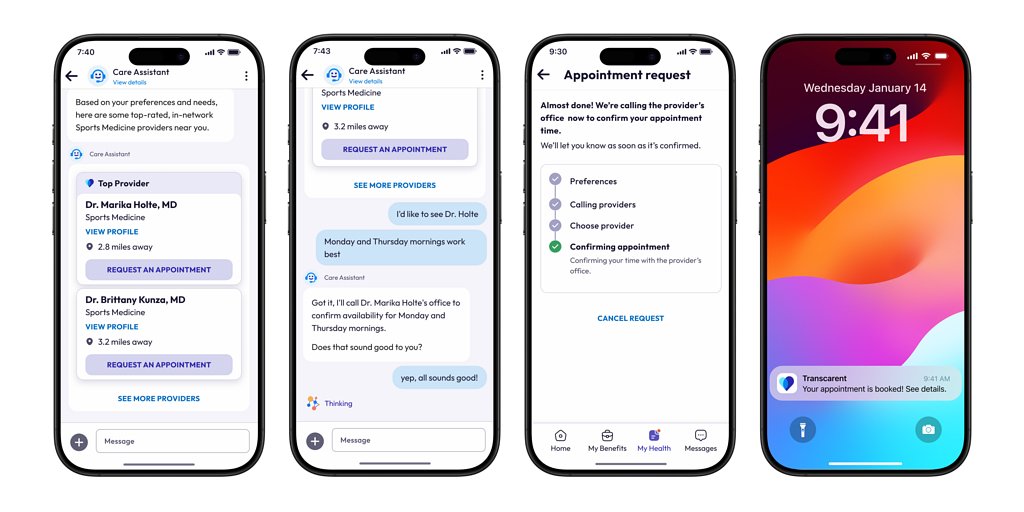
AI Takes the Wheel: Transcarent's New Platform Acts on Your Health
LAS VEGAS, NV – January 06, 2026 – In a move that signals a significant shift from passive assistance to proactive execution in digital health, Transcarent today unveiled major new capabilities for its WayFinding 2.0 platform at the Consumer Electronics Show (CES). The company is moving beyond the now-familiar AI chatbot model to what it calls “agentic AI”—a system designed not just to answer questions, but to take action on behalf of the user, from booking doctor's appointments to creating long-term health plans.
The enhanced platform introduces a suite of features powered by generative AI, including voice-activated scheduling, advanced symptom checking, a “Total Recall Memory Engine™” for deep personalization, and a “Personalized Health Path™” for each member. This evolution represents a deliberate step to tackle the friction and complexity that defines the healthcare experience for millions, aiming to create a single, intuitive interface for managing one's health journey.
Beyond the Chatbot: AI Enters the 'Agentic Action Era'
At the heart of the announcement is a fundamental change in the role of AI. Where most current health AI acts as a sophisticated search engine or a conversational guide, Transcarent's agentic model is built to perform multi-step tasks autonomously. It's a distinction the company's leadership is keen to emphasize.
“We were the first to put the power of clinically developed, trusted, generative AI into the hands of health consumers, and now more than a million people have access to our WayFinding experience,” said Glen Tullman, Chief Executive Officer of Transcarent. “We’ve officially moved beyond the ‘chat assistant era’ into the ‘agentic action era’ in healthcare.”
This new era is defined by tangible actions. The platform’s AI agents can now handle end-to-end scheduling for both virtual and in-person care. A member can use their voice to request an appointment, and the system will identify high-quality, in-network providers based on Transcarent’s proprietary data, factoring in personal preferences like location and language. The AI then handles the entire booking process.
Another key feature is an advanced symptom checker. Users can describe how they are feeling in natural, conversational language. The platform provides clear information and guidance toward appropriate care options, leveraging a safety framework built on a massive dataset of millions of de-identified interactions from doctors in Transcarent’s affiliated medical groups. This “clinician-in-the-loop” development approach is designed to mitigate the risk of AI “hallucinations” and ensure guidance is safe and clinically sound.
Hyper-Personalization Meets Healthcare
The WayFinding 2.0 platform deepens its personalization through two core innovations: the Total Recall Memory Engine™ and Personalized Health Paths™.
The Total Recall Memory Engine™ functions as a longitudinal memory layer for each user. It learns an individual's health history, care preferences, and interaction patterns over time. This allows the system to move from being reactive to anticipatory. For example, if a doctor provides instructions during a virtual visit, the engine recalls those details to deliver persistent reminders for medication adherence, follow-up screenings, or physical therapy exercises, actively supporting the member in following their treatment plan.
Building on this, the platform generates a Personalized Health Path™ for every member. This isn't a generic wellness plan; it's a dynamic roadmap shaped by input from doctors, nurses, and specialists, all augmented by AI. The path proactively recommends preventive measures, necessary screenings based on age and risk factors, and other relevant information to promote long-term health. This feature is informed by data from millions of clinical interactions, allowing the system to make precise and actionable recommendations for each person's next best step.
Navigating a Crowded Field of AI Health Tech
Transcarent's announcement arrives as CES 2026 showcases a broad industry pivot towards agentic AI across all sectors. The healthcare technology space is particularly active, with companies debuting everything from non-contact biometric monitoring systems to gene-based AI solutions. This crowded landscape makes a clear value proposition essential.
Transcarent's strategy is to position itself as the unifying layer for employer-sponsored healthcare. By integrating medical benefits, pharmacy solutions, expert second opinions, and care delivery into a single experience, the company aims to become the “One Place for Health and Care™.” The new agentic capabilities are designed to drive value directly for employers and health plans by reducing the administrative load on HR teams and encouraging more effective use of health benefits. Research commissioned by the company in 2025 revealed that while many HR leaders are eager to adopt AI, 60% harbor significant concerns about data privacy and security, highlighting the importance of a trusted platform.
By automating routine but time-consuming tasks and guiding employees to the right care at the right time, the platform promises to lower costs and improve engagement. For employees, the benefit is a simplified, less frustrating experience. For employers, it's a potential solution to rising healthcare costs and a way to offer a more supportive benefits package in a competitive labor market.
Building Trust in an Autonomous System
Granting an AI system the autonomy to schedule appointments and manage health reminders inevitably raises critical questions about data privacy, security, and algorithmic bias. Transcarent is addressing these concerns head-on by emphasizing its robust governance framework.
The company states that it operates as a HIPAA-covered entity and holds certifications for HITRUST, SOC 2, and ISO 27001. It is also a member of the Data & Trusted AI Alliance (D&TA), collaborating on standards for responsible AI. Its governance model is guided by principles from the OECD and the risk management framework from the National Institute of Standards and Technology (NIST).
In practice, this translates to a multi-pronged safety system. All generative AI products are developed with clinician oversight. The system undergoes continuous human-in-the-loop testing, code reviews, and regular audits to identify and mitigate bias, protect privacy, and ensure ethical use. Crucially, the company clarifies that its AI is built to support consumers in navigating their care, not to diagnose, treat, or replace the clinical judgment of a human doctor.
As Transcarent rolls out these powerful new tools, its success will depend not only on the technology's performance but also on its ability to earn the trust of both the organizations that pay for it and the individuals who rely on it for deeply personal health decisions. The shift to an “agentic action era” in healthcare is a bold step, and its implementation will serve as a crucial test case for how automation and human oversight can coexist to build a more efficient and responsive healthcare system.