
- 100 million: Anyline completed 100 million digital tire inspections in 2025.
- $5.7 billion: The global market for AI-powered vehicle inspection systems is projected to reach $5.7 billion by 2032.
- 82%: 82% of commercial fleets still rely on error-prone handheld gauges for tire checks.
Experts agree that AI-powered tire inspections represent a critical advancement in vehicle safety, operational efficiency, and customer trust, marking a necessary shift from manual methods to data-driven assessments.
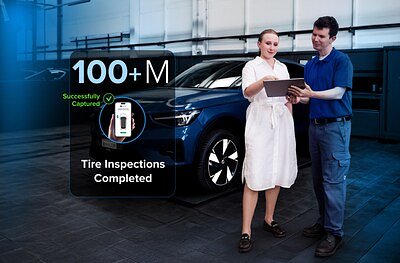
AI Pit Stop: How 100 Million Tire Scans Are Remaking Auto Service
VIENNA – December 18, 2025 – In a clear signal of the automotive industry's accelerating digital shift, AI firm Anyline announced today it has surpassed 100 million digital tire inspections in 2025. This milestone is more than a corporate achievement; it represents a critical tipping point in how vehicle safety is managed, moving from subjective manual checks to data-driven, AI-powered assessments on a massive scale.
The achievement, driven by adoption across leading dealerships, independent tire retailers, and automotive service chains like Discount Tire, highlights a profound transformation happening in service bays globally. Using nothing more than a standard smartphone, technicians are now equipped to capture critical tire data with unprecedented speed and accuracy, revolutionizing a process that has remained largely unchanged for decades.
A Market Hungry for Digital Transformation
The rapid adoption of technologies like Anyline's is occurring within a market ripe for disruption. The global market for AI-powered vehicle inspection systems, valued at $1.2 billion in 2023, is projected to surge to over $5.7 billion by 2032, expanding at a compound annual growth rate of over 18%. This explosive growth is fueled by a convergence of pressing industry needs: the relentless pursuit of operational efficiency, the challenge of persistent labor shortages, and an increasing consumer demand for transparency and trust.
Despite the availability of advanced tools, a significant portion of the industry still operates on legacy methods. Recent industry surveys reveal that an estimated 82% of commercial fleets still rely on error-prone handheld gauges for tire checks, while 66% depend on manual, paper-based data logging. This gap between available technology and current practice represents a vast opportunity for improvement. AI-powered mobile inspections directly address these inefficiencies by automating data capture, standardizing assessment criteria, and creating an instant digital record.
"Surpassing 100 million tire inspections in a single year is a defining moment for Anyline and the industry," said Lukas Kinigadner, Co-CEO at Anyline. "Tire inspection isn't a 'nice to have;' it's a safety-critical process that depends on consistency and accuracy at scale. We're on a mission to transform that process with fast, accurate and dependable digital assessments that make technicians' work easier and keep the customer experience at the center. This milestone is a strong signal that we're on the right track."
From Manual Guesswork to AI Precision
At its core, the technology turns a common mobile device into a sophisticated diagnostic tool. By simply pointing the phone's camera at a tire, the AI-driven software can instantly measure tread depth, capture the Tire Identification Number (TIN) to determine its age and manufacturing details, and read all other critical sidewall information. The process eliminates the inconsistencies of manual gauges and the potential for human error in transcribing complex codes.
The benefits ripple across the entire service ecosystem. For vehicle owners, it means enhanced safety. Research indicates that a significant number of drivers experience tire-related emergencies, a risk that can be mitigated with more frequent and accurate checks. Digital inspections provide early warnings for worn or damaged tires, allowing for proactive replacement.
This technology also builds a new foundation of customer trust. Instead of being told their tires are worn, customers can be shown a clear, visual report with precise measurements and photographic evidence. This verifiable documentation demystifies the repair recommendation process, empowering customers to make informed decisions and strengthening their relationship with the service provider. For the shops themselves, the efficiency gains are monumental. At the scale of 100 million inspections, the reduction in time spent on manual measurement and data entry translates to millions of saved labor hours—a critical advantage for businesses navigating workforce shortages and high operational costs.
Lowering the Barrier to Adoption
Recognizing that widespread adoption depends on ease of integration, Anyline has strategically moved to embed its technology directly into the existing workflows of its partners. The recent introduction of the TireBuddy ToolKit, a software development kit (SDK), marks a pivotal step in this direction. An SDK allows businesses to integrate Anyline’s powerful scanning capabilities directly into their own proprietary mobile applications, rather than forcing technicians to juggle multiple, disconnected software tools.
This approach dramatically lowers the barrier to entry, allowing large enterprises and platform partners to customize the inspection process to fit their unique operational needs without a costly and disruptive overhaul of their current systems. The toolkit includes modules for guided tread depth measurement, TIN/DOT reading, and standardized wear assessment, all designed to function reliably in the varied and often challenging conditions of a real-world service bay.
"With our TireBuddy ToolKit, our goal is to make advanced tire inspection as easy as adding an SDK into an existing app," explained Simon Brooks, Vice President of Product at Anyline. "We're excited to see how our customers customize it for their workflows, and we look forward to TireBuddy powering even more safe, consistent tire inspections in 2026."
Reskilling the Workforce for the Digital Garage
The rise of AI in the garage is not about replacing skilled technicians but augmenting their expertise. By automating the repetitive and error-prone task of data collection, these digital tools free up technicians to focus on what they do best: complex diagnostics, high-quality repairs, and direct customer interaction. The role is evolving from one of manual inspection to one of data interpretation and expert consultation.
This technological shift necessitates a parallel evolution in workforce training. With an estimated 74% of automotive repair shops planning to adopt AI-powered tools within the next two years, the demand for digitally literate technicians is set to soar. Training programs must adapt, incorporating curricula that teach not only the mechanics of a vehicle but also the operation and interpretation of advanced diagnostic software.
Ultimately, this evolution stands to make the profession more efficient and potentially more appealing to a new generation of talent. By equipping technicians with smarter tools, the industry can enhance productivity, improve safety outcomes on a global scale, and build a more transparent and trustworthy relationship with the driving public. As millions more tires are scanned, the data gathered will continue to fuel smarter maintenance, safer vehicles, and a more resilient automotive service industry.