
- $5 billion: The amount raised by Bill Ackman’s new fund, Pershing Square USA (PSUS).
- 16% drop: The initial share price decline on its first trading day, opening at $42 vs. the $50 IPO price.
- 2,600% net return: Pershing Square Capital Management’s performance from 2004 to 2025, outperforming the S&P 500.
Experts view the cool reception of Ackman’s fund as a reflection of investor skepticism toward closed-end funds and the high-risk, high-reward nature of his investment strategy, despite his strong long-term track record.
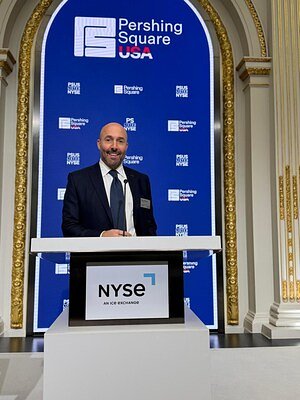
Ackman's $5B Fund Debuts to Cool Reception Amid Global Interest
NEW YORK, NY – May 04, 2026 – The much-anticipated debut of billionaire activist investor Bill Ackman’s new investment vehicle, Pershing Square USA (PSUS), was met with a cool reception on Wall Street last week, despite successfully raising $5 billion and attracting a roster of prominent international investors.
The fund, one of the most significant market offerings of the year, began trading on the New York Stock Exchange on April 29 but saw its share price immediately fall below its initial public offering price, raising questions about its unconventional structure and market appetite for such vehicles.
An Unconventional Offering
Pershing Square USA was launched not as a typical IPO, but as part of a combined offering with Pershing Square Inc., the parent company of Ackman’s asset management firm. Priced at $50 per share, the structure was designed to entice investors with a unique incentive: for every five shares of the PSUS fund purchased, investors also received one share of the management company, Pershing Square Inc., at no additional cost.
This dual-share structure was engineered to make the offering more attractive and to combat a common ailment of closed-end funds: the tendency for their shares to trade at a persistent discount to their net asset value (NAV). By giving investors a stake in the asset manager itself, Ackman aimed to better align interests and provide an additional source of potential growth.
PSUS is set to operate a concentrated portfolio, investing in 12 to 15 high-quality, large-capitalization companies primarily based in North America. The strategy mirrors Ackman’s long-held philosophy of taking large, long-term minority stakes in businesses he believes are undervalued. The Pershing Square ecosystem already includes stakes in global giants like Alphabet, Amazon, and Uber. However, this access comes with a 2% annual management fee, a standard but significant cost for investors.
A Chilly Wall Street Debut
Despite the innovative structure and Ackman's formidable reputation, the market’s initial reaction was tepid. On its first day of trading, PSUS opened at $42 per share, a steep 16% discount from its $50 IPO price. The decline worsened through the day, with the fund closing down approximately 18% at $40.93. While shares saw a modest recovery in subsequent days, they remained well below the initial offering price.
Financial analysts noted that the rocky start reflects inherent investor skepticism toward closed-end funds. Ackman’s own London-listed fund, Pershing Square Holdings (PSH), has historically traded at a significant discount to its NAV, a risk that investors in PSUS are now weighing. The initial performance suggests that even the bonus shares in the management company were not enough to prevent an immediate price drop as the market sought to find its own valuation.
Ackman, in comments following the debut, noted that the firm prioritized allocations to retail investors to broaden access, a departure from typical IPOs that favor large institutions. This strategy may have contributed to the initial volatility as some investors who received larger-than-expected allocations sold off shares quickly.
The Ackman Factor: A Legacy of Highs and Lows
At the center of this financial drama is Bill Ackman himself, one of Wall Street's most visible and polarizing figures. Since founding Pershing Square Capital Management in 2004, he has cultivated a reputation as a shrewd activist investor with a remarkable long-term track record. From 2004 to the end of 2025, his firm generated a net return of over 2,600%, vastly outperforming the S&P 500.
His career is marked by spectacular successes, including a multi-billion-dollar profit from a bet against the market during the 2020 crash and successful activist campaigns that reshaped companies like Wendy's and Chipotle. These wins have cemented his status as a financial visionary for many.
However, his record is also punctuated by high-profile failures. A disastrous bet on Valeant Pharmaceuticals resulted in massive losses, and a more recent, short-lived investment in Netflix cost the firm over $430 million. This history of bold, high-stakes moves means investors in PSUS are betting not just on a portfolio of stocks, but on Ackman’s continued ability to navigate markets and drive value.
International Backing from South of the Border
Despite the initial market turbulence, the offering drew significant capital from a global pool of institutional and high-net-worth investors. Among them was Jack Landsmanas, the president of Corporativo Kosmos, one of Mexico's largest and most influential business groups.
Corporativo Kosmos is a titan in Mexico's food industry, managing complex logistics to deliver over three million meals daily to a vast network of schools, hospitals, and companies. As CEO, Landsmanas oversees a sprawling operation and is also a prominent philanthropist, having founded the Pablo Landsmanas Foundation, which is dedicated to food security, health, and education initiatives across Mexico.
Landsmanas's participation as an invited investor underscores the global appeal of Ackman's strategy and the increasing integration of Latin American capital into sophisticated U.S. financial markets. The press release from Kosmos noted the move aligns with a business approach focused on large-scale operations and long-term strategic development.
A Sign of Shifting Capital Flows
The participation of prominent Mexican business leaders like Landsmanas comes at a complex time for Mexico's financial landscape. The country has recently experienced significant capital outflows, with foreign investors reducing their holdings of Mexican debt and equities. Analysts have pointed to a combination of domestic political uncertainty and global macroeconomic pressures as drivers of this trend.
However, the investment in PSUS represents a counter-current. It highlights a strategic move by sophisticated Mexican investors to look beyond domestic markets for diversification and access to unique, long-term growth opportunities. By participating in a high-profile U.S. IPO, these investors are not only placing a bet on Bill Ackman but are also deepening their integration into the global financial system.
This trend suggests that while broad capital flows may be volatile, a segment of private capital from Mexico and other emerging economies is actively seeking a place in the world's most advanced investment vehicles, reinforcing a sophisticated strategy of global diversification that transcends national economic headwinds.