
- Global data center electricity demand: Projected to more than double from 415 TWh in 2024 to 945 TWh by 2030, driven by AI workloads. - Power efficiency: ABB's HiPerGuard 34.5kV UPS operates at 98% efficiency, saving $880,000 annually for a 100 MW AI data center. - Infrastructure reduction: The technology cuts copper cabling and equipment footprint by 20-25%.
Experts agree that ABB's HiPerGuard 34.5kV UPS represents a transformative leap in AI data center power management, offering unparalleled efficiency, cost savings, and grid resilience.
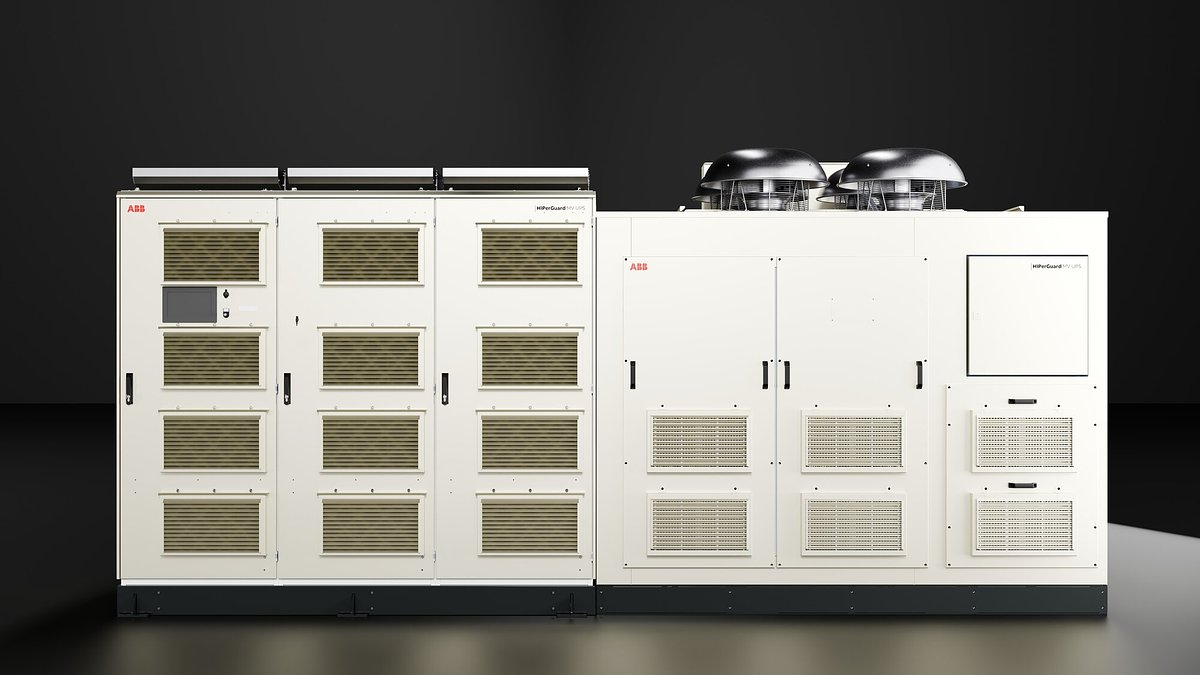
ABB Tackles AI's Power Crisis with Breakthrough 34.5kV UPS Tech
WASHINGTON, D.C. – April 21, 2026 – As the artificial intelligence boom places unprecedented strain on global power grids, technology leader ABB has unveiled a groundbreaking solution designed to redefine how AI data centers consume and manage electricity. The company's new HiPerGuard 34.5kV medium voltage uninterruptible power supply (UPS) enables these power-hungry facilities to connect directly to the grid, slashing energy waste, simplifying complex infrastructure, and paving the way for a more sustainable and resilient digital future.
Announced at Data Center World Washington 2026, the innovation arrives at a critical juncture. The relentless demand for AI is fueling an energy consumption crisis, pushing traditional data center power architectures to their breaking point. ABB's latest technology promises not just an incremental improvement, but a fundamental shift in how the backbone of the AI revolution is powered.
The AI Energy Dilemma
The meteoric rise of artificial intelligence is not just a story of algorithms and processing power; it's a story of electricity. Global data center electricity demand, which stood at 415 terawatt-hours (TWh) in 2024, is projected to more than double to a staggering 945 TWh by 2030, an amount roughly equivalent to Japan's entire annual consumption. Industry experts attribute around 70 percent of this explosive growth directly to AI workloads.
This surge is driven by a dramatic increase in power density. While a traditional server rack might consume 5-15 kilowatts (kW), the specialized GPU-laden racks required for training and running advanced AI models now routinely draw 40-100 kW or more. A single large AI data center can demand anywhere from 100 megawatts (MW) to over a gigawatt of power, rivaling the consumption of a small city.
This reality has exposed the limitations of legacy low-voltage power systems. Conventional data center designs often involve multiple, inefficient voltage conversions, stepping power down from the grid only to convert it back up for distribution, losing precious energy at each stage. This complexity not only wastes electricity but also requires vast amounts of copper cabling and occupies a significant physical footprint, driving up both capital and operational costs.
A Fundamental Shift in Power Architecture
ABB's HiPerGuard 34.5kV directly confronts these challenges by allowing AI data centers to plug directly into medium-voltage utility lines, the same power level at which electricity is typically distributed across cities. This approach eliminates several wasteful conversion steps, enabling the system to operate at an exceptional 98 percent efficiency.
The financial implications of this efficiency are profound. For a 100 MW AI data center, every one percent gain in power efficiency translates into an estimated $880,000 in annual operational cost savings. By starting with a 98% efficiency baseline, the HiPerGuard offers a significant economic advantage in an industry where power is one of the largest operating expenses.
"For the first time, with ABB technology, AI data centers can connect directly to the grid at 34.5kV, cutting conversion energy losses and reducing infrastructure complexity," said Sebastien Surply, Critical Power Leader for ABB’s Smart Power Division, in the company's announcement.
The benefits extend beyond energy savings. The simplified medium-voltage architecture requires substantially less copper cabling and reduces the overall equipment footprint by 20 to 25 percent. This not only cuts down on initial infrastructure costs but also frees up valuable floor space within the data center, allowing operators to deploy more revenue-generating servers.
Beyond Efficiency: The Microgrid-Ready Future
Perhaps the most forward-looking aspect of the HiPerGuard is its "microgrid-ready" design. This architecture transforms the data center from a passive, voracious consumer of energy into an active, intelligent participant in the power grid. The system is engineered to seamlessly integrate diverse energy sources, including battery energy storage, on-site gas generation, and renewable sources like solar and wind.
This flexibility allows operators to optimize for both resilience and cost. During periods of high grid prices or instability, a data center can switch to its own stored or generated power. By integrating with ABB's Power Exchanger technology, the system also unlocks new revenue streams. Data center operators can perform peak shaving—using stored battery power to reduce their draw from the grid during high-demand periods—or offer frequency regulation services back to the utility, helping to stabilize the grid.
This capability is becoming increasingly vital as the proliferation of AI data centers strains local power infrastructure. Instead of simply adding to the problem, grid-interactive data centers can become part of the solution, enhancing grid stability and facilitating the broader adoption of intermittent renewable energy sources. This positions the technology as a key enabler for meeting corporate environmental, social, and governance (ESG) goals in an energy-intensive industry.
Setting New Standards for Safety and Scalability
With the integration of large-scale battery systems comes a heightened focus on safety. Recognizing this, ABB has secured UL Solutions' UL 9540 certification for the HiPerGuard, making it the first product of its kind to achieve this stringent standard for energy storage safety and performance. This certification provides critical assurance that the system's battery and power conversion components have been rigorously tested to mitigate risks such as thermal runaway, a crucial consideration for mission-critical facilities.
Beyond safety, the system is designed for the rapid, unpredictable growth of AI workloads. Its modular architecture supports incremental capacity expansion in 25 MW blocks, allowing operators to scale their power infrastructure in lockstep with demand. This "plug-and-play" approach avoids the massive upfront cost and risk of overprovisioning a facility, enabling a more agile and capital-efficient growth strategy.
This real-world scalability is already being proven. ABB's HiPerGuard technology forms the backbone of the electrical infrastructure at Applied Digital's massive AI data center campuses in North Dakota. These facilities, including the 400 MW Polaris Forge 1 and 300 MW Polaris Forge 2, are purpose-built for high-density AI and rely on the medium-voltage architecture to achieve the necessary power density and efficiency. The partnership demonstrates that this next-generation power solution is not merely theoretical but is actively enabling some of the world's largest AI deployments, providing a blueprint for the future of the industry. As AI continues to evolve, flexible and efficient power infrastructure will be the critical foundation upon which its progress is built.