
- 2 million fractures annually in the U.S. due to osteoporosis
- 92% of gynecologists would prescribe an anabolic therapy if an oral option were available
- 80% of women over 50 remain undiagnosed and untreated one year after a fracture
Experts advocate for an 'anabolic-first' strategy, emphasizing the potential of Entera Bio's oral anabolic therapy (EB613) to revolutionize osteoporosis treatment by improving access and patient compliance.
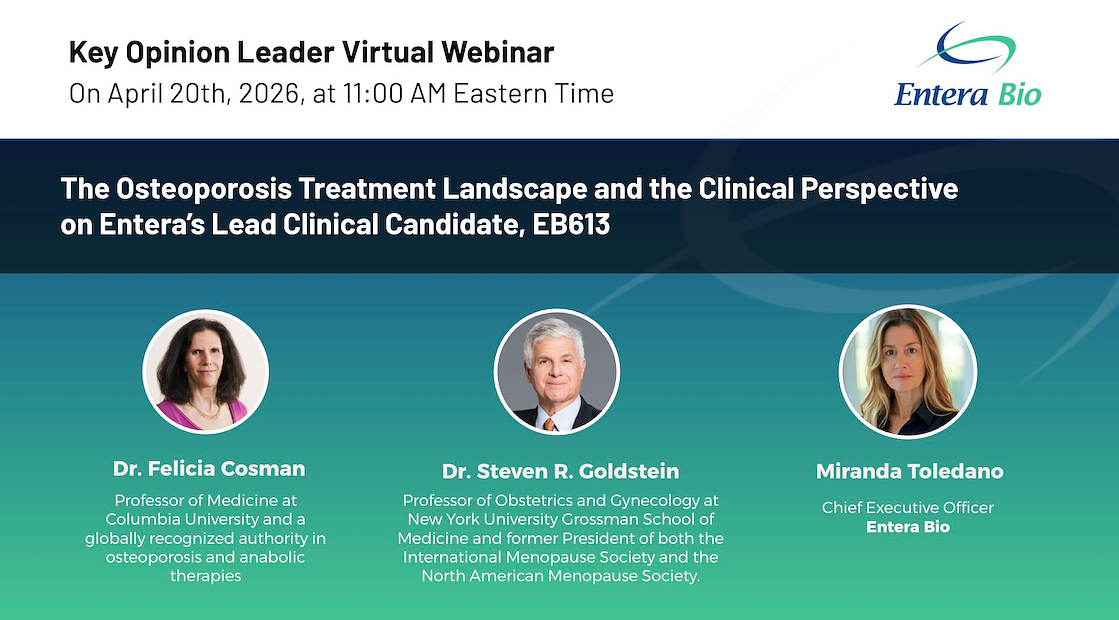
A Pill for Brittle Bones: Entera Bio's Quest to Fix Osteoporosis Care
NEW YORK, NY – April 20, 2026 – Osteoporosis is a silent epidemic. Each year in the United States, the disease contributes to approximately two million fractures, with devastating consequences. A woman who fractures her hip has a 21% chance of dying within a year, a statistic more grim than a diagnosis of stage one breast cancer. Yet, despite the availability of powerful treatments, a vast and dangerous gap in care persists. Most patients, particularly women, remain untreated.
Now, clinical-stage biopharmaceutical company Entera Bio (NASDAQ: ENTX) is advancing a solution that experts believe could fundamentally reshape this broken landscape. In a recent roundtable with leading medical authorities, the company spotlighted its lead candidate, EB613, a once-daily pill designed to be the first-ever oral anabolic (bone-building) therapy. By moving a potent, well-understood drug class from a needle to a tablet, Entera aims to dismantle the primary barriers that prevent millions from protecting their bone health, a move that could turn the tide against the crippling disease.
The Crippling Gap in Osteoporosis Treatment
The core of the osteoporosis crisis isn't a lack of effective medicine, but a failure of access and acceptance. Current treatments are largely split into two categories: oral anti-resorptives like Fosamax, which slow bone loss, and injectable anabolic agents like Forteo, which actively build new bone. While anabolics are significantly more potent, their use is startlingly low.
A recent survey of gynecologists—who often serve as the primary care physicians for women's bone health post-menopause—revealed the stark reality. As discussed during Entera Bio's Key Opinion Leader (KOL) event, only 12% of these doctors currently prescribe any injectable anabolic agent. The hurdles are numerous: patient fear of needles, the inconvenience of daily self-injections or monthly office visits, and a referral system that funnels patients to specialists, creating bottlenecks where many simply fall through the cracks.
“There's a tremendous disconnect here that I think this oral agent would fill,” stated Dr. Steven Goldstein, Professor of Obstetrics and Gynecology at NYU Grossman School of Medicine, during the panel. The survey data backs him up: a staggering 92% of the same gynecologists said they would prescribe an anabolic therapy if an oral option were available.
This treatment gap has dire consequences. Studies show that over 80% of women over 50 remain undiagnosed and untreated one year after suffering a fracture. The current standard of care often starts with less potent anti-resorptives, reserving powerful anabolic drugs for severe cases after significant bone has already been lost. This reactive approach is one that top specialists are now desperately trying to reverse.
A Paradigm Shift to 'Anabolic-First'
Experts like Dr. Felicia Cosman, a leading osteoporosis authority and Professor of Medicine at Columbia University, are championing a paradigm shift towards an “anabolic-first” strategy. The concept is simple: for high-risk patients, use the most powerful tools first to rebuild bone structure, then switch to an anti-resorptive agent to maintain those gains.
“The idea is to try to diagnose a woman with osteoporosis and then fix the osteoporosis,” Dr. Cosman explained during the roundtable. “An oral anabolic, EB613, would make it so much easier for doctors to prescribe anabolic therapy, and for patients to take bone building therapy.”
EB613 is not a new chemical entity. It is an oral formulation of teriparatide, the same active ingredient in the widely used injectable Forteo®. This allows Entera Bio to pursue a 505(b)(2) regulatory pathway, leveraging decades of existing safety and efficacy data from the injectable version. This strategy could potentially de-risk and accelerate its path to market.
By placing this powerful therapy into a simple pill, Entera Bio hopes to “democratize” anabolic treatment. A gynecologist or primary care physician could prescribe it directly upon diagnosis, bypassing the specialist referral bottleneck and initiating potent therapy years earlier than is typical today. For a silent disease where patients often don't feel their bones degrading, the convenience of a pill could be the deciding factor between treatment and a future debilitating fracture.
The Science and Strategy Behind EB613
The promise of EB613 is backed by encouraging clinical data. In a Phase 2 study published in the peer-reviewed Journal of Bone and Mineral Research, EB613 demonstrated what Dr. Cosman described as a “dual mechanism of action.” It not only stimulated markers of new bone formation but also simultaneously suppressed markers of bone breakdown—a powerful combination for strengthening the skeleton.
Crucially, the bone mineral density (BMD) gains seen at six months were comparable to those achieved with injectable PTH. In fact, the data showed significant increases in BMD at the femoral neck and total hip, sites where injectable Forteo® often takes longer to show an effect. This early and robust response is a key indicator of a drug's potential to quickly reduce fracture risk.
Bolstered by these results and a recent FDA agreement to use BMD as a primary endpoint, Entera Bio is moving EB613 into a pivotal Phase 3 trial imminently. The company announced an accelerated timeline, now expecting topline results in the second half of 2028. The trial is designed to test EB613 both as a standalone therapy and, critically, in sequence with an anti-resorptive drug, directly validating the 'anabolic-first' paradigm that experts advocate for.
A High-Stakes Play in a Billion-Dollar Market
For Entera Bio, a clinical-stage company with a market capitalization hovering around $60 million, EB613 represents a transformative opportunity. The global osteoporosis drug market was valued at over $16 billion in 2025 and is projected to grow substantially, with a clear trend toward more effective, premium-priced anabolic agents. If approved, EB613 would be the first and only oral anabolic on the market, positioning it to capture a significant share of both new and existing patients.
However, the path forward is not without risk. The company is operating with a cash runway projected to last into the third quarter of 2026, making the successful execution and funding of its ambitious Phase 3 program paramount. Yet, Entera is not a single-asset company. Its proprietary N-Tab® platform for oral peptide delivery also underpins programs for hypoparathyroidism and a highly sought-after oral GLP-1/glucagon dual agonist for obesity, signaling broader potential.
For now, all eyes are on EB613. The upcoming Phase 3 trial will be the ultimate test of whether the convenience of a pill can finally close the chasm in osteoporosis care and deliver on the promise of stronger bones for millions.