
- 41 years old: Abby's age when she suffered a massive heart attack.
- 30-50%: National survival rates for adult cardiac patients placed on ECMO.
- 90-mile ambulance ride: The treacherous journey through a winter storm to transport Abby to Boston for a heart transplant.
Experts would likely conclude that Abby's survival was a testament to the critical role of advanced medical interventions like ECMO and the coordinated efforts of highly skilled healthcare teams in saving lives under extreme conditions.
A Heart's Journey: From Valentine's Day Collapse to a Second Life
SPRINGFIELD, Mass. – December 30, 2025 – In the days leading up to Valentine's Day 2025, Abigael "Abby" LaBonte of Easthampton added a small, festive heart to her manicure. She had no way of knowing that this simple symbol would soon become a profound emblem of her own fight for life and a testament to the medical team that refused to let her go.
What began as flu-like symptoms on February 14 quickly escalated into a life-or-death crisis. After feeling unwell all day, Abby went to bed early, only to wake at 11 p.m. feeling worse. "I went to bed and then got up around 11 p.m., told my husband I wasn't feeling good again, and he said, 'That's it, we're taking you to the emergency room,'" she recalled. Her husband, Joe, called his mother to watch their two sons, Jake and Nate, and rushed Abby toward the hospital. They didn't get far before she collapsed. A 911 call, a police officer's rapid response, and a frantic ambulance ride brought her to Baystate Medical Center, where the true nightmare was just beginning: at only 41 years old, Abby was in the throes of a massive heart attack.
A Race Against Time on Life Support
The scene at Baystate Medical Center was one of controlled chaos. "I came in to my shift at 7 a.m., and the chaos had already started," said Jonathan Hurley, one of the nurses on the Heart and Vascular team. "It was very hectic... She was declining fast."
Abby's heart was failing. The team's only option was to deploy one of modern medicine's most advanced and high-risk interventions: Extracorporeal Membrane Oxygenation, or ECMO. This sophisticated form of life support involves routing a patient's blood outside the body into a machine that acts as an artificial heart and lungs, oxygenating the blood before pumping it back into circulation. It is a last-resort measure, a bridge to give a patient's organs a chance to rest and recover.
The procedure is fraught with peril. National survival rates for adult cardiac patients placed on ECMO can be as low as 30-50%, with significant risks of bleeding, stroke, and infection. It requires a highly skilled, coordinated team working in unison. "We got the surgeons and perfusionist involved to do bedside interventions that take a lot of skill and coordination," Hurley explained. "From that point forward, our only goal was to get her stable enough to go to Boston." The Baystate team's expertise in deploying this cutting-edge technology under extreme pressure was the first critical link in the chain of survival that would save Abby's life. They succeeded in stabilizing her, but her only long-term hope was a heart transplant, an evaluation for which would have to happen at Beth Israel Deaconess Medical Center in Boston.
The Ninety-Mile Fight for Life
With Abby stabilized on the complex ECMO machine, the plan was to fly her by helicopter to Boston. But a fierce New England winter storm had other ideas. Wind and ice grounded all air traffic, leaving only one treacherous option: a 90-mile ambulance ride through the storm.
The journey was anything but routine. Accompanying Abby in the ambulance was Joshua Williammee, the perfusionist who managed the delicate ECMO machine keeping her alive. For the entire trip, Williammee was her lifeline, constantly monitoring and adjusting the equipment as the ambulance navigated the wintery roads. In a harrowing turn of events, Abby's already shattered heart went into cardiac arrest seven more times during the drive. Each time, the team in the ambulance fought to bring her back, all while Williammee ensured the ECMO circuit remained stable.
"It was one of the most stressful rides of his life," Williammee later admitted of the experience. He made the long journey back to Springfield that night not knowing if Abby would survive. "It literally has never happened where we get to see someone we transported away," he said, reflecting on the uncertainty that often defines his critical role. "It's kind of emotional." His efforts, and those of the transport team, ensured Abby arrived in Boston with a fighting chance.
A New Heart, A New Beginning
Upon her arrival in Boston, Abby began the long and arduous path toward recovery. By late March, the verdict was clear: her heart was too damaged to recover. She needed a transplant. In April, she received the gift of a new heart.
The surgery marked not an end, but the beginning of a new chapter defined by rigorous recovery and lifelong management. Heart transplant recipients face a complex future. They must take a daily cocktail of immunosuppressant drugs to prevent their bodies from rejecting the new organ, which in turn leaves them vulnerable to infections. The recovery process involves intensive physical and occupational therapy to rebuild strength lost after months of critical illness. For Abby, this meant returning to the very same rehab center where she had once worked, now as a patient. "With the help of the therapists, I'm regaining my strength," she said.
Throughout this ordeal, her family was her rock. Her husband and two sons, aged 10 and 12, took on new responsibilities at home. "They've been doing things like laundry and emptying the dishwasher," Abby said with a smile. "It might seem like little things, but they turned out to be big things." Her parents were a constant presence. "My mom made sure I was never alone, and I can never thank her enough," she shared.
A Full-Circle Moment of Gratitude
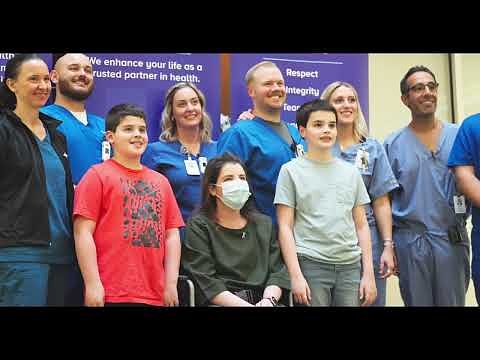
Months later, with her new heart beating strong, Abby was filled with an overwhelming sense of gratitude for the people who had made it possible—the unseen heroes at Baystate who had kept her alive against all odds. In October, she and her family returned to the Springfield hospital for an emotional reunion.
For the first time, she came face-to-face with the nurses, surgeons, and the perfusionist who had worked so frantically to save her on that terrifying Valentine's Day. "Just meeting people I have never met before, people who literally kept me alive until I got to Boston, I will never forget this day," Abby said. "As they were introducing me, I was like, 'Oh, that's what you did! I heard about that, that's who you are.' It was so cool to meet that side."
The reunion was just as powerful for the medical staff. In the world of critical care, especially when patients are transferred to other facilities, providers rarely witness the long-term outcomes of their efforts. "It's absolutely incredible," said nurse Jonathan Hurley. "We never really get this full circle, but it's really nice to see how well she's doing... It really confirms why I came into this profession."
Perfusionist Joshua Williammee, who had endured the stressful ambulance ride, was finally able to see the positive result of his work. "When I went on this career path, this was the job I wanted: to help people," he said. "So it was nice to see the fruits of our labor."
Abby's story is a powerful reminder of the human element at the core of a complex healthcare system. While large hospital systems like Baystate Health are often measured by broad metrics and safety grades, this single case highlights the profound impact of a dedicated, highly skilled team. Her son Jake summed up the family's feelings in a simple message to the team: "I will never forget this. Thank you so much."
Reflecting on the experience, Abby gained a new perspective on her caregivers. "It didn't really dawn on me that nurses and doctors have lots of feelings," she admitted. "I thought they were like, 'Next patient. Bring in the next patient.' But they really take things to heart, and that means a lot to me." Her journey, from a simple heart on her fingernail to receiving a new one in her chest, had come full circle, connecting a grateful patient with the team that refused to give up. As Hurley noted, "We don't always get to meet the people we fight for. But when we do, it's a reminder that every second, every skill, every effort matters."